














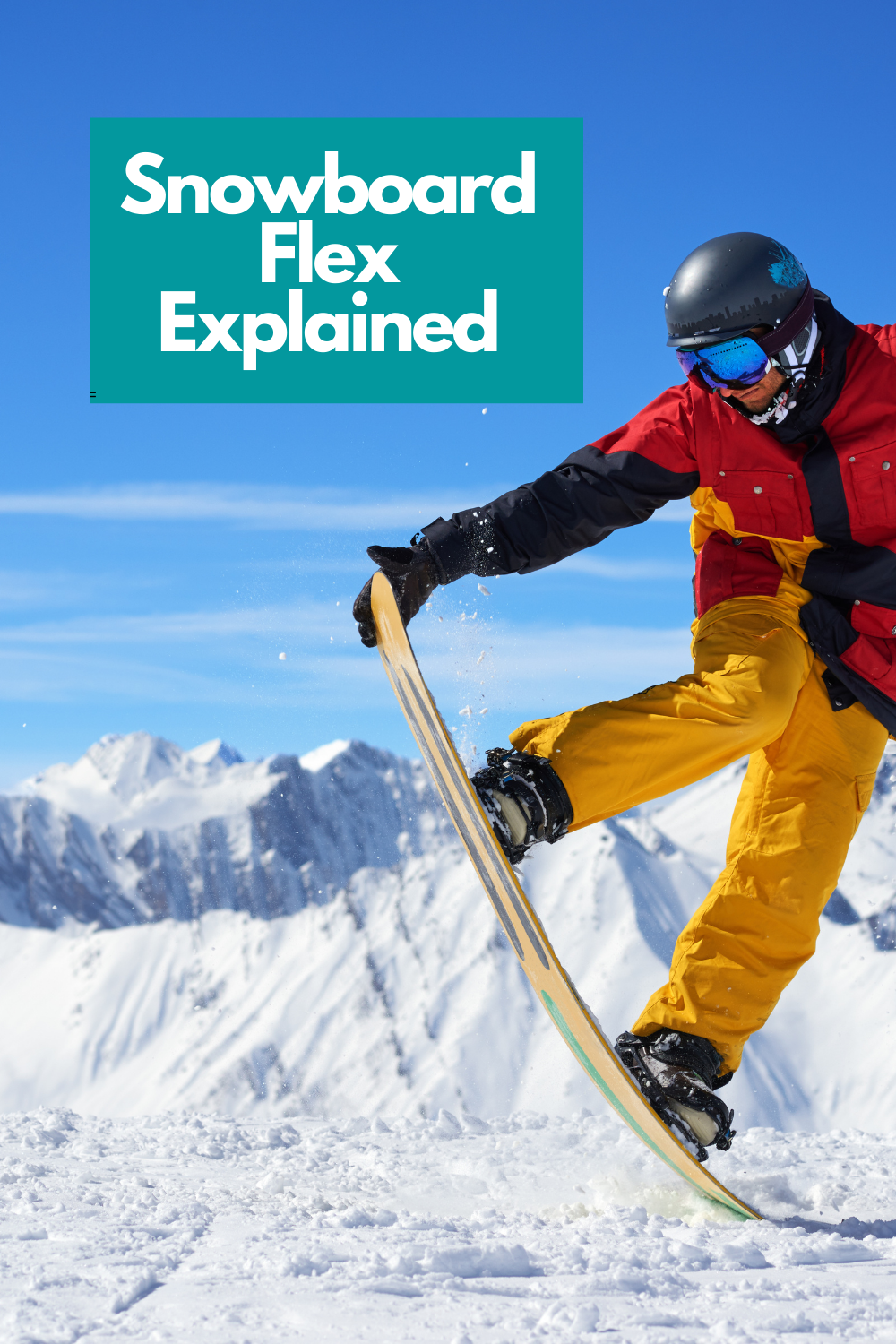
Snowboard Flex Ratings Explained | Snowboard Buying Advice
Snowboards come in all shapes and sizes, so it makes sense that their flex would also vary. Snowboard manufacturers rate the flex of each of their snowboards from 1 (soft) to 10 (high) which shows a large variation in flex scores. Snowboard flex is an important factor in how a snowboard performs different tasks and it is important to understand why specific snowboards retain certain characteristics and how it affects their performance.

SNOWBOARD FLEX RATING SYSTEM
Snowboard manufacturers rate the flex of their snowboards across a scale of 1 (soft) to 10 (stiff). Sadly there is not a defined standard across all manufacturers however the scale should help you in rating where a snowboards flex sits within that brands line up. It is rare to find snowboards that are rated at the extremities of the scale as a board that is rated as a 1 would not be very stable at speed and a 10 would be too stiff for most people to enjoy and press.
WHAT FLEX IS RIGHT FOR ME?
Depending on your style of riding and what you want to do you will need to look for a snowboard within a specific flex rating. Below are suggestions for beneficial flex patters of; Freestyle, Freeride or All-Mountain snowboarders
FREERIDE
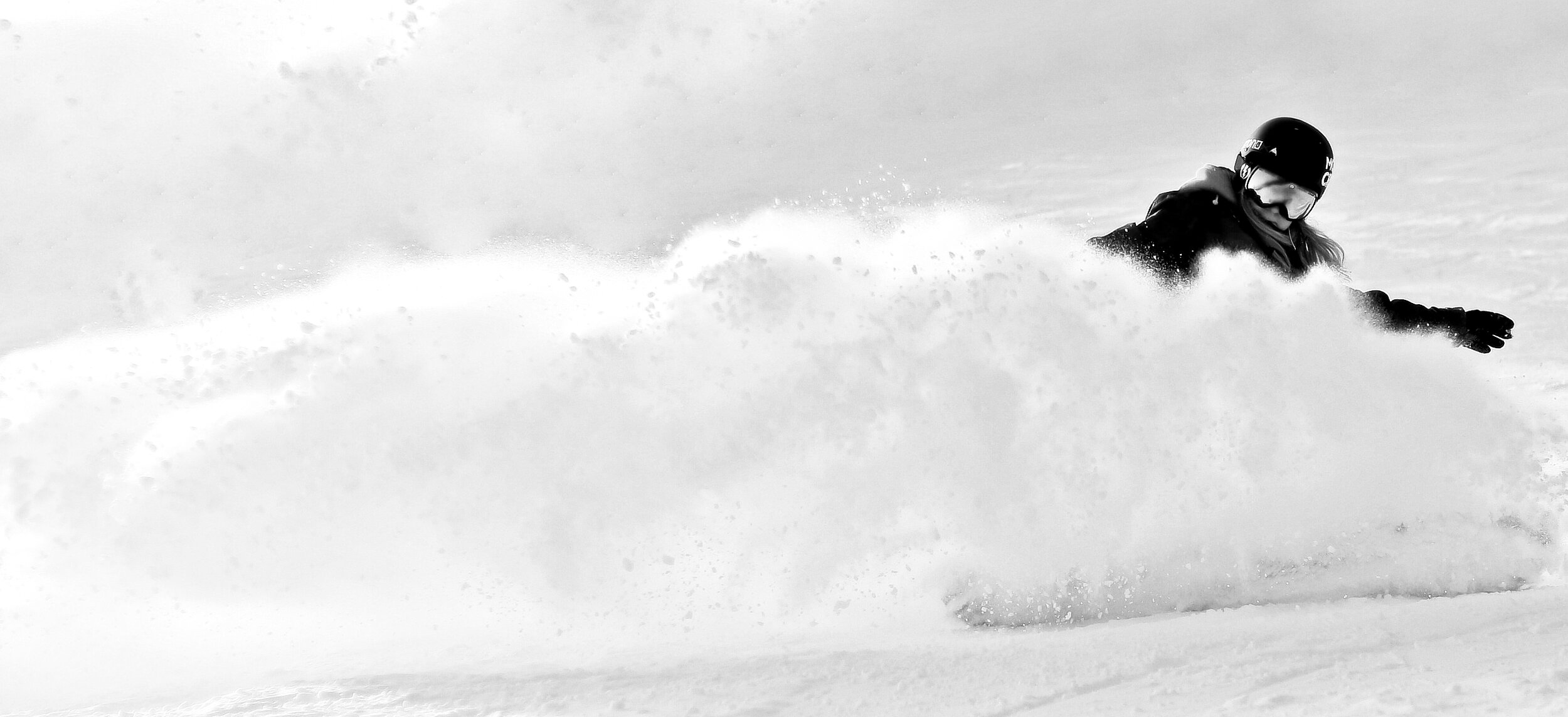
If you like to go fast, ride steeps, and dig trenches with your carves then you will need a board that feels reassuring. By opting for a board with a stiffer flex you will benefit from greater stability and edge hold at higher speeds. A softer flexing board could be prone to ‘washing out’ through a more aggressive turn. True freeride snowboard will have flex ratings above 7 and will often use premium materials like carbon to ensure stiffness is maintained over time.
Due to the stiff flex of freeride boards, they are not recommended for beginner snowboarders.
FREESTYLE
Freestyle snowboards will come in a range of flexes depending specifically on the type of features you intend to hit. Mid flexing freestyle boards will offer a great compromise between being pressable and being able to support landings. A flex rating between 4-7 will be a good option for freestyle riders who want also want to make use of the whole mountain.
Freestyle snowboarders who want to make the most out of riding; boxes, rails, or street features will be better opting for a softer flexing board. But be wary the very soft boards will be great for butters but not a lot else. A Jib board rated between 3-5 should be very pressable but still have enough about it to leave the park and enjoy the rest of the mountains.
If you prefer jumps to jibs than moving towards the stiffer end of the board flex ratings may be beneficial. A stiffer board for hitting kickers will help you generate more speed by being stable on run in as well as more pop when you ollie. This will help you when hitting larger features where more speed is required. A stiffer board will also help you when landing too far back on your tail as it is less likely to wash out.

ALL-MOUNTAIN
If you are a snowboarder who likes to do a bit of everything then an all-mountain board may suit you better. Due to their versatility, most all-mountain snowboards will retain a medium flex pattern although could be medium soft or medium stiff.
MEDIUM
Medium all-mountain snowboards really will be the go-to boards for snowboarders who want to do everything. These boards will be stiff enough to hold an edge throughout a carve and hit kickers, whilst also retaining some of the playfulness of a more pressable board.
MEDIUM SOFT
Medium soft flexing snowboards will lend themselves more to jibs and rails but retain the stiffness to leave the park and explore the mountain. Medium soft boards are also great for beginners who will appreciate the non too aggressive nature helping them ease into turns.
MEDIUM STIFF
Medium stiff all-mountain boards will lose some of the playfulness of a medium soft flexing snowboard but gain further stability allowing the rider to charge harder and faster. Great for those who hit jumps but avoid rails a medium-stiff all-mountain snowboard is also well suited to the intermediate who is looking to progress their riding.
HOW DO SNOWBOARDS FLEX?
Snowboards flex in two main flex patterns; longitudinal and torsional, with both having an effect on how the board rides.
LONGITUDINAL FLEX
When we talk about longitudinal flex we refer to the flexibility of the snowboard from nose to tail. It is longitudinal flex that is referred to in manufacturer flex ratings which gives an indication of the overall flex of a snowboard. Longitudinal flex can run the full length of the board (continuous) or can be different throughout the board’s length (progressive).
These are some examples of snowboard flex variations.
TWIN PARK SNOWBOARDS
Some twin park boards will have a softer flex at the tip and tail whilst remaining stiffer under the feet and between the binding inserts. By having a softer nose and tail stiffness the board is more easily pressed into butters but still retains pop for ollies with the stiffer underfoot flex.
JIB SNOWBOARDS
Jib boards will have a soft continuous flex throughout the length of the board. This allows the tip and tail to be pressed whilst also allowing the centre of the board to flex ensuring a deeper press.
POWDER SNOWBOARDS
Powder boards tend to have a stiff flex from the tail through to the front binding inserts. Towards the nose the flex will soften allowing the nose of the snowboard to flex and raise above the snow. The stiffer flex towards the rear of the snowboard will help the board to be stable at faster speeds.
RACE SNOWBOARDS
Boarder X or Alpine race boards will have a consistent stiff flex running the length of the board. Speed is the aim of these boards so a stiffer flex will keep the snowboard stable at higher speeds whilst ensuring consistent edge hold.
TORSIONAL FLEX
Torsional flex refers to how a snowboard flexes from edge to edge. This is often seen when a snowboarder pedals their feet as they turn the snowboard. Torsional flex occurring across the width of the snowboard is important as it will affect how easily the snowboard turns. Although important, torsional flex is often ignored and is not rated on the manufacturer’s flex scale.
OTHER CONSIDERATIONS
ABILITY
Whether you are an experienced rider or this will be your first snowboard then ability should play a factor in your snowboard flex choice. Stiffer snowboards are harder to turn at slower speeds and this will make them a poor choice for beginner snowboarders. Beginners would benefit from a softer flexing board but if you think you will progress quickly then you could outgrow a softer board quite fast. A stiffer board is great for advanced riders but even experienced snowboarders don’t always like stiff snowboards. Ultimately the best way to find out if a stiff or soft board would suit your riding style is to get to a demo day and try them out.
ONE SNOWBOARD FOR LIFE
If you are a gear geek or like to refresh your quiver regularly then the next point may not apply to you, snowboards soften over time and with use. This means if you are going to be getting lots of use out of your snowboard you may want to consider choosing a board that is slightly stiffer than your preferred ride. This way when it softens up with regular use you will be left with a board that works well for you.
Worth Noting - Snowboards with premium materials like carbon stringers will soften less over time as these materials retain their original characteristics.
YOUR WEIGHT
Sorry I know nobody likes talking about their weight but when it comes to snowboard choices it is always an important consideration. So much so that snowboard manufacturers will add a recommended weight range for each size and model of the board they sell. In terms of flex, if you weigh more than the recommended weight range there is a danger that when flexing the board you may snap it. Alternatively, if you weigh much less than the recommended weight range you may struggle to flex the board to its potential making ground tricks harder to perform.
GET IN TOUCH
As always thanks for reading and if you are still unsure feel free to get in touch via the socials or the comment section. Make sure to check out our Snowboard Buyers Guide where you will find all the information regarding how to buy a snowboard.
PIN IT FOR LATER

CARE TO SHARE?
IF YOU FOUND THIS POST USEFUL AND YOU THINK IT MAY ALSO HELP OTHERS, PLEASE LIKE, SHARE AND COMMENT TO PROMOTE IT TO OTHERS

Argentina Snowboarding Guide
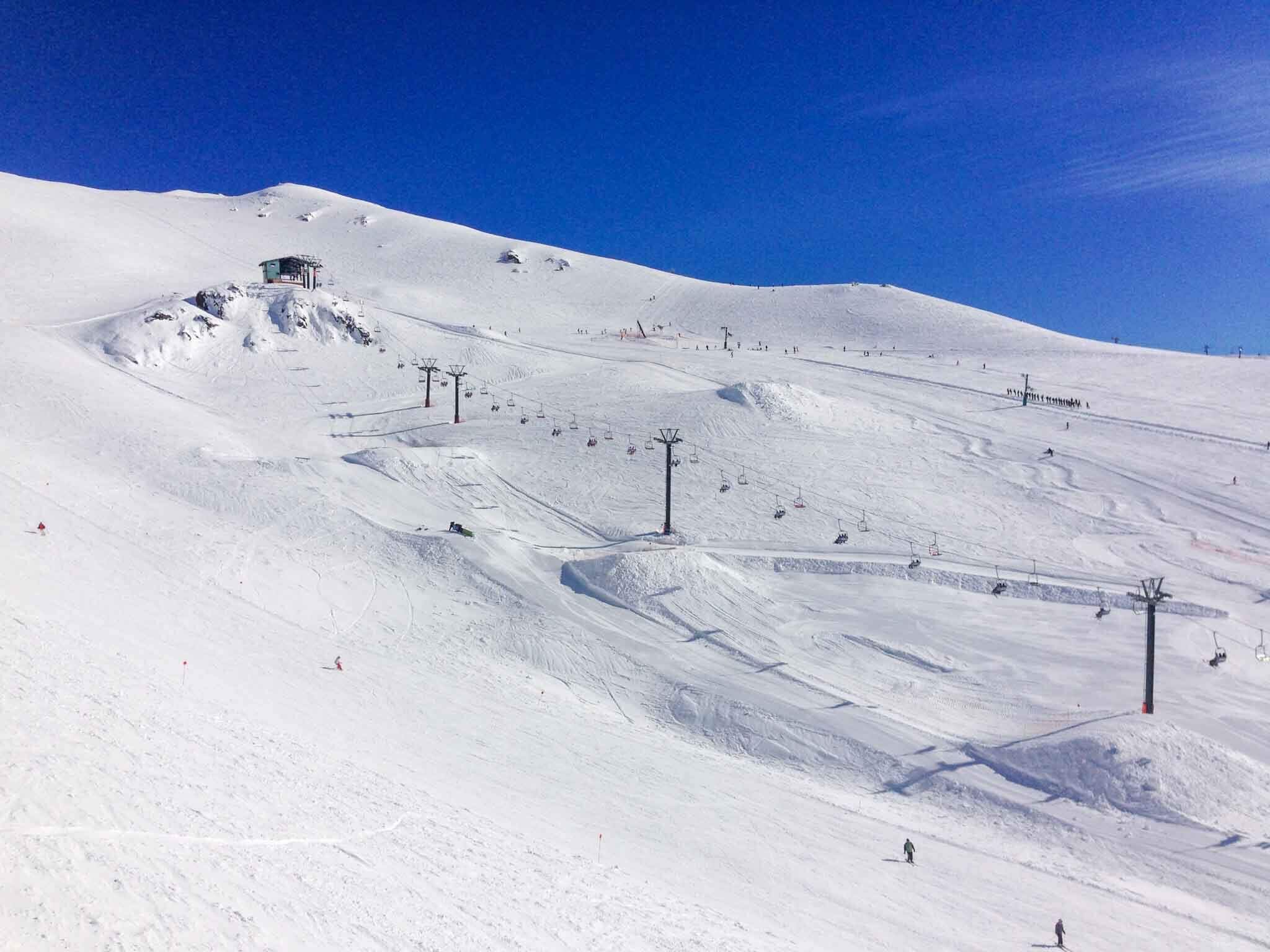
Argentina has a rich history and a welcoming culture that has seen many Europeans settle and call it home. A quick walk around the capital of Buenos Aires will see the influence of its European settlers in the names, faces, and traditions of the locals. You will need to leave Buenos Aires and head into the Andes Mountains to reach the snow. In this Argentina snowboard guide, I will look at Argentinian ski resorts that will help you make the most of your Argentina ski holidays.

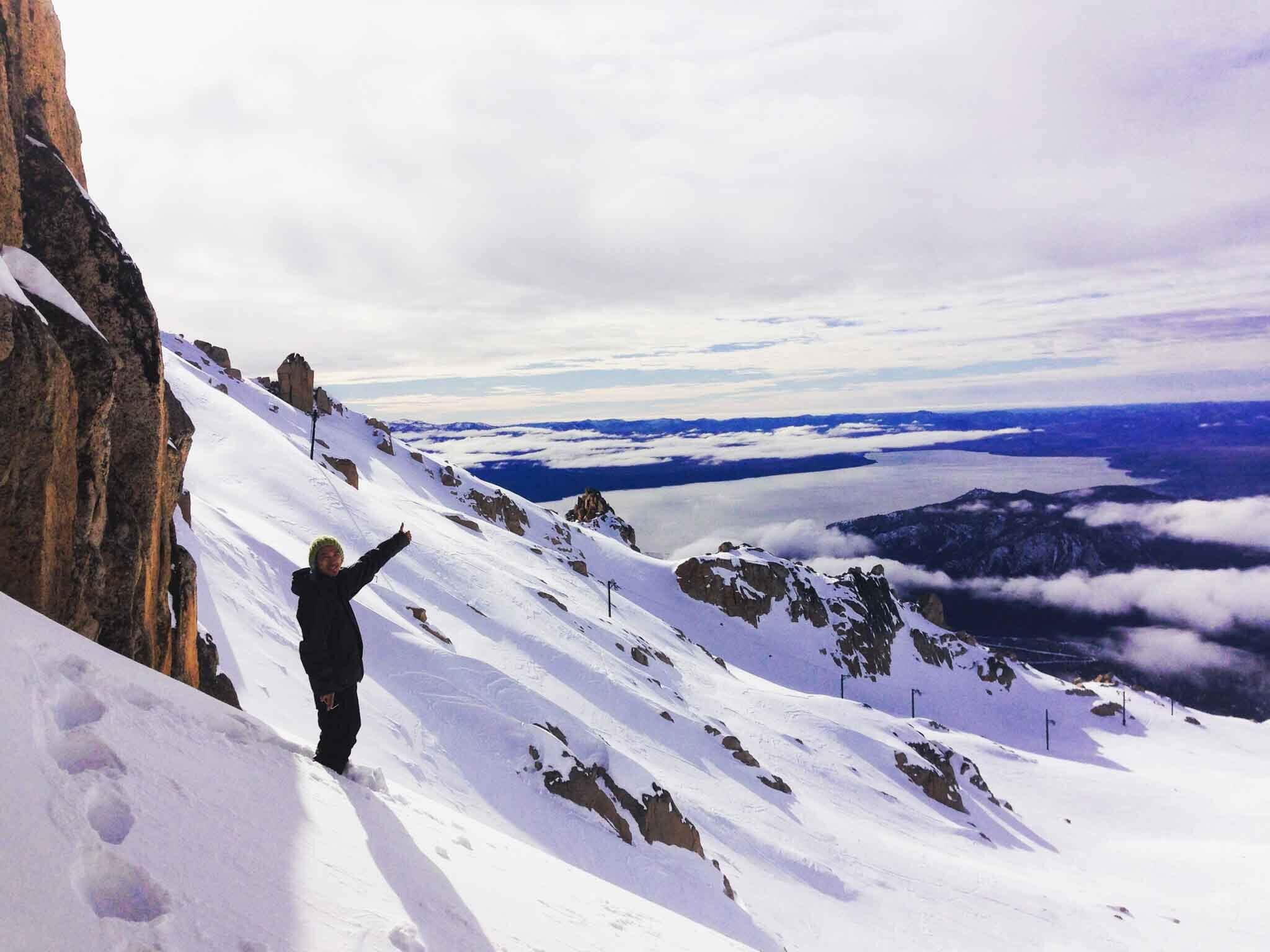
La Laguna @ Cerro Catedral
WHERE TO SNOWBOARD IN ARGENTINA
Snowboarding in Argentina is split between three distinct areas; High Andes (Mendoza), Lake District Patagonia, and Southern Patagonia Ushuaia.
PATAGONIA AND THE LAKE DISTRICT SKI RESORTS
Possibly the most popular place to snowboard in Argentina, the Lake District in Patagonia is stunning. When snowboarding in the Lake District expect to find epic views of mountains surrounded by lakes.
Bariloche is a popular access point to the resorts in this region with direct flights available from Buenos Aires. In Bariloche, you will find a bustling town filled with chocolate shops, bars, and incredible steak restaurants. Be sure to check out El Boliche de Alberto for the best Argentinian steak experience.
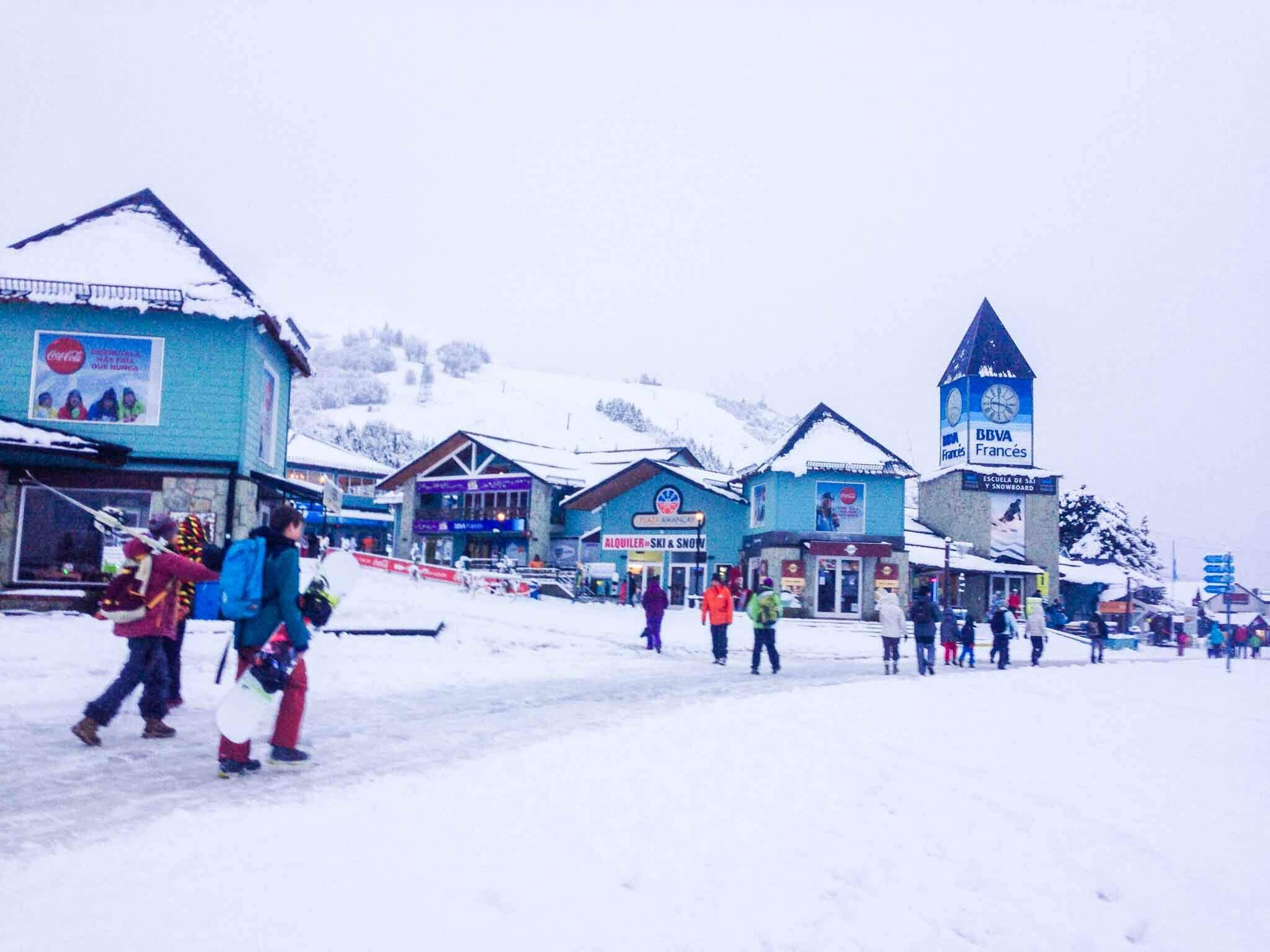
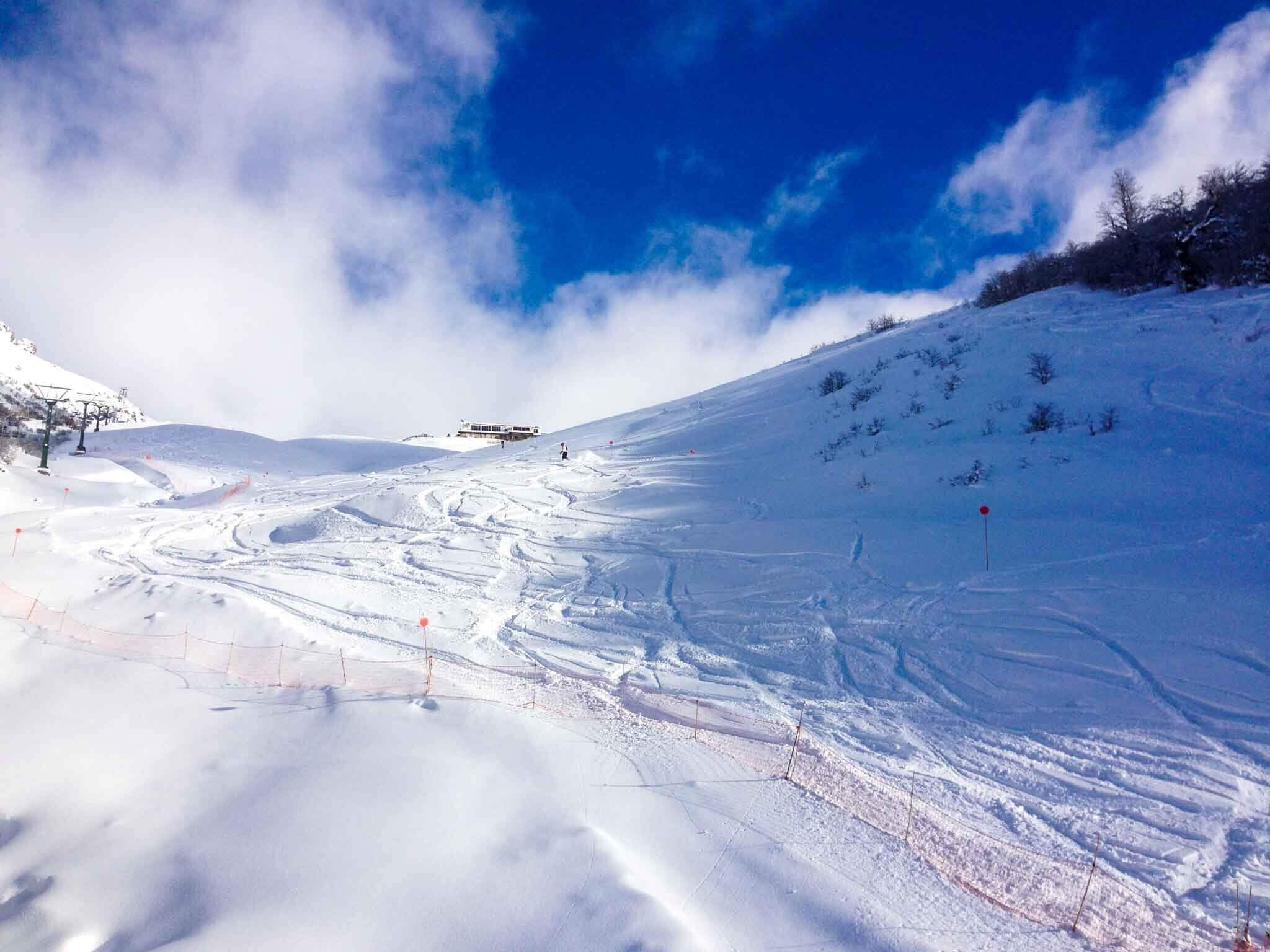
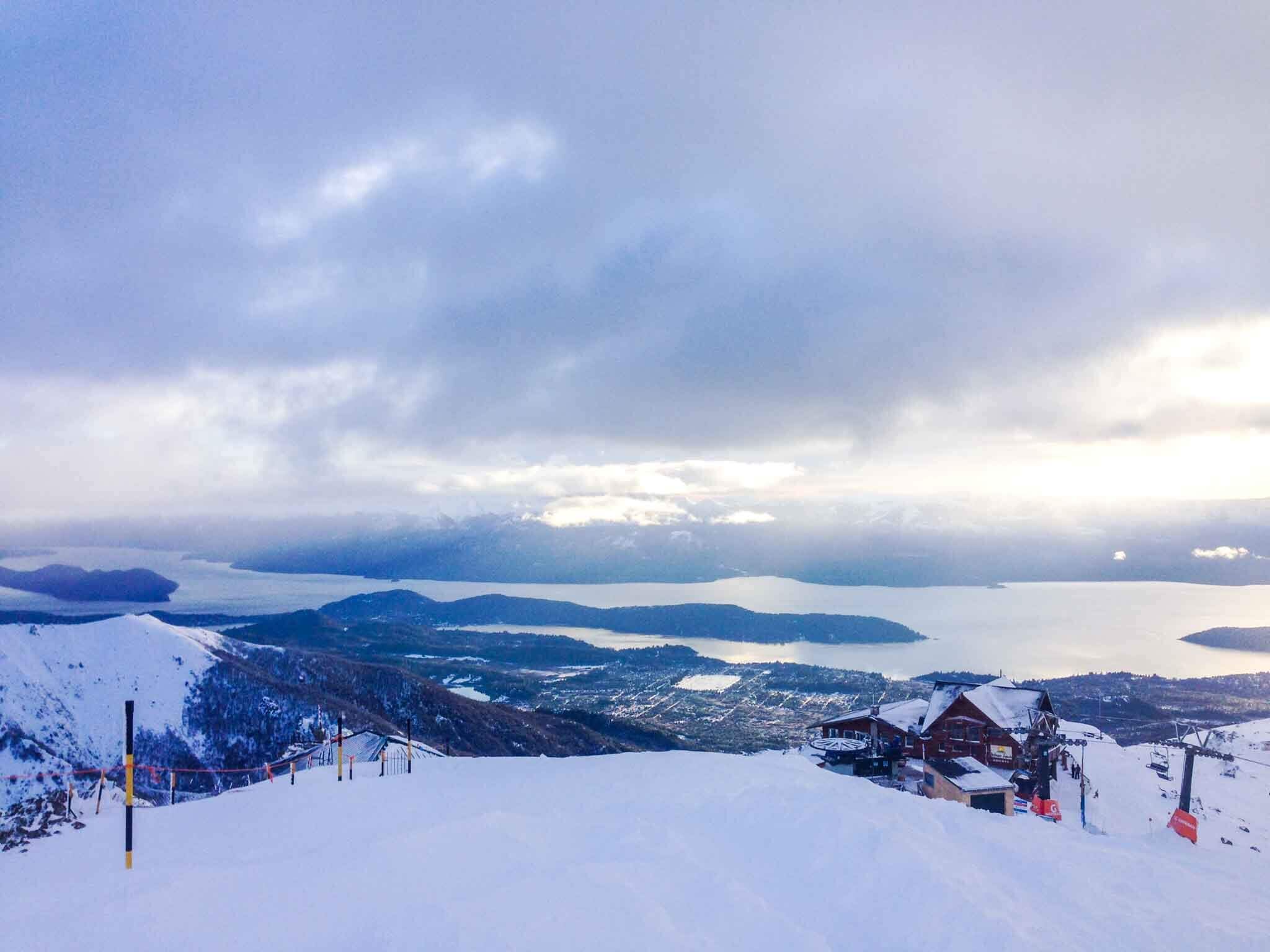
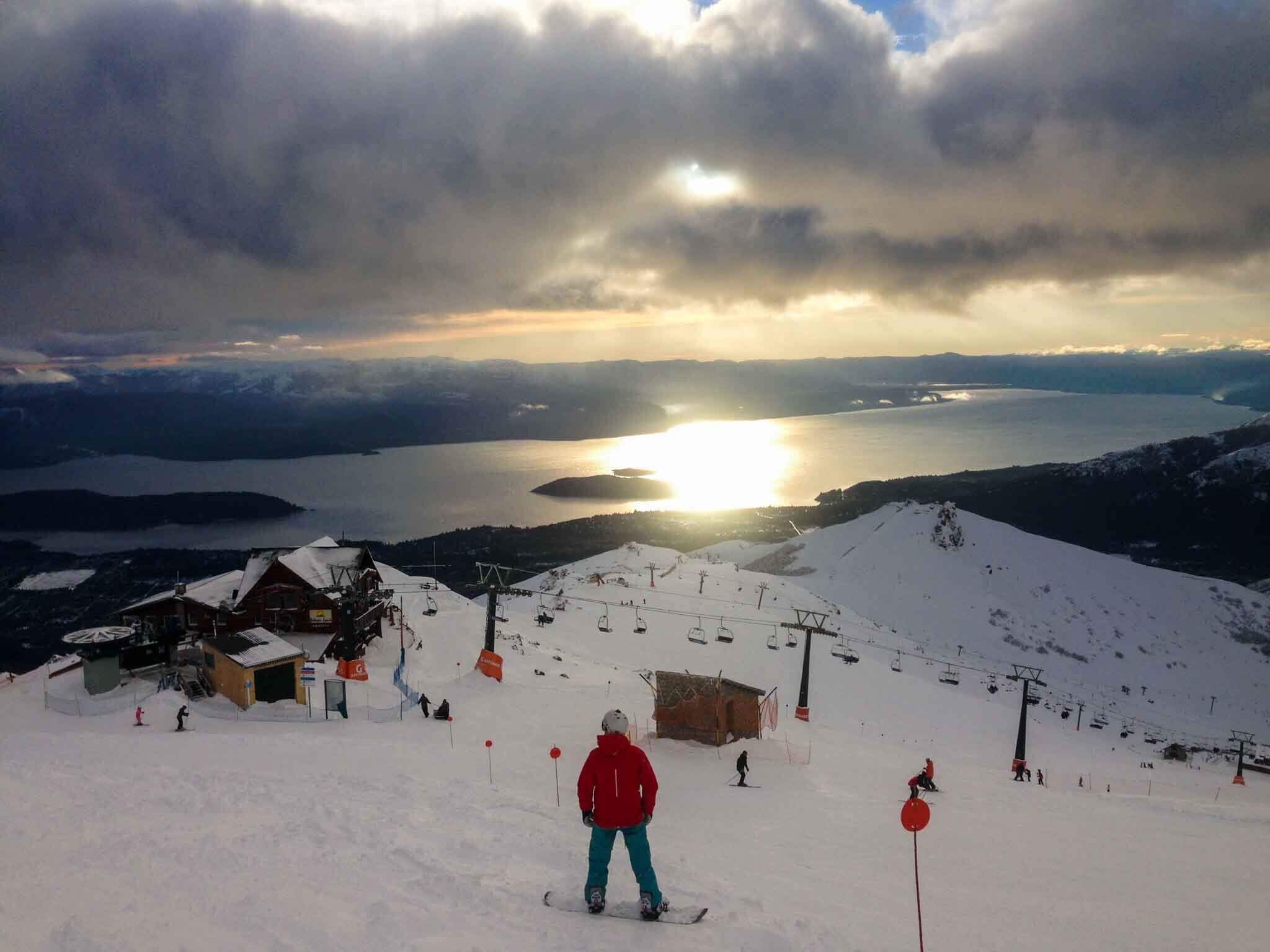
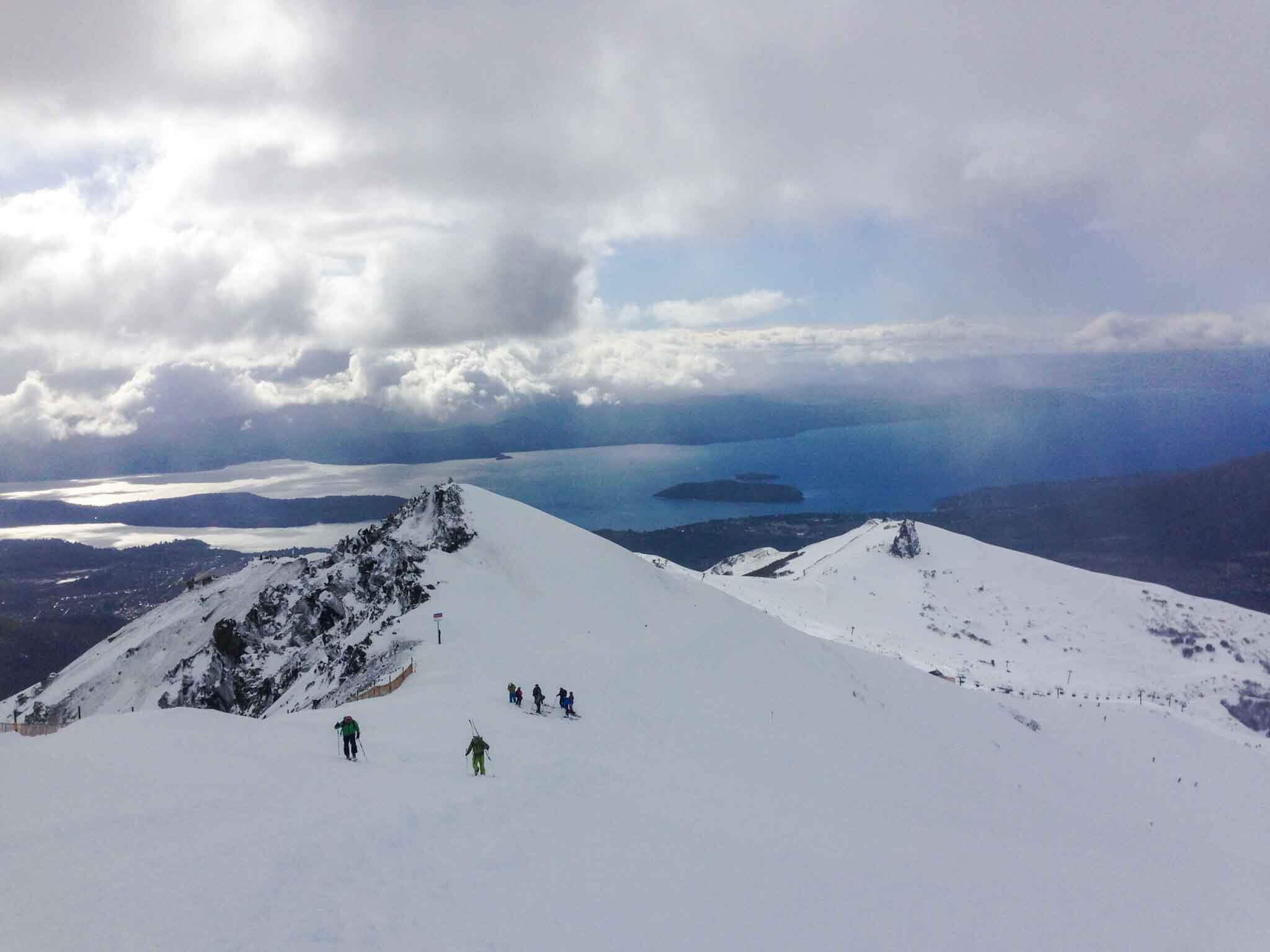
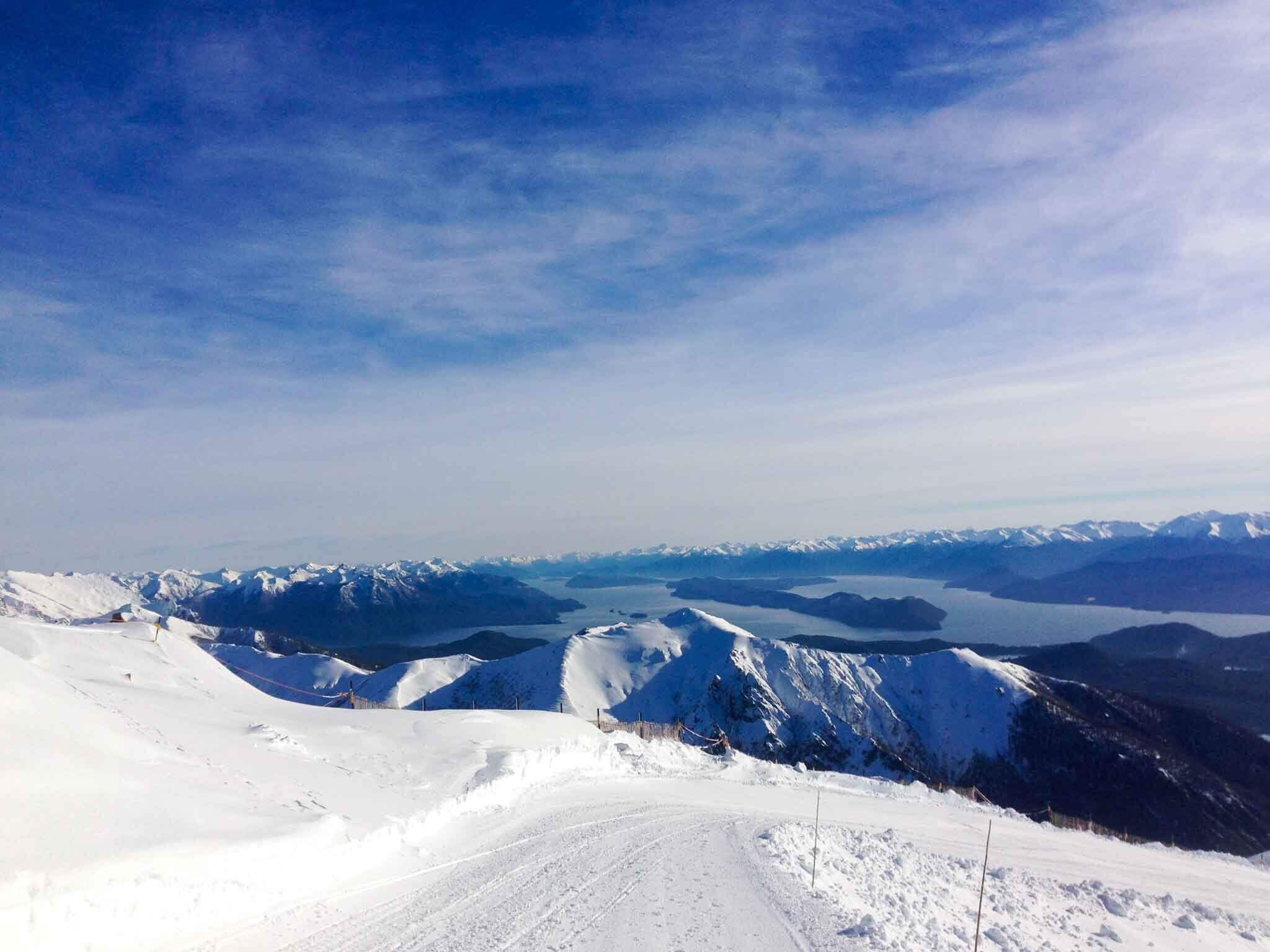
Most importantly, Bariloche is only a 12-mile drive to the Patagonia ski resort of Cerro Catedral, which offers modern lifts and some incredible terrain. Catedral Alta Patagonia is one of the prettiest resorts I have snowboarded at with views across Lago Nahuel Huapi into Chile. More importantly than the views, the terrain at Catedral Alta Patagonia is insane with easy access backcountry into the La Laguna area.
North of Bariloche you will find Caviahue ski resort which sits on a stratovolcano Copahue at nearly 3000m. Caviahue runs mostly surface lifts with a mere 418m of vertical drop.
Other notable Lake District ski resorts are; Cerro Chapelco, Cerro Bayo and La Hoya. Chapelco is outside the town of San Martin de Los Andes and offers some good riding through the trees. A mere 40 miles from Bariloche you will find Cerro Bayo. Cerro Bayo is a small ski resort offering a different experience to that found at nearby Cerro Catedral. South of Bariloche you will find La Hoya, which despite its modest size packs a punch. La Hoya has steep couloirs and the longest ski season in Argentina due to the colder temperatures.
MENDOZA SKI RESORTS
Snowboarding in Mendoza may be harder to access than most ski areas in Argentina but it may just be worth that extra effort. Mendoza is home to Las Leñas ski resort which is known worldwide for its steep freeride terrain. Las Leñas is the highest ski resort in Argentina with lifts reaching 3,340m. This pretty much guarantees great snow and Las Leñas receives an average of 5-6m per season. A combination of lift-accessible steeps and easy-access hiking make Las Leñas popular with the extreme crowd.
Mendoza is also home to Los Penitentes ski resort close to the border of Argentina and Chile. At Los Penitentes, you are unlikely to find many international skiers and snowboarders instead, Penitentes caters to the locals. That is not to say that Los Penitentes does not get international clients just that it is less common as a multi-day ski destination and is more likely to be an add-on. Similarly to Las Leñas, Penitentes has terrain above 3000m with a good proportion of the terrain intended for advanced riders.
SOUTHERN PATAGONIA SKI RESORTS
Ushuaia at the very southern tip of Argentina in Tierra del Fuego is home to Cerro Castor. Cerro Castor is not only Argentina’s most southerly ski resort but also the world’s. Cerro Castor is essentially at the end of the road but is surprisingly accessible. Direct flights to Ushuaia are possible from Buenos Aires which makes skiing and snowboarding at Cerro Castor popular. The terrain at Cerro Castor isn’t on the same scale as what you may find at Las Leñas or Cerro Catedral but the location is incredibly unique.
IF YOU FIND VALUE IN THIS POST CONSIDER CLICKING THE BUYMEACOFFEE LINK BELOW TO SUPPORT MY CONTENT

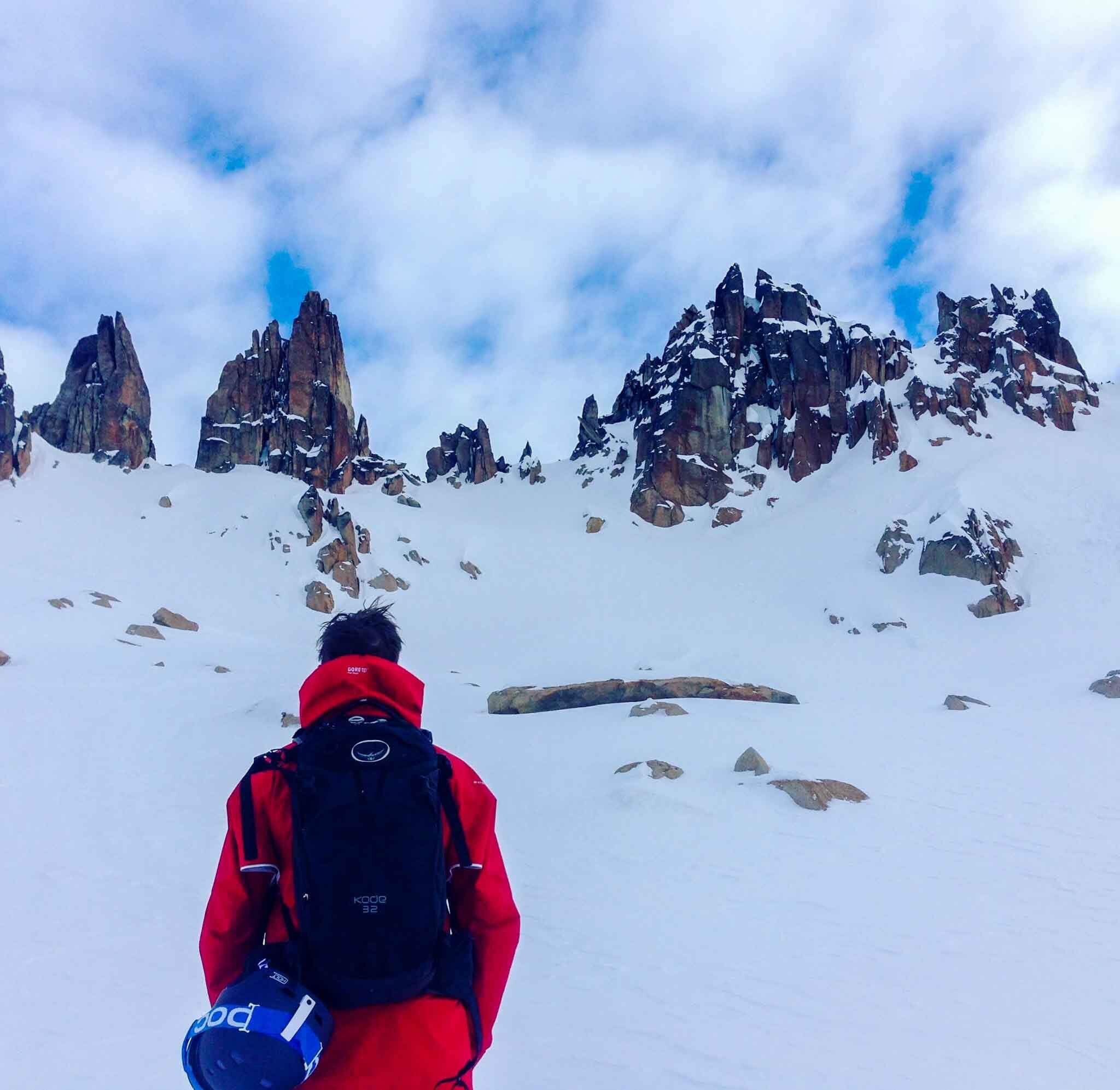
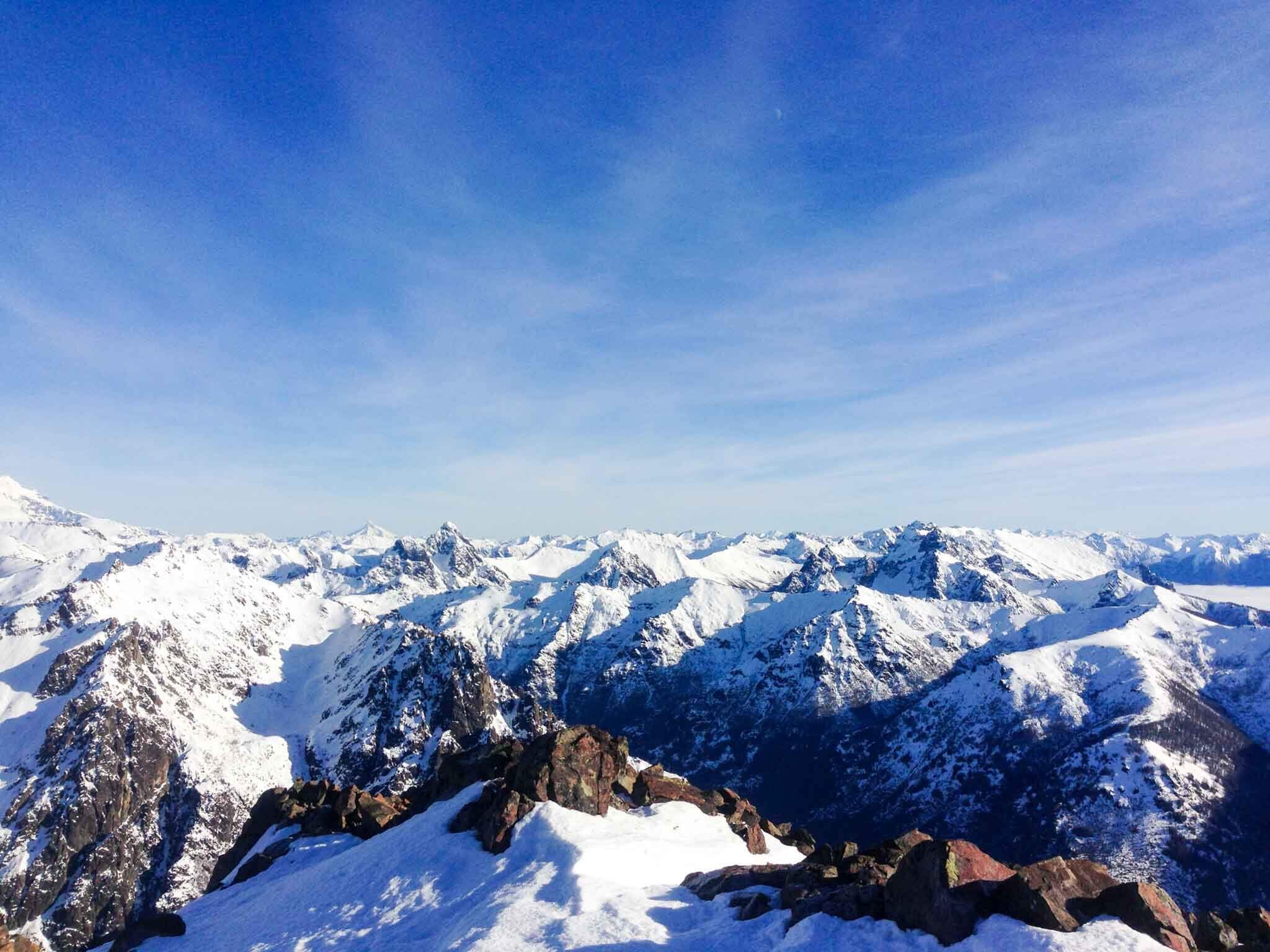
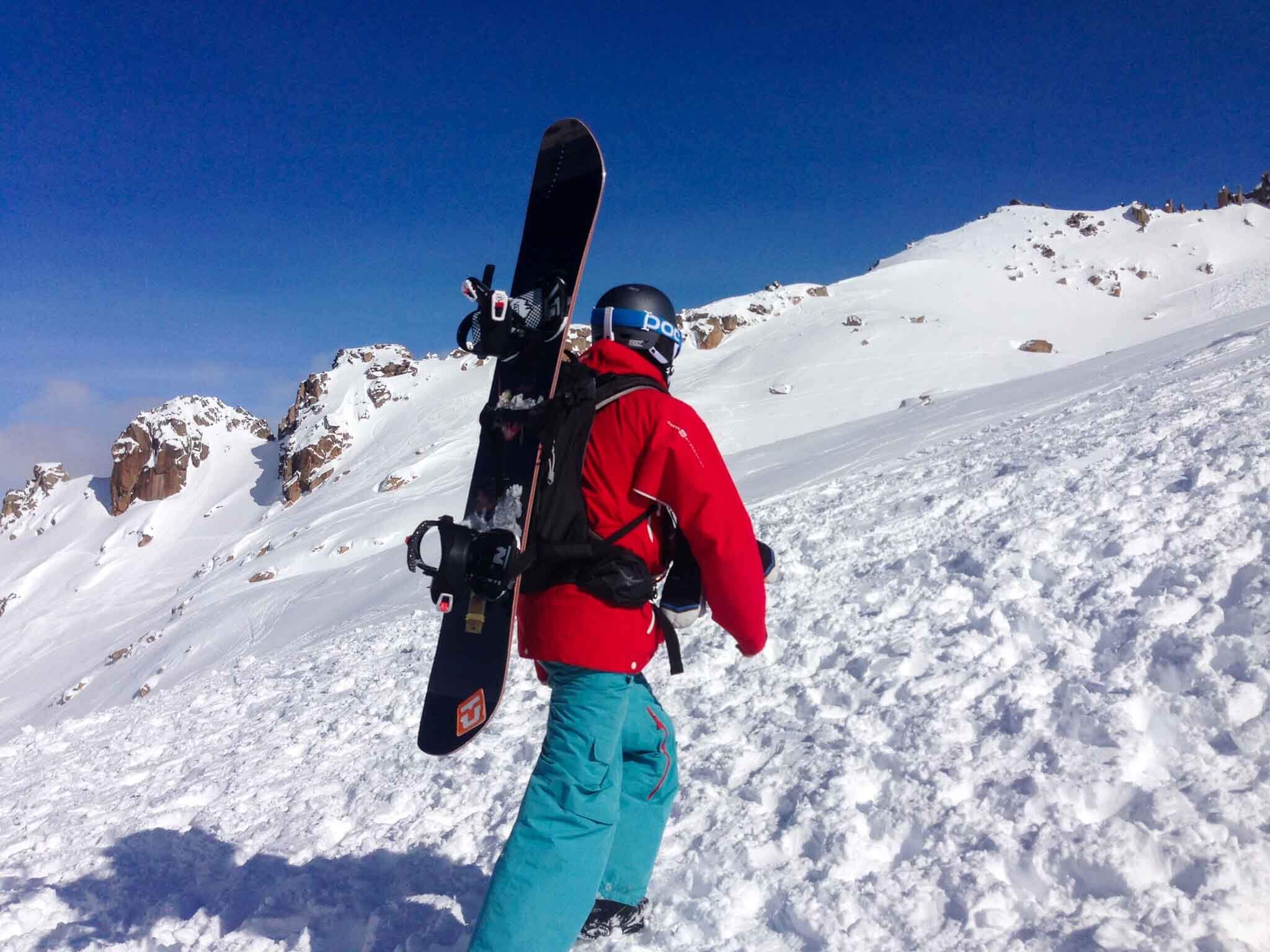
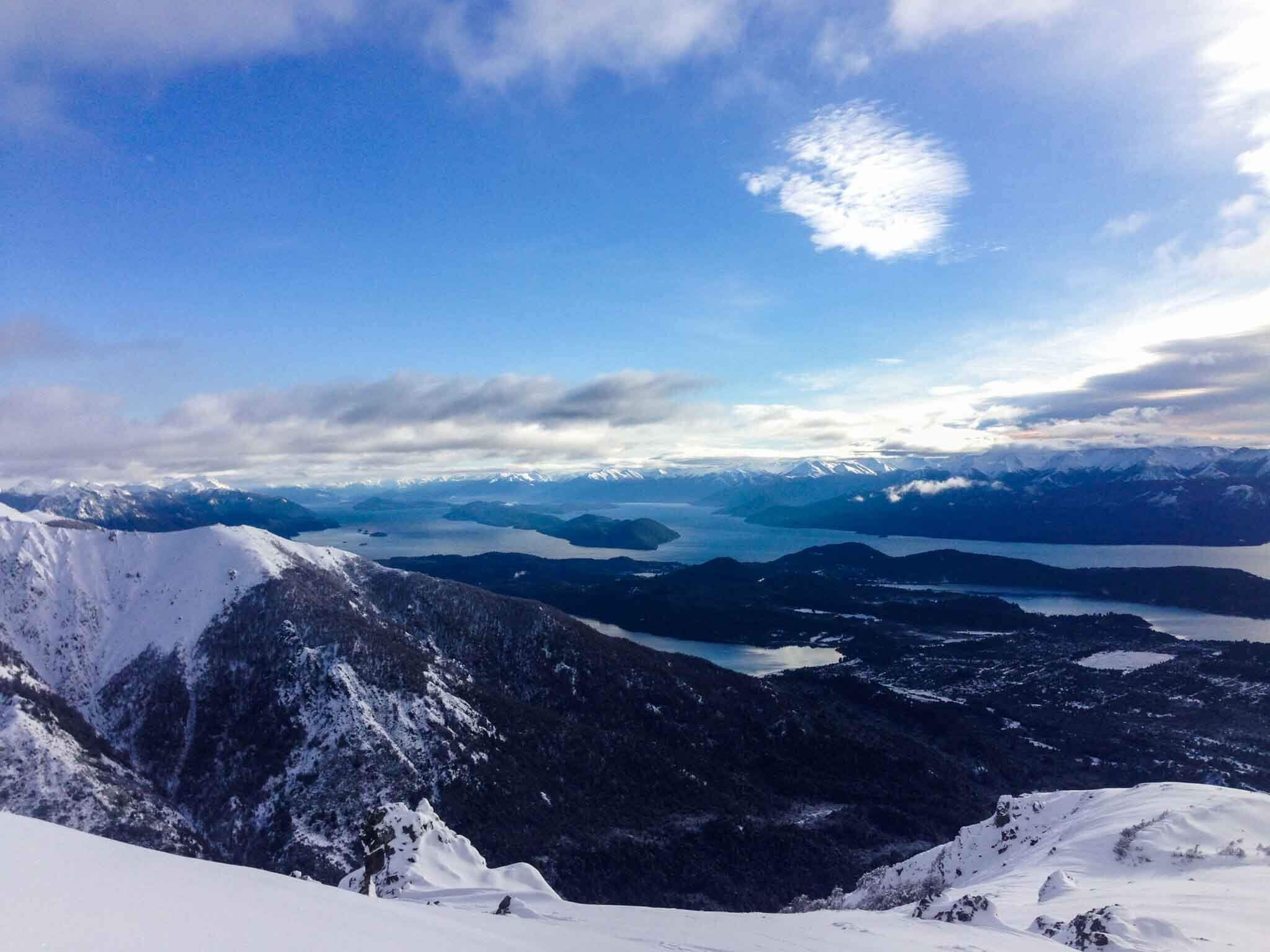
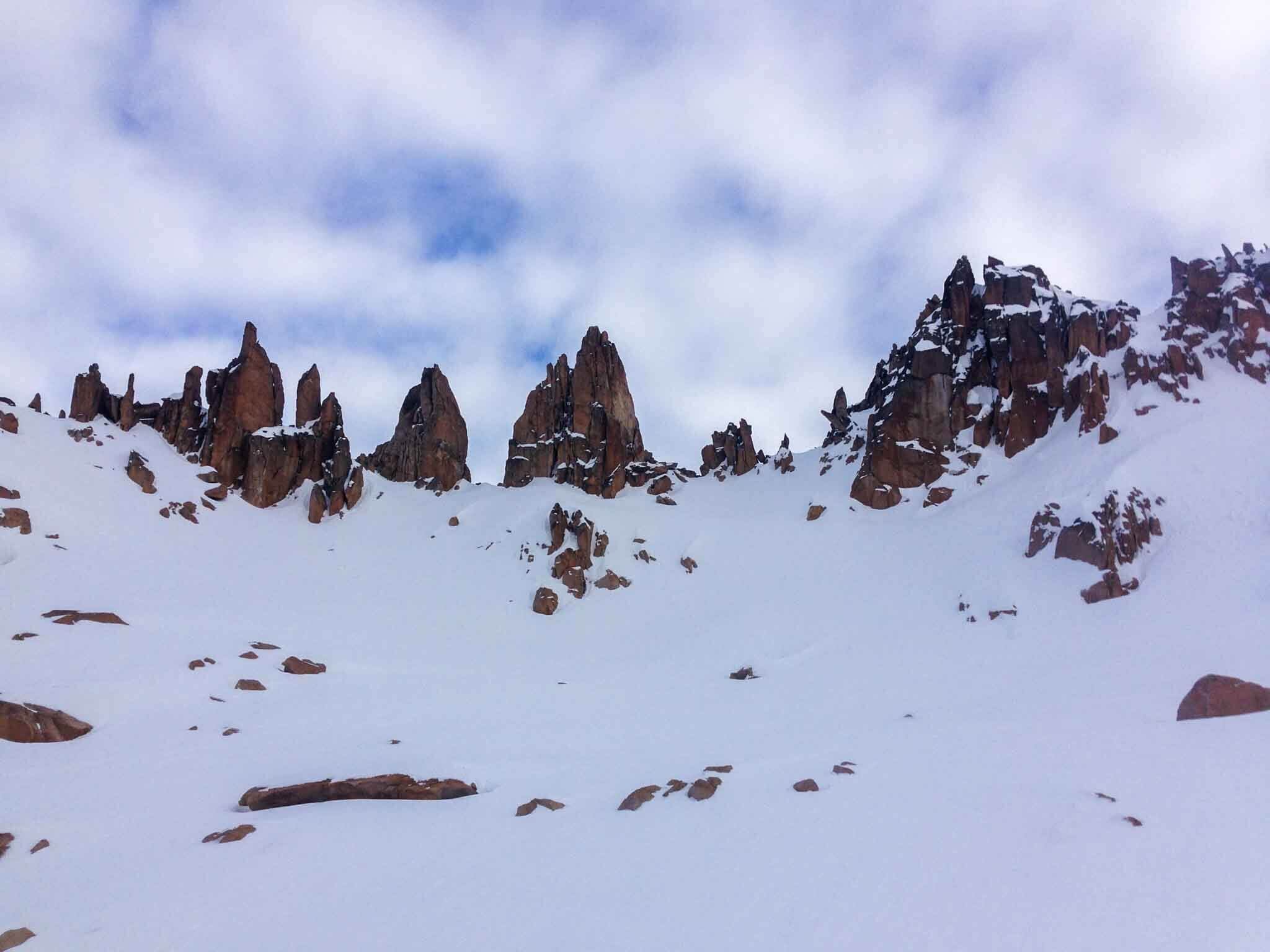
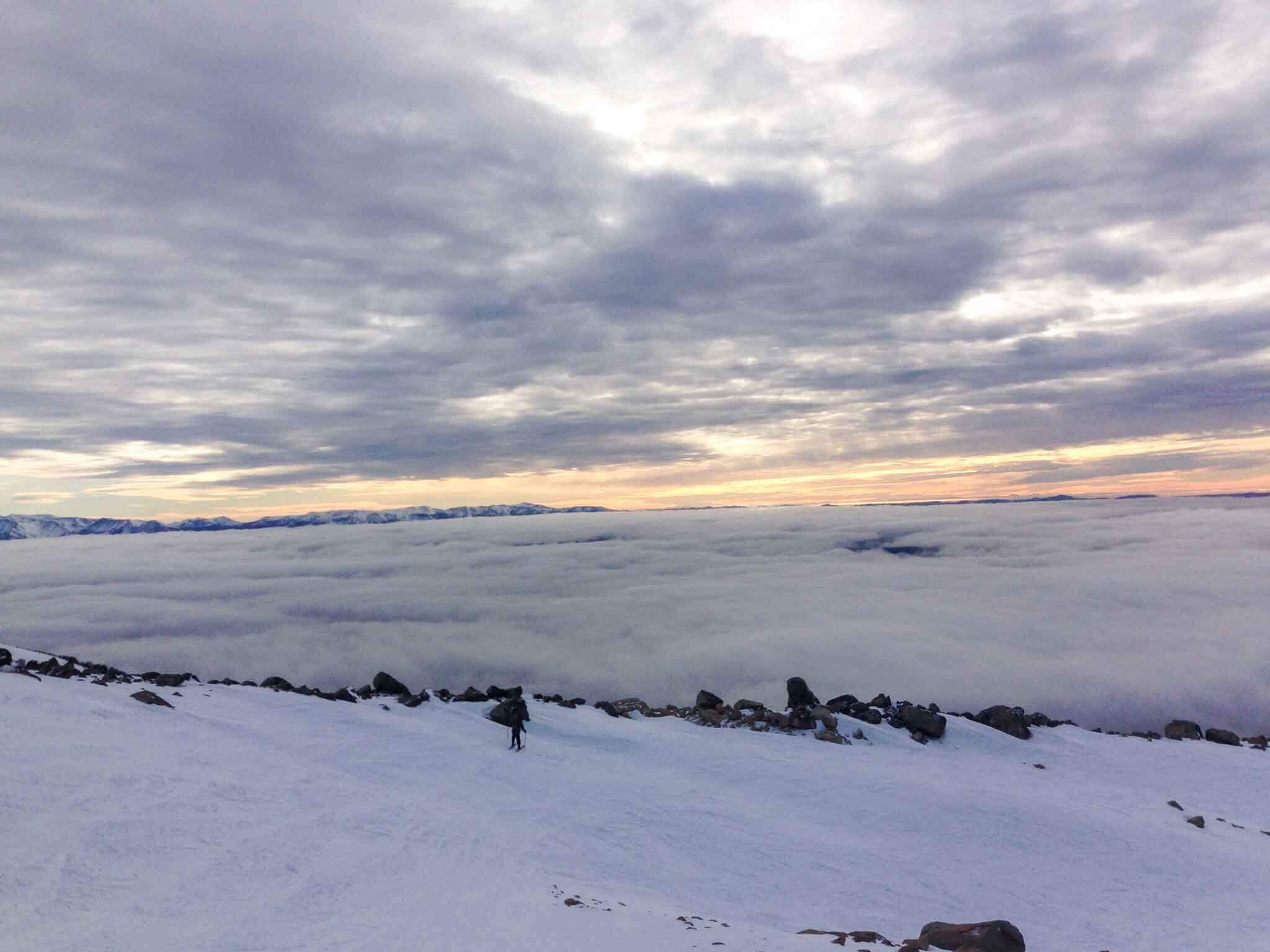
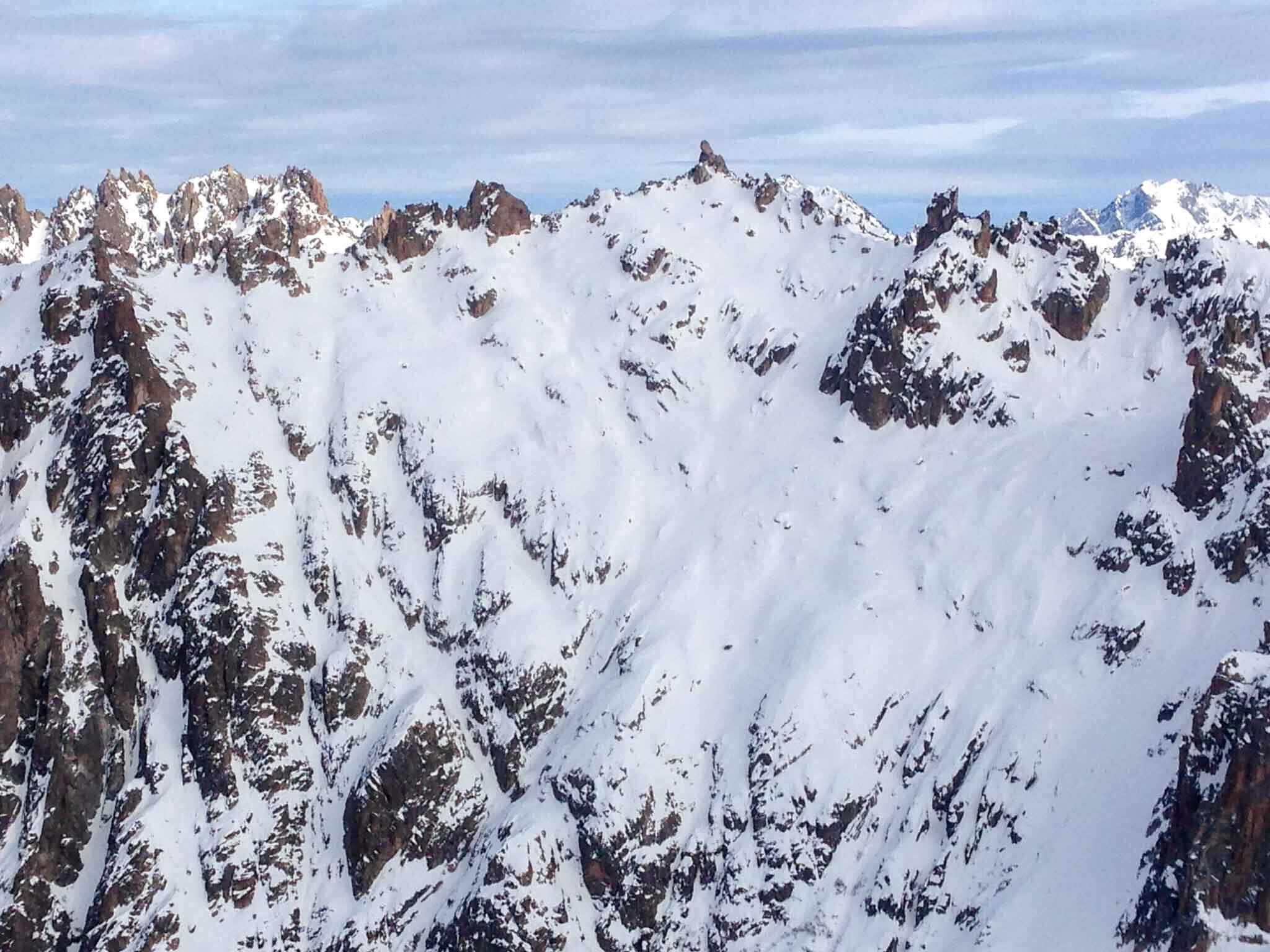
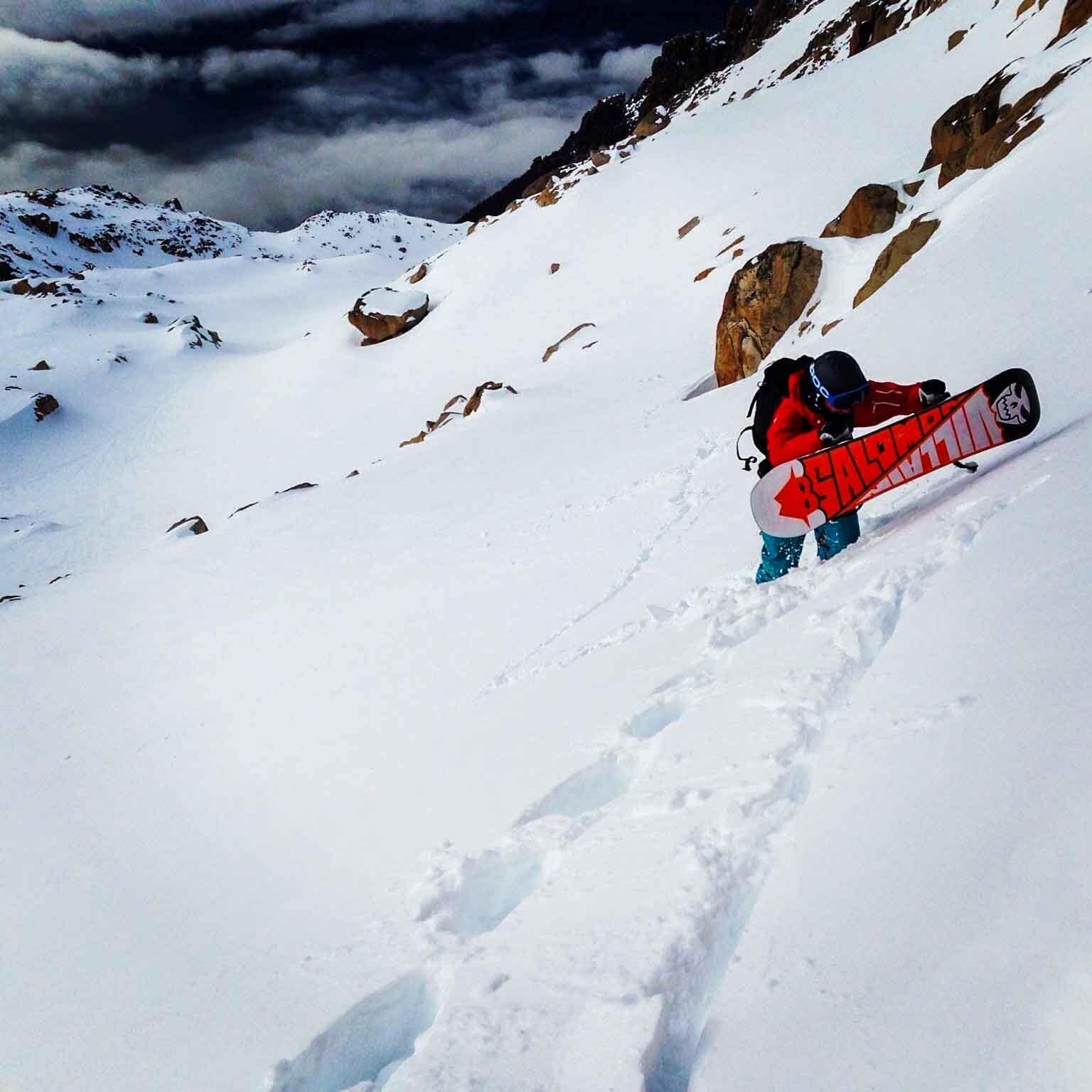
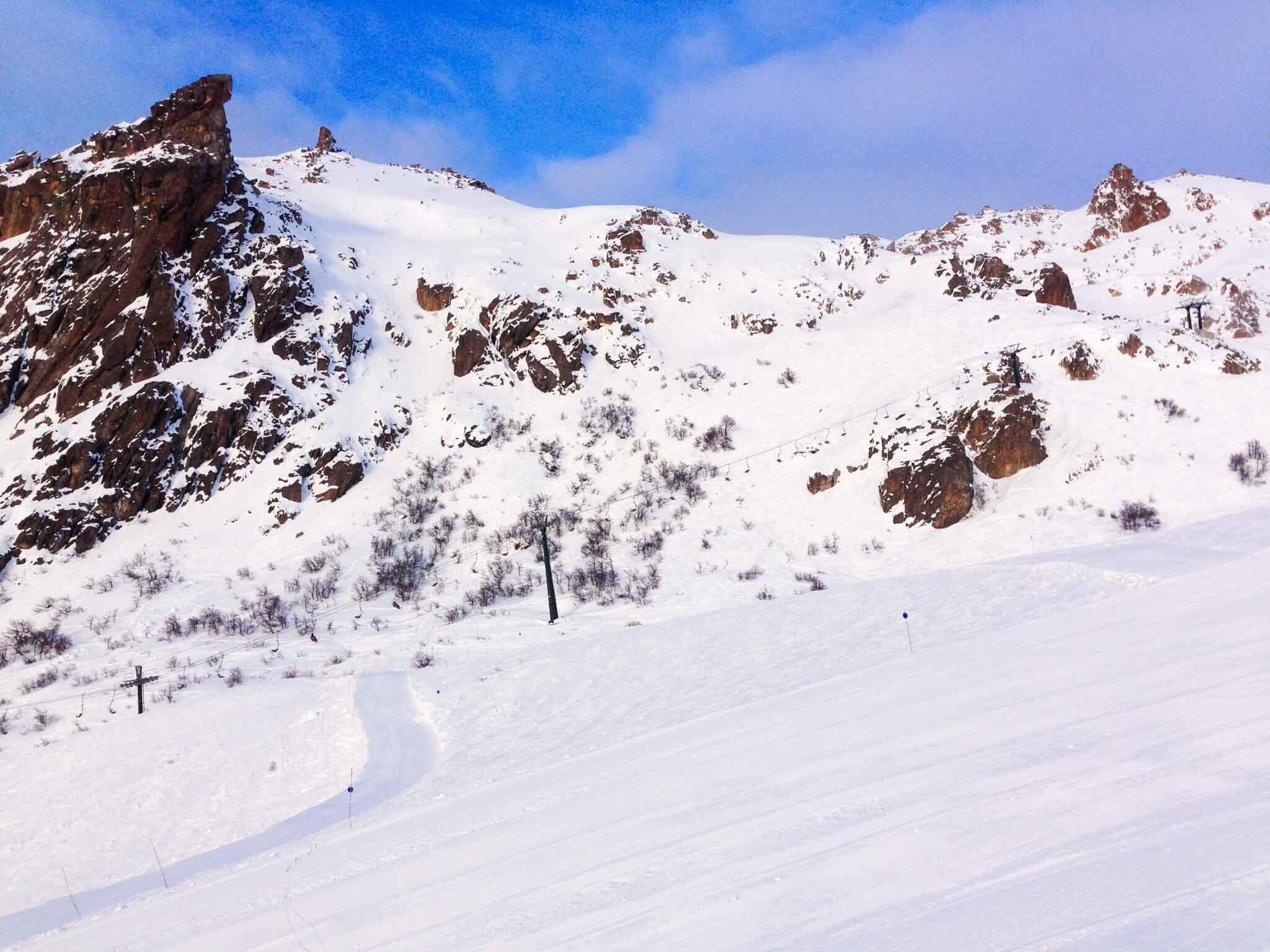
ARGENTINA GALLERY
WHAT TO EXPECT WHEN SNOWBOARDING IN ARGENTINA
Snowboarding in Argentina can be amazing and it can be a complete write-off. In Argentina, you really have to be prepared for the worst and make the most of the good days you get. Like in most mountain environments, the weather dictates everything and Argentina can be prone to some pretty serious weather systems. There is nothing quite like the feeling of being sat on a chairlift in 100km winds whilst hoping the resort staff can get the chair running again. With this in mind, Argentina’s resorts can be prone to wind closures that can last days rather than hours.
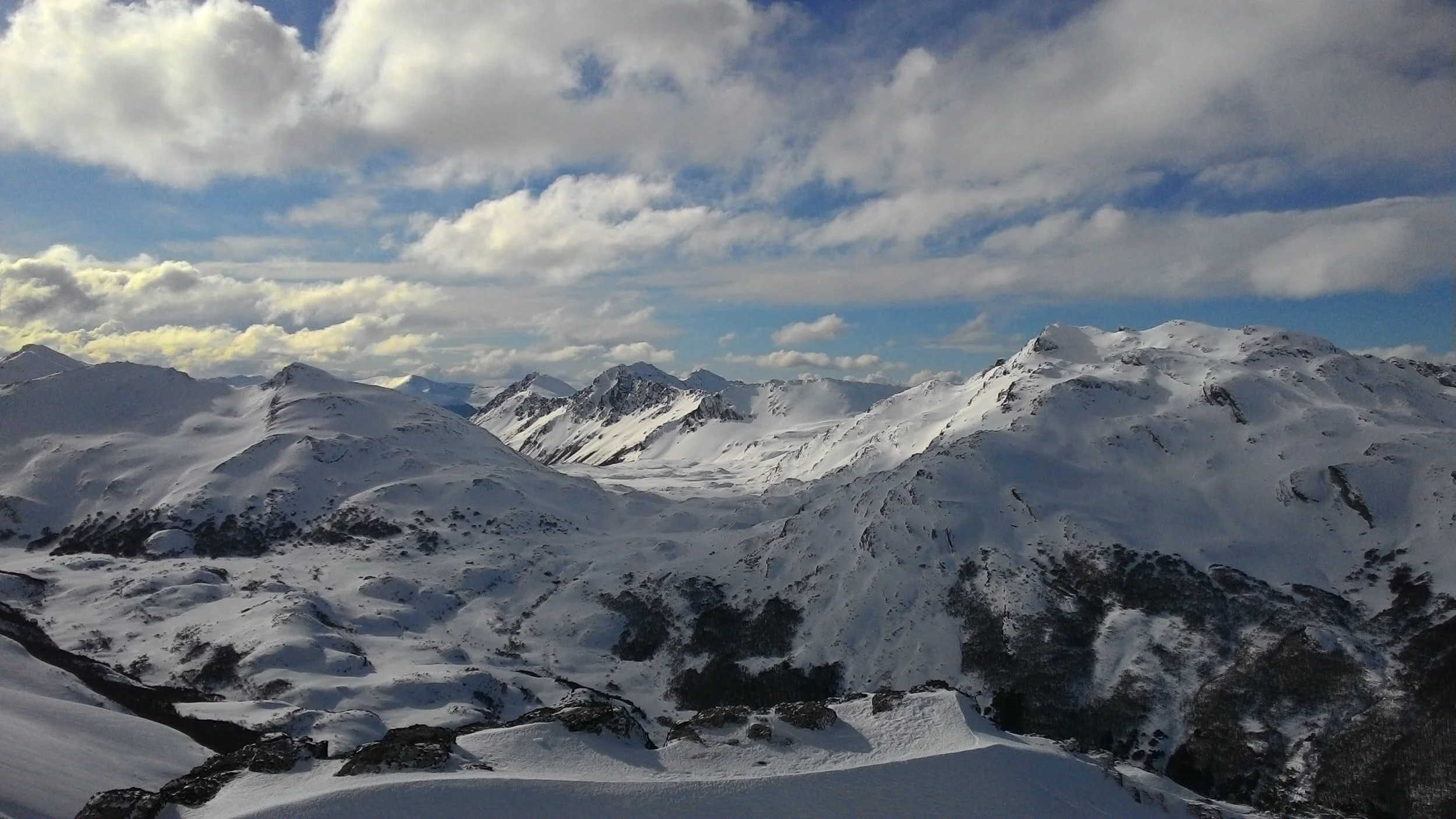
When conditions are good, Argentina is an incredible place to snowboard. Bluebird days bring with them insane views of Argentina’s rugged landscape and powder days combine epic snow and some jaw-dropping terrain. The majority of my days on snow in Argentina have been positive and it is worth remembering that on the days when things don’t go right.
The resorts are a mixture of modern facilities and some of the slowest chairlifts you could ever experience. Cerro Catedral specifically has a good mixture of high-speed chairs and some older ones that really could do with replacement. With that being said if there is one place I don't mind a slow chairlift ride it’s Argentina, the views are worth it.
Freeride is the main reason to visit Argentina with the Andes Mountain range creating some incredible natural terrain to play in. If freestyle is your thing, then there will be terrain parks to play in but don’t expect the same scale as some New Zealand resorts.
WHY SNOWBOARD IN ARGENTINA
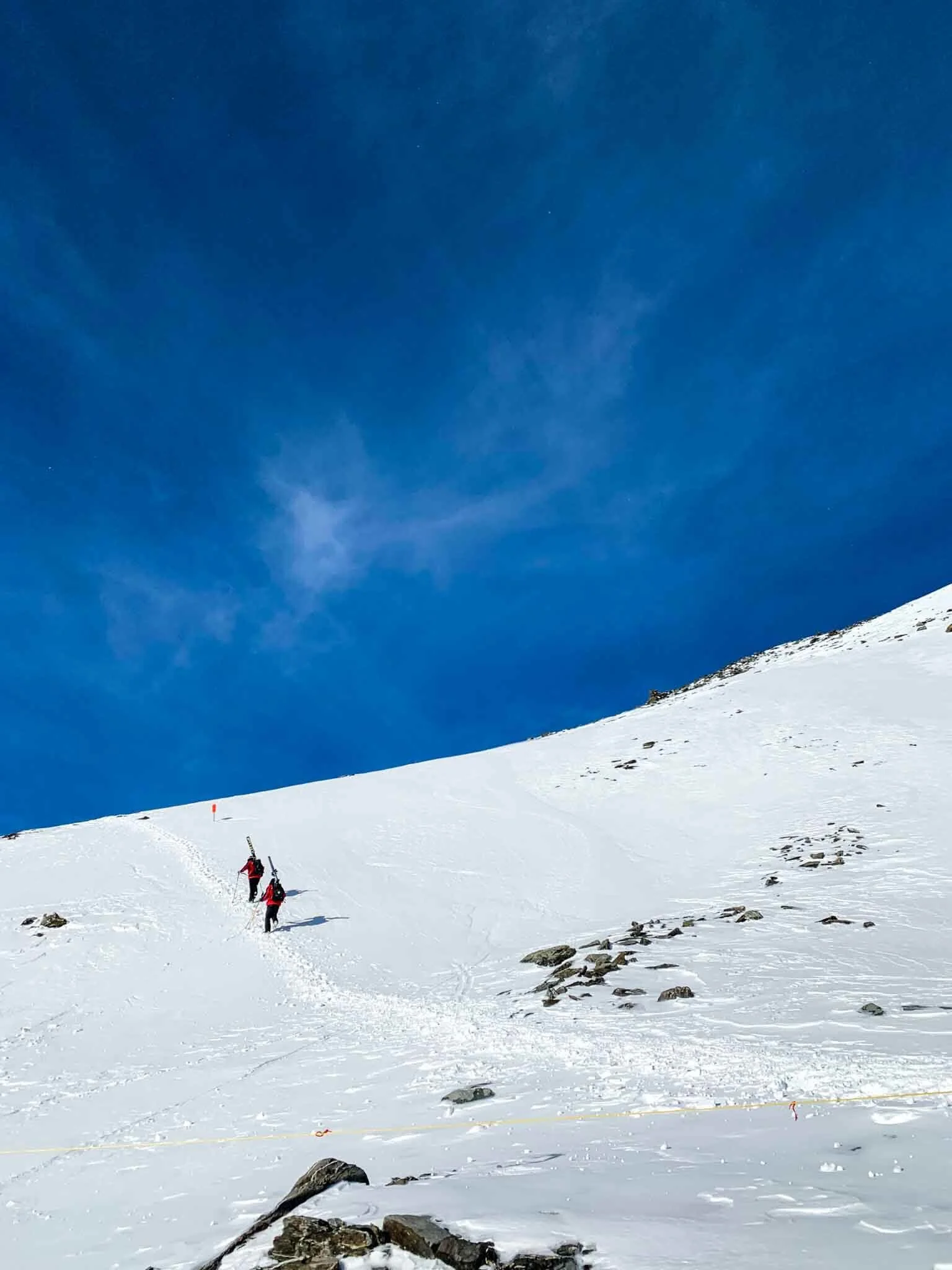
Argentina is a great destination for a summer snowboard trip. Unlike Australia and New Zealand, you will find big mountain terrain within the resort boundaries. This means that not only will you be chasing summer pow laps but you can head into some pretty epic areas to get it. There is hikeable terrain at most Argentinian resorts with Las Leñas and Cerro Catedral having great sidecountry access straight from the chairlift.
Argentinians are great people and will be a highlight of any trip to this awesome country. I found Argentinians to be incredibly welcoming during my travels and even had some volunteers show me their local spots on the hill. I was blown away by the helpful nature of the Argentinians whether it be; hitchhiking to the resort or inviting me for Asado.
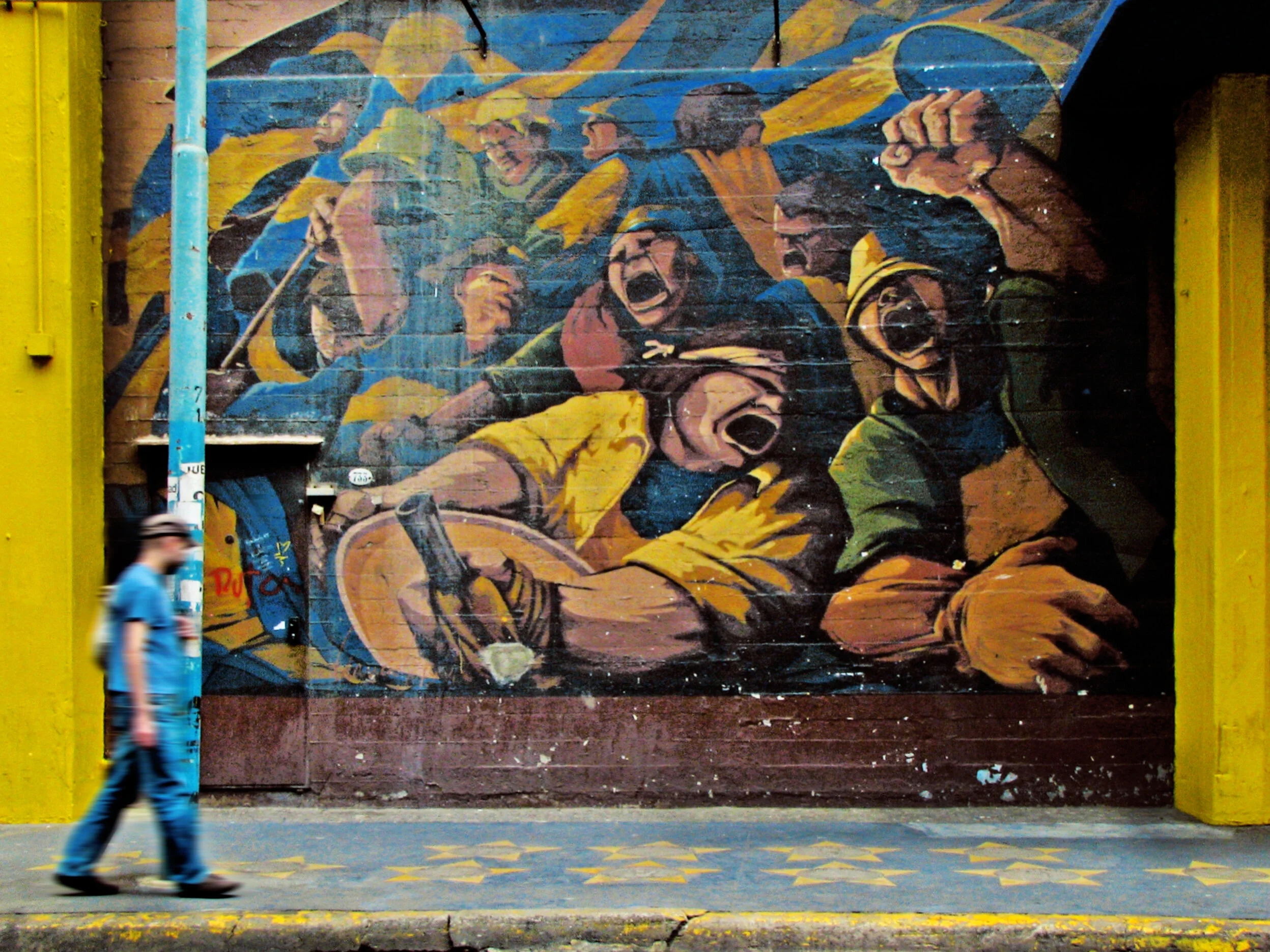
Argentina is about so much more than just the on-snow experience. The capital of Buenos Aires is well worth investing a couple of days of your trip to visit. Everything from the historic Plaza De Mayo to watching a football match at La Bombonera should be high on your tourist bucket list. Of course, any trip to Buenos Aires would be incomplete without a steak dinner and a night learning the Tango.

La Laguna @ Cerro Catedral
ARGENTINA SKI SEASON DATES
As summer seasons go Argentina’s is pretty long. Starting in June and running into October. Depending on the season the early and late season conditions can be pretty sketchy with the best time to visit during August. In August you will have your best chance of scoring that Argentinian powder day however it can be crowded during the holiday season. Luckily, my experience is that most tourists to Argentine ski resorts are first-timers and won’t be out stealing your stashes.
POPULAR ARGENTINA POSTS



TRAVEL TO ARGENTINA
Getting to Argentina from London is a long flight, 14 hours into Buenos Aires and you will need to connect to get closer to your chosen resort. Internal flights in Argentina can be expensive but will save you a long bus journey. Argentina’s bus network is pretty impressive and fairly inexpensive. Be sure to choose the ‘cama’ option which is a reclining seat and will offer more comfort.
ARGENTINIAN APRES SKI
Argentinians know how to have fun and this is no different in their ski towns. Most resorts will offer a lively happy hour after the lifts are closed but this is normally just a prelude to what is to come. Argentina is about the community so expect to be invited to eat Asado. If the mood takes you, nightclubs are popular but be prepared to start late with most opening around midnight.
TRAVEL MONEY ARGENTINA
Argentina is famous for a currency that is continually fluctuating. This means getting your money at the right time can make a huge difference in how affordable your trip is. It is well known that in Argentina there are two currency exchange rates, the official rate, and the black market rate. The black market rate will get you around 20-30% more for your money over exchanging your money in banks but this is obviously at your own risk.
ARGENTINA FREQUENTLY ASKED QUESTIONS
IS SNOWBOARDING BETTER IN ARGENTINA OR CHILE?
Argentinian and Chilean ski resorts offer you incredible terrain if you love freeriding. With terrain that will challenge even the most experienced snowboarders, you can really push your boundaries in both countries. Like most places in the world, Argentina and Chile have different scale resorts suited to different styles or levels of snowboarding and you just need to find the resorts that suit your style. There are plenty of reasons to visit both countries for a snowboarding trip.
HOW MUCH IS A SKI PASS IN ARGENTINA?
As with most things in Argentina the actual cost when you consider currency conversion can change drastically. Expect to spend between £40 to £80 per day for a lift pass at the major resorts. It is worth checking out the Flexi pass options if you want some coverage due to poor weather and you can save massively by purchasing multi-day passes.
IS IT SAFE TO TRAVEL AROUND ARGENTINA?
As with all countries is it best to use common sense and proceed with caution in high-risk areas. Our experience is that Argentina is a safe place to travel and we have never had any issues. Listen to local advice and leave potential problem spots before it gets dark. Around the ski resorts, Argentina is incredibly safe and you can feel more relaxed. Buenos Aires is one of the safest cities in South America but it does have its problem spots. In Buenos Aires, areas like La Boca are huge tourist hotspots and prone to crime. We enjoyed visiting La Boca but the advice was always to leave before 5 PM.
DOES ARGENTINA HAVE GOOD SNOW?
Argentina can deliver some epic snow conditions with big mountain powder runs a thing of legend. Typically the ski season has its most reliable conditions through July and August in Argentina so it is best time time your trip between these months.
DOES ARGENTINA HAVE GOOD SKIING?
If you are looking for a summer skiing destination then you can’t go wrong by opting for Argentina. Argentina is home to some mega-resorts like Las Lenas and Cerro Catedral which offer some of the best skiing on the continent. The ski resorts in Argentina are on a bigger scale than those in other summer skiing destinations like Australia.
GET IN TOUCH
As always thanks for reading and know it is your turn to have your say! Let me know in the comment section if you have visited Argentina. What was your favourite activity in Argentina?
PIN IT FOR LATER


IF YOU FIND VALUE IN THIS POST CONSIDER CLICKING THE BUYMEACOFFEE LINK BELOW TO SUPPORT MY CONTENT


Five Best Ski Runs In Hakuba Valley
The Hakuba Valley is an area of Japan renowned for world-class skiing and snowboarding. Blessed with an average of 12m of snow per winter, it is no wonder that people flock from around the globe to experience Japanese powder conditions. In this post I share the five best ski runs in the Hakuba Valley.
With ten resorts included on one pass there is an expanse of terrain to choose from when heading to Hakuba. This means whittling all the options down to a list of the five best runs possible in Hakuba was a hard task. This list is based on my experience of snowboarding in Hakuba in Jan-Feb 2019 and my fondest memories of the trip. The runs I have selected are varied and I will fully explain my reasoning below.

5. TSUGAIKE DBD GATE 3
Tsugaike is nicknamed ‘powder heaven’ and this should tell you all you need to know. Geographically it is close to Hakuba Cortina but it doesn’t draw the same crowds despite receiving similar amounts of snow. This is most likely down to the restriction on tree riding at Tsugaike, requiring you to take a course to enter to the tree areas or DBD. There are four main gates into the Tsugaike DBD area and I enjoyed the lines through Gate 3 the most. Gate 3 provides a longer run than Gate 1 with a steeper incline but the same well spaced trees!
4. HAKUBA 47 TERRAIN PARK
When you think of a Japanese snowboard trip heading to the terrain park is not what comes to mind. Sadly not every day can be a powder day and Hakuba 47 offers another option to keep you entertained during your trip to Hakuba. The terrain park at Hakuba 47 is in my opinion the best in Hakuba. The layout is great with its own (fairly slow) chairlift, making park laps a fairly simple task. Hakuba 47 has Hakuba’s only half pipe at the top of the park which leads down to a choice of lines. Skiers and snowboarders can choose between simple ride-on boxes to large kickers and more advanced rail features.
3. CORTINA CHAIR 5 TREE RUN
Cortina was bound to feature in this list and it does twice, but the run from the number 5 chairlift might be a surprise entry to some. This is where I found some of my best and less contested turns in Cortina. With the crowds that flock to Cortina if you want to make the most of it you need to get away from the crowds. Number 4 chairlift accesses some great terrain but you can expect a 40 minute lift cue on a busy day. With this in mind the trees that are accessible from Number 5 chairlift are a great option. My advice is from the top of the chairlift go left, take a short traverse and then drop in. Most skiers and snowboarders go right of the chair meaning you can find untracked lines well into the afternoon. Whatever chairlift you use at Cortina will lead to widely spaced trees and copious amounts of JAPOW! Taking chairlift number 5 just means you don’t need to share.
2. SANOSAKA LAKE DOWN TRAIL
Sometimes good things come in small packages and Sanosaka is a prime example. Making the list at number two is my favourite non-powder day run in Hakuba, Lake Down Trail. It blows my mind how quiet this resort is and you can have the groomers to yourself all day. Lake down trail is a wide blue run offering great views of Lake Aoki. Stood at the top you have the option to take the groomed piste or go to skiers right where there is a pump track… as the run mellows out towards the chairlift, you will also find some small park features. This means in one run you can; take in a great view, carve a groomer, build up speed on the pump track, hit a jump, slide a rail and then head up for some more…. oh did I mention dogs are allowed? So be sure to keep an eye out for a furry friend.
1. CORTINA TO NORIKURA BACKCOUNTRY RUN
Hakuba Cortina not only has no restrictions on where you can tree ride but it is also linked to neighbouring resort Norikura Onsen Ski Resort. From the top of number 4 chairlift at Cortina, you can access a backcountry run that takes you between the two resorts and this was a highlight of my days at Cortina. As soon as you drop in you are met with perfectly spaced trees and a steep incline that make face shots a regular occurrence. The amount of snow combined with the terrain makes this a run I have not found elsewhere on my snowboard travels. You will want to gradually ride towards skiers left as this will take you towards Norikura resort where you will be able to head back up and do it all again.
Have you visited Hakuba? Do you have a favourite run? Let me know in the comments.
RELATED POSTS


Smith IO Mag Ski Goggle Review
The opinions expressed in this review are my own and I am not paid by the brand. If this review helps you decide that the Smith IO Mag is the goggle for you, please consider buying me a coffee here.
For a number of seasons, I have ridden with people who rave about Smith Optics. The people I know and trust have always had positive experiences and this was enough for me to jump on the bandwagon. WELL … the positivity and the chance to try Chromapop lenses. Prior to writing this review, I have ridden with the Smith IO Mag goggles in a variety of conditions in; Japan, China, France, Italy, the USA, and New Zealand. I have experienced everything from extreme whiteouts and rain through to beautiful bluebird days while wearing these goggles. I rode these goggles with the Giro Combyn Helmet which has been a great fit.
SMITH IO MAG OVERVIEW
The Smith Optics IO Mag is a high-end goggle that comes into the Smith range to replace the IO7. Priced at £220 they are at the upper end of the goggle market in terms of price, but they do come with two Chromapop lenses. The IO Mag was introduced to make lens changes easier and utilizes a magnetic system but with the added security of a latch on either side of the goggles. The lens is spherical and the frameless design offers a great field of vision, although noticeably not as wide as on major competitor the Anon M4.
SMITH IO MAG FIRST IMPRESSIONS
Out of the box, the Smith IO Mags make a good impression. I ordered the Austin Smith Collab model that comes with a North Face goggle case that is really handy. It is great that the Smith IO Mags all come with two lenses (normally a sunny and storm lens). This makes the IO great value for money. The IO Mag is medium size but there is a larger version the XL if you prefer larger goggles. When purchasing I was worried that the clip on the rear of the goggle would be uncomfortable but this is far from the case.
HOW GOOD ARE THE SMITH IO MAG GOGGLES?
The Smith IO Mag goggle is a top performer. I have owned and tried a lot of goggles in the past and these are certainly amongst the best. I will try to break down my thoughts in the categories below.
Smith IO Mag Field of Vision
The frameless goggle gives the IO Mag a wide field of view that is not normally found with medium-fit goggles. The spherical design provides a peripheral vision that is not distorted at the edges of the lens as found with cylindrical lenses. You will be able to see the foam and nose bridge when looking towards your feet so if the field of view is your primary concern then look at the IO Mag XL.
IO Mag Lenses
Smith has been at the forefront of lens technology for a few years now. The spherical shape matches the curvature of your eye meaning there is less distortion, especially towards the periphery of the lens. It’s hard to beat Chromapop and the IO Mag comes with two Chromapop lenses. Chromapop lenses are Smith contrast lenses that filter blue light to increase clarity and definition on snow. Added to this Smith has a patented Porex filter on each lens that prevents fogging during elevation changes.
How Easy Is The Lens Change
This is my only real bugbear with the Smith IO Mag. As a goggle that is advertised with a magnetic lens change system, you would expect a really simple transition. Sadly Smith has added two latches on either side of the lens which just makes the process more fiddly than it has to be. Ok, it’s still easy but it’s not as easy as it could be. I understand the reason for the catches is to make the lenses more secure but Anon achieve this without the catch.
Smith IO Mag Fogging
The simple answer to this one.. no. I’ve been really impressed with how the Smith IO Mag has not fogged at all. The patented Porex filter works a treat and allows for fast changes in elevation. The goggle is well ventilated and has not fogged up on me whilst hiking.
Comfort
The Smith IO Mag is one of the more comfortable goggles I have worn. I would suggest that they might not be a good option if you have a larger face as you might find the frame fits tightly around the bridge of your nose. The comfort offered by the face foam is excellent and I have not found it to be irritable, even with prolonged use. The strap has a clip at the back that I thought would not work well under a helmet but it can’t be felt.
Smith IO Mag Durability
I own the Smith IO Mag and had to use my own money to buy them so I have looked after them well. That being said they have taken many a fall or been dropped on the floor accidentally but the lenses have held up really well. I have stored the lenses in the top of my backpack whilst riding and are scratch-free. The rest of the goggle is in great condition with no visible wear and tear to the face foam, frame, or straps.
Smith IO Mag Style
The IO Mag goggles from Smith Optics comes in a range of straps so you can personalise it to your taste. If you are a fan of the frameless look you will love these goggles. Personally, I like a larger frame so would like to try the Mag XL but for most people, the IO Mag would be a good size. Smith also offers a range of lens options so there is further functional personalisation available there.
What I Love About The Smith IO Mag…
The fit is incredibly comfortable on the IO Mag
Chromapop lenses are some of the best on the market
The clip on the goggle strap makes them really easy to take on and off.
What I Dislike About The Smith IO Mag…
I think the IO Mag missed the point of magnetic lens change. The lens change system is more complicated than it needs to be.
FINAL THOUGHTS ON THE SMITH IO MAG
I would definitely recommend the Smith IO Mag as the only negative I could find was the addition of two latches on the lens change. The lenses are quality and the goggle super comfy, I think most people would be really happy with this purchase.
BUY SMITH IO MAG


The Complete Grand Massif Snowboard Guide
A combined five-resort ski area with reliable snow and affordability not found in other parts of France, the Grand Massif is a trip everyone should consider. From the super resort of Flaine with its art deco buildings and sculptures on the slopes to the quaint village feel of Samoëns, you can find something for everyone in Le Grand Massif. The Grand Massif combines the five resorts of Flaine, Les Carroz, Samoëns, Morillon and Sixt-Fer-A-Cheval to provide access to 265kms of slopes with a good snow record.
View before dropping into the Tete de Saix
GRAND MASSIF FIRST IMPRESSIONS
Arriving in the Grand Massif has always been hassle-free on each of my trips there. Access via transfer from Geneva airport is seamless and the transfer times to the villages are not excessive. My first trip to the Grand Massif saw me stay in Samoëns where access to the ski area is via Grand Massif Express or Vercland gondolas. Facilities and lift infrastructure throughout the Grand Massif is brilliant.
GRAND MASSIF SKI AREA
The Grand Massif Ski Area is home to five unique French Ski Resorts. Combined they account for 265km spread across 152 pistes which makes remarkable value when a season pass can be purchased for under €600 (Early Bird Pricing). The ski area of the Grand Massif doesn’t stand out as groundbreaking in that it is not the steepest or the largest however, it is well-equipped to deliver an exceptional package to its guests.
The Grand Massif can be considered one of the best combined French ski areas to visit with its extensive piste map with connecting trails offering something for the whole family. Half of the terrain in the Grand Massif is marked as green or blue pistes which means it can be great for those learning to ski or intermediates looking to explore a larger area.
The fact that the Grand Massif caters well to beginners shouldn’t put off the more able skier or snowboarder with the variation of terrain across the resorts offering substantial challenges. There are several interesting black trails and some easily accessible off-piste including Agate which is accessible from Flaine’s highest point, Tete Des Lindars (2561m).
Each resort making up the Grand Massif offers something different, so it is well worth investing in a full area pass. This is especially true given that it is not a big deal to ski from one end of the piste map to the other, which can be the case in the larger Portes Du Soleil and Three Valleys ski areas.
You can travel between the resorts of Flaine, Les Carroz, Morillon, Samoëns and Sixt using chairlifts or free shuttle buses. On piste- the links between the resorts are also well-established with plenty of options to ride between the resorts. I enjoy the Grand Massif for not being restricted to one ski area for a day. In contrast to the 3 Valleys where you may opt to ski in Val Thorens for a day and then Meribel on another, the Grand Massif is big enough to make it interesting but small enough that skiing multiple resorts in a day is not just possible but advisable.
FLAINE
Flaine represents the highest point in the Grand Massif at 2500m, ensuring a consistent snow record throughout the season. A year-round resort, Flaine comes alive in the winter and is the most well-known resort in the area.
Flaines Village as seen from a Mountain Restaurant
The pistes in Flaine are well-maintained and were designed by Emile Allais, a former French Ski Champion. The beginner’s area at Flaine is perfect for establishing those first turns. However, I would still opt for lessons in nearby Samoëns, which provides a great space for learning including a children’s park.
Intermediate skiers and snowboarders will enjoy Flaine’s expanse of terrain and easy access to the nearby resorts. There is some interesting tree riding to be found and those looking for a challenge should head towards Gers Bowl, especially when there is fresh snow.
Flaine is serviced by fast lifts and a combination of chairs and gondolas can be found. A ride on the Flaine bucket lift is a unique experience. Perhaps for beginners, the best thing about Flaine’s lift system is free access to the moving carpets, ensuring an option to self-learn.
READ THE FULL FLAINE SKI RESORT GUIDE HERE
LES CARROZ
Les Carroz sits in the heart of the Grand Massif and is an ideal location to explore the rest of the resorts. With easy access to Flaine, Samoëns and Morillon it is easy to see why so many people choose Les Carroz as their base.
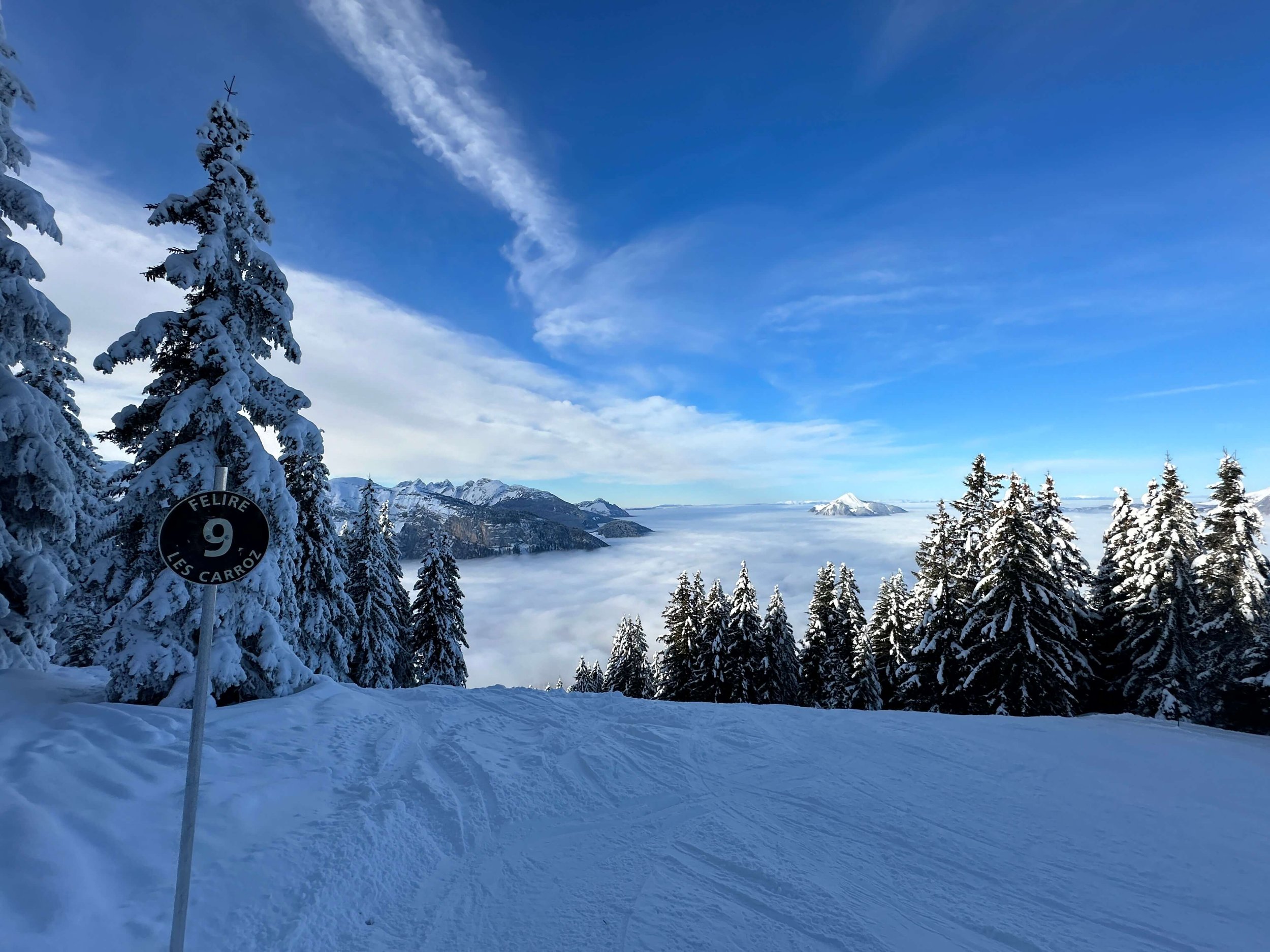


Les Carroz ski resort is relatively small with 37km of local pistes however this stat doesn’t do it justice. There is plenty of fun to be found away from the piste, through the trees and in the off-piste near Corbalanche and the Tete de Saix. As a small resort, Les Carroz benefits from being part of the wider Grand Massif ski area but equally stands alone as a resort that offers a good all-round package. Les Carroz boasts a pretty awesome terrain park and boarder cross track, as well as a couple of challenging black pistes.
READ THE FULL LES CARROZ SKI RESORT GUIDE HERE
SAMOËNS
If you are looking for a slightly different ski holiday base, then Samoëns certainly offers you an alternative to purpose-built on-mountain accommodations. The beautiful village at the base of the Grand Massif Express gondola has a quaint town centre which hosts nice restaurants, ample shopping and entertainment for the children. The village of Samoëns is amongst my favourite bases for any ski holiday.

The resort itself is found above the village and is accessed via either the Grand Massif Express or Vercland gondolas. Samoëns ski resort is possibly the most versatile ski area in the Grand Massif. Ranging from one of the largest beginner areas in the French Alps to challenging off-piste skiing and snowboarding. Beginners will find everything they need in Samoëns with a steady progression of runs serviced by magic carpets and chairlifts, although this area can become a bottleneck for crowds in peak weeks.

Intermediates will love the Coulouvrier chairlift, a high-speed chair currently the longest in Europe at 2.9km, which accesses blue and red runs that pass through a natural bowl. Additionally, the run down to the old Vercland bubble gives ample opportunity for stretching those legs.
Advanced skiers and snowboarders will want to make a b-line for the Chariande Express chairlift before the crowds and move away from the resort base. From here they will have the option to drop into an unpisted bowl or head over to the Tête de Saix.
READ THE FULL SAMOËNS SKI RESORT GUIDE HERE
MORILLON
With one of the lowest altitudes out of the Grand Massif resorts at 1100m you could be forgiven for ignoring Morillon, this would be a mistake. The local area has 45km of trails which are home to some of the best cruisey pistes in the entire Grand Massif.
Beginners and intermediates will enjoy the wide pistes in Morillon with the 7km Marvel Slope a particular highlight. Winding its way through the trees Marvel Slope is a great place to spark that excitement in young skiers. In Morillon, you can ride down to the village which is a fantastic way to end your day on snow.
Unfortunately, the lower terrain in Morillon is rarely in action these days with the lower reaches of Morillon struggling with little snow below 1100m. Luckily the 650m of vertical drop between the top of Sairon chair and the gondolas mid-station. offers some fantastic terrain.
I have spent multiple weeks based in the village of Morillon and am fond of it. Morillon is a quieter base for your Grand Massif ski holiday, but with easy access to Les Carroz and Samoëns in addition to the local area, Morillon can be a great budget base for your Grand Massif trip.
READ THE FULL MORILLON SKI RESORT GUIDE HERE
SIXT
Sixt is a ski resort set amongst a nature reserve that is unspoilt by the modern world and mega-resorts that sit around it. The finishing point for the incredible 14km Cascades piste that starts with views of Mont Blanc before ending in this beautiful French village. Sixt is a resort of culture and heritage. You head to Sixt to step away from the crowds and take in the surroundings. At only 765m snow can be sketchy towards the end of the season however the Rouget waterfalls will be a draw.
Sadly skiing and snowboarding in Sixt fer a Cheval is becoming a thing of the past. Last winter (23/24) I don’t recall the ski area in Sixt being open at all and the Cascades trail from Flaine was also noticeably absent. If you are staying in Sixt don’t fret as you have free shuttle buses linking the village to Samoëns and Morillon where you can access the Grand Massif ski area.
SEASON DATES
The season in the Grand Massif runs between December and April. Although all resorts will have good snow throughout the season Flaine will have the best conditions in early and late season. Sixt can suffer from poor snow towards the end of the season, due to its altitude at 750m, but this makes it an affordable base with free buses connecting you to other resorts.
GRAND MASSIF PISTE MAP

Grand Massif Piste Map
TRAVEL AROUND THE GRAND MASSIF
With 265kms of terrain it can be easy to feel overwhelmed with the decisions of where to ski each day. However, with the Grand Massif being so well connected, it is fairly easy to ski across all of the resorts in one ski day. Travelling between the ski resorts of Flaine, Morillon, Les Carroz, Samoëns and Sixt Fer a Cheval is possible via the connecting lifts or in some cases free shuttle buses.
GRAND MASSIF CHAIRLIFTS
The main way to move between the resorts of the Grand Massif is to use the linked chair lifts. The links are fast chairs and allow for large amounts of people to move between the resorts fairly easily. Just be sure to keep an eye on the times that each link will close so as not to get stuck in the wrong resort. Sometimes the linked chairlifts close due to high wind, this was rare during my visits but was communicated brilliantly by staff at each chair.
The Tete de Saix is the main crossroads of the Grand Massif with the following lifts all meeting on or close to the Tete de Saix; Coulouvrier (Morillon), Chariande Express (Samoëns), Tete de Saix (Les Carroz) and Corbalance (Les Carroz). From here it is easy to ski directly into the aforementioned resorts or head to the Vernant chair which accesses Flaine.
GRAND MASSIF BUS ROUTES
Included with your Grand Massif lift pass is free access to the inter-resort shuttle buses. The routes are colour-coded so it’s fairly simple to navigate. Although there is a timetable for the buses, they are not always regular so be sure to plan.
Sixt, Morillon and Samoëns are linked by bus with a few different routes heading to the varying lift stations. If you are based in Sixt and do not have access to a car it is likely you will need to rely on the bus service to move between the resorts. Skiing between Samoëns and Morillon is simple but the buses are there as another option if needed.
Flaine has local buses that run around its village dropping skiers and snowboarders back to their accommodation. From Flaine, you can take a bus to Les Carroz however it is most likely you will choose to ski this route instead.
DRIVING
Driving is an option I would certainly consider if returning to the Grand Massif. Samoëns offered free parking in the base area of the Grand Massif Express and this might make other aspects of a self-catering trip more practical. Similarly, there is free parking at Morillon gondola and various lifts in Les Carroz. It is worth noting that Flaine is a car-free resort so bare this in mind.
TRAVEL TO THE GRAND MASSIF
When visiting the Grand Massif I have always booked a transfer from Geneva Airport. This method of getting to the Grand Massif has always seemed the most simple and I have never felt like I needed a car. Companies like Go Massif and Alpin Bus offer regular transfers from Geneva Airport.
To check transfer prices you can search for the best deals below.
GRAND MASSIF ACCOMMODATION
Being such a varied combination of ski areas the Grand Massif can offer accommodation to suit all budgets and tastes. On the top end of the scale is the Club Med in Samoëns, offering an all-inclusive option with ski in ski out location that would be perfect for families. The upmarket village of Les Carroz offers some plush accommodation options but if you have a lower budget don’t be put off. I stayed in a budget apartment in Les Carroz and found it a perfect base from which to enjoy the Grand Massif. Similarly, I found a budget apartment in Samoëns for a New Year trip in a location adjacent to the Grand Massif Express. As with most French ski areas, there is the option for an apartment on the slopes with Samoëns 1600 and Flaine being great options.
GRAND MASSIF PROS
Grand Massif Season Pass costs only €489 if purchased before mid-December.
The Grand Massif offers 265km of pistes on one lift pass.
The Grand Massif has a variety of ski areas with each resort offering something different.
Snowsure skiing in Flaine until late April makes a Grand Massif ski trip reliable.
The villages of the Grand Massif offer a short transfer time from Geneva Airport.
GRAND MASSIF CONS
Samoëns base area can get crowded during peak weeks.
High winds can close the linked chairlifts between different resorts.
GRAND MASSIF GALLERY





FINAL THOUGHTS
I am incredibly fond of my visits to the Grand Massif which have offered an expanse of skiable terrain at a reasonable price, especially for France. During my rips I have experienced the best and worst of the possible snow conditions however I have always found a way to get some enjoyable skiing in. The Grand Massif should be on your bucket list if you are looking for a multi-resort ski area with some brilliant terrain and something for the whole family.
DISCOVER GRAND MASSIF
https://www.grand-massif.com/en/
GRAND MASSIF VIDEOS
RELATED POSTS



Off-Piste Etiquette: Where Is The Boundary?
Whether you love fresh corduroy in the morning or a park lap in the sun, there is one thing that unites all skiers and snowboarders… a powder day! Waking up in the morning to a fresh cover of snow is why so many people work minimum wage resort jobs but when the pistes are tracked out where we go next is often heated debate. Having snowboarded across the continents this is our take on where the boundaries lie.
ARGENTINA
The mountain environment in Argentina is pretty special. The Andes offer towering peaks and pretty harsh weather systems. These weather systems bring plenty of snow but also incredibly high-speed winds that can make the snowpack variable. At Cerro Catedral the freeriding opportunities were incredible and I have heard the same for many other South American resorts.
Cerro Catedrall offers the opportunity for easy access backcountry into La Laguna area and there is no boundary rope showing the laid-back attitude of the South American ski patrols. The Nubes area would close when the lift could not run due to high winds, but there was no barrier to those who would take the hike to the top. This means backcountry at Cerro Catedral and other South American ski resorts should not be taken lightly and you really should operate with caution and knowledge. With the lack of closures at Cerro Catedral, we often found ourselves asking questions and even walking away from a run after reaching the summit of a hike.

JAPAN
If there is one place in the world I had always wanted to experience snowboarding it was Japan. An absolute mecca for skiers and snowboarders, the amount of snow that Japanese resorts receive in a season shouldn’t be legal! With such regular snowfall, heading off-piste or into the backcountry needn't be high on your priority list, that is until you realize just how good tree riding is here in Japan.
Attitudes to off-piste in Japan are completely juxtaposed to what we Europeans are used to. For starters, some Japanese skiers and riders believe that the trees are home to spirits and it was believed these should be disturbed. This attitude resulted in many Japanese ski resorts roping off their tree runs and designating them as out of bounds.
Now I don’t know about you, but if I see an area of widely spaced trees with a carpet of fresh snow that is exactly where I want to be. Fortunately, Japanese ski resorts are starting to open these areas to budding powder hunters, although you may need to take a course to enter.
In Hakuba, these resorts offered off-piste skiing under the following conditions
Hakuba Cortina - No restrictions
Tsugaike Kogen - On completion of DBD course and only in gated areas
Hakuba Iwatake - In gated areas only
Hakuba 47 - On completion of the course and only in gated areas
Norikura Onsen - No Restrictions
Hakuba Goryu - Adventure course only
At least the few resorts not currently opening off-piste terrain to the public are blessed with an incredible snow record. That being said, with the number of Western tourists visiting Japan each year, it can’t be long before these resorts get with the times… Can it?
IF YOU FIND VALUE IN THIS POST CONSIDER CLICKING THE BUYMEACOFFEE LINK BELOW TO SUPPORT MY CONTENT.
NORTH AMERICA
North America is home to some great off-piste resorts with Canada’s powder triangle and America’s West Coast Resorts getting pounded with fresh powder. North American resorts tend to have groomed and ungroomed terrain. In effect, from a European perspective, I would not class it as off-piste.
You can feel pretty safe at all times in the knowledge that even the ungroomed terrain is patrolled, although be aware accidents do happen and it is again down to you to use your best judgment. It is pretty clear within both US and Canadian ski resorts that a rope means DO NOT CROSS and you do so risking not only your life but your lift privileges.
Ropes tend to mean that patrol is currently managing terrain and crossing could put you in range of dynamite, not something I’d advise. Resorts in Canada are starting to introduce gated areas, for example, Sunshine Village has Delerium Dive, but these are still the minority. If you want the true backcountry experience in North America you will have to leave the resort boundaries completely. Outside of the resort’s boundaries, you are in charge of your safety and there isn’t anybody coming to help you if things go array, not without paying huge fees anyway.
EUROPE
Oh Europe, the land of you can ski where you want but if you die don’t look at us culture. Europe pretty much offers freeriders exactly that, the freedom to ride. Do not get me wrong, in Europe, you will find ropes and closure signs however you have the freedom to cross them at your own risk.
Resorts like Verbier offer runs classed as Itineraries which are within the resort’s boundaries but are unmanaged. Normally a row of yellow poles will mark the route down an itinerary run but besides that, you are free to ride wherever you see a fresh turn.
WHY IS IT SO DIFFERENT IN EUROPE?
Well, I think it comes down to two main cultural aspects. Firstly from my experience, in Europe people are more likely to ski with an instructor or guide than in North America. This means Europeans are happy to hire an expert to make safety decisions for them.
Secondly, and linked to point one, by having a culture of hiring ski/snowboard instructors or guides Europeans also promote a culture of learning. This education culture promotes a strong sense of mountain etiquette and understanding of the risks which is not always prevalent when these decisions are made for you by ski patrol.
For this reason, I would urge caution when riding off-piste or backcountry routes in Europe. It is not uncommon to find a crevasse or other unmarked hazards between pistes so what could you find in the backcountry?

NEW ZEALAND
Similarly to North American resorts, in New Zealand, the Ski Patrol will let you know where the boundary is. Any area outside of the pisted terrain tends to be roped off but with gated access. The main difference I found when riding in New Zealand as compared to Canada was that at the gate you would occasionally find a patroller to give you a heads-up on the conditions. Mt Hutt, in particular, was great for this, with a Patroller normally sitting at the entrance to the lower towers informing people about the traverse. In the absence of a patroller, there would normally be a sign giving a rundown of recent conditions.
Leaving the resort boundary in New Zealand is similar to the European attitude… here is the information you need to know, now go and make smart decisions. If you choose to leave the resort boundary you are no longer covered by the protection of ski patrol. New Zealand resorts are small and with this in mind, you may want to explore outside the boundary lines. Outside of the resort’s boundaries terrain isn’t managed for avalanche danger (unless it could cause havoc on the access roads) so be sure to have the correct equipment and ride with a friend.
AUSTRALIA
Ok honestly, Australia is not being added to this list as a joke. Having spent time working Australian winters I know first-hand that Australian snowboarding can be really good. Although resorts are heavily reliant on snowmaking that does not mean there is no backcountry scene. Within the resorts, Australia is similar in approach to New Zealand and Europe. If you step out of the resort’s boundaries you do so at your own risk. Sometimes the best snow can be found outside of the resort’s boundary due to the high wind found at Australian resorts. This wind often blows snow, natural/man-made, out of bounds and into some pretty interesting gullies.
Check out the video below for some insight into Australian backcountry snowboarding.
CHINA
Heading out of bounds directly from the ski resort in China is a big no-no and not actually that exciting. With resorts tending to be purpose-built and with much focus on the inbounds experience, off-piste in China isn’t really a thing. There will be ropes and fences that are possible to cross in the resort, but the risk of losing your pass is rarely worth the rewards as runs are pretty short.
If you are heading to China instead opt for a backcountry tour. The mountains in China can rival anywhere in the world for terrain and the backcountry should be at the top of most people’s lists when visiting. Consider the Altai Mountains which border Mongolia offering some incredible peaks. Our advice is to travel with a guide, as amazing a country as China is, there are plenty of ways you can overstep the line and end up in trouble. Having a guide will help you stay safe both on snow and culturally.

FINAL THOUGHTS
Wherever your travels take you this year if you plan to venture off the groomers be sure to know the local attitudes. By understanding the local’s approach to backcountry you will be in a better place to make decisions that will keep you safe, but also on the right side of ski patrol. Knowing the local culture can inform your decisions with regard to the amount of support you will receive if you run into trouble. If you are heading through the gate and out of bounds, stay safe and ride with a friend.

Samoëns Ski Resort Guide | Grand Massif
Samoëns offers two bases, the traditional village with its cobbled streets and historic town square and the satellite village of Samoëns 1600 where ski-in-ski-out accommodation provides direct access to the Grand Massifs 265km of pistes. Samoëns is a fantastic base to the wider Grand Massif but equally remains a stand-alone ski resort with plenty to offer.
Samoëns 1600m
SAMOËNS FIRST IMPRESSIONS
Arriving in the town of Samoëns has a different feel to most European ski areas. The old village sits at the base of the Grand Massif Express, a gondola that rises 900m to the ski area. From the gondola top station, a quick run takes you to the Chariande Express where you can access the rest of the extended ski area.
SAMOËNS SKI AREA
Samoëns is perfectly placed to access the slopes of the Grand Massif resorts of Flaine, Morillon and Les Carroz by chairlift or the village of Sixt by bus. If you do not want to venture too far then Samoëns has enough to keep most of the family entertained.
The beginner’s area in Samoëns is first class and would make a perfect base for learning, although during peak weeks it can suffer from overcrowding. There is a magic carpet, some surface lifts, and a friendly chairlift, after graduating from this area you should be able to handle everything the mountain has to offer. The ski schools will meet in Samoëns 1600 by the gondola or entrance to Club Med.
Those looking to explore further will not be disappointed with Samoëns, there are many interesting steeps and off-piste routes that lead back to the Chariande Express Chair. Some great skiing can also be found near the Coulouvrier chair with some interesting blue and red-grade slopes.
After fresh snow, most will head to the Tete de Saix and the links over to Flaine, where you will find some awesome powder lines and tree skiing. Many neglect the long run down from Samoëns to Vercland, which can have great conditions after fresh snow. Sadly snow to Verclands base area can be unreliable.
Samoëns ski area can be prone to high wind causing the links over to Flaine, Les Carroz and Morillon to shut down. If this happens skiing in Samoëns can be great for bad weather days with ample cover in the bowl and between the trees. If you still plan to ski another Grand Massif resort on a bad weather day this is possible via the local free bus service.
BEGINNERS TERRAIN SAMOËNS
The beginner’s area in Samoëns is amongst the best in the Grand Massif. What I like about the beginner’s area is there is a perfect progression in terms of lifts. Beginners can start worry-free on the Magic Carpets before moving onto a slow drag lift and then the two slow beginners chairlifts which all access green runs.
INTERMEDIATES TERRAIN SAMOËNS
The intermediate terrain in Samoëns offers a perfect blend of challenge and enjoyment for skiers and snowboarders looking to progress their skills. With its wide array of groomed blue and red runs, this picturesque ski area caters well for intermediates. Intermediate skiers and snowboarders will also benefit from the links to nearby resorts like Morillon and Les Carroz which have beautiful blue cruisers.
Samoëns Grand Massif
ADVANCED TERRAIN SAMOËNS
Advanced skiers and snowboarders will need to enjoy heading away from the piste to make the most of skiing in Samoëns. Yes Aigle Noir can claim to be amongst the most challenging black pistes in the Grand Massif but there is little else on the piste map.
Where Samoëns comes into its own is the slackcountry areas between the pistes which can be exceptional after fresh snowfall. Samoëns is great for catching snow that gets blown into its large bowl. and this makes it a really fun resort to hit when the conditions are good.
WHERE TO SKI IN SAMOËNS DURING A STORM
Sadly in Samoëns there is little cover from bad weather when conditions turn to their worst. Luckily nearby Morillon and Les Carroz ski resorts have some fantastic terrain which is lined by trees which gives good context in bad weather.
ACCESSING THE GRAND MASSIF
From Samoëns it is easy to transition between the other Grand Massif resorts allowing you to make the most of the whole ski area. From Samoëns take the the Chariande Express or Coulovrier chairs which will take you to the Tete de Saix, the crossroads of the Grand Massif. For Flaine, head to Verdant chair, alternatively you can ski directly into Morillon and Les Carroz from this point.
Coulovrier Chair above Samoëns
FREESTYLE SAMOËNS
In terms of freestyle, you have a couple of options in the Grand Massif. Flaine has a terrain park and border cross tracks that wind down skiers left of the bowl as you head towards the village. In Les Carroz there is a small park that is serviced by a poma, the layout of this park didn’t allow for good flow between jumps and rails but had some of the best features.
SAMOËNS SNOW HISTORY
Samoëns has a pretty reliable snow history however it is worth noting that over the last few seasons, the lower reaches of the resort towards the Vercland gondola have suffered with a lack of snow. In general, throughout the past winter the majority of Samoëns and the further Grand Massif had exceptional snowfall and it’s fair to say that you will get decent snowfall when you are in the higher reaches of the resort.
RELATED VIDEOS
SAMOËNS LIFTS
Samoëns has 3 major lifts, the Grand Massif Express and Vercland gondolas which whisk skiers up to the main area of Samoëns 1600 and the Chariande Express which departs 1600m and arrives at the Tete de Saix. There are two additional quad chairs in the beginner’s bowl and the addition of some surface lifts and magic carpets.
Skiers in Samoëns also have good access to the Coulouvrier chairlift, Europes longest, when it is in service. Sadly the Chariande 2 lift that used to run from the main bowl alongside the Chariande Express is no longer in service. I made the video below to discuss the reasons for this.
SEASON DATES
The season in Samoèns runs from early December to the end of April with closing normally around the 20th April. The resort has invested heavily in snow making to ensure they are able to maintain great conditions in both the early and late season.
SAMOËNS PISTE MAP
Grand Massif Piste Map
To see the interactive piste map click here
GETTING TO SAMOËNS
Getting to Samoëns is pain-free with Geneva airport around an hour away. I’ve always taken a resort transfer directly into my Grand Massif accommodation which has always been smooth. Although driving is possible I have always favoured transfer to these resorts
TRANSFER COMPANIES
Most of my transfers to Samoëns have been with GO MASSIF. Go Massif have been fantastic for shared transfers between Geneva and the Grand Massif and having used their service multiple times I would recommend them.
Alpin Bus are a company that I have used for private transfers between Geneva Airport and the Grand Massif. The communication throughout has been fantastic and service came in cheaper than Go Massif for the private option.
FIND YOUR TRANSFER
SELF-DRIVE
If you would prefer to self-drive there are numerous counters available at Geneva Airport where car-rental is possible. From Geneva, you can expect to drive for 1-1.5 hours depending on conditions. Other nearby airports; Chambéry and Lyon, also offer short drive times of 2 hours and 2.5 hours respectively. Driving to Flaine from Geneva represents one of the shortest ski resort transfers in the Alps.
TRAVEL AROUND THE GRAND MASSIF
The Grand Massif is a large area but luckily access between the resorts is fairly simple. From Samoèns you are perfectly placed to explore the other resorts.
SAMOËNS TO FLAINE
From Samoèns you will want to take the Chariande Express chair. Here you can either drop off into the off-piste near the Corbalanche Chair then head towards Vernant's chair. If you would prefer to stick to the pistes then Silice (blue) will take you to Dolomie (blue) which will lead you to Vernant. From the top of Vernant take Tourmaline (blue) all the way into Flaine.
SAMOËNS TO MORILLON
The fastest route via the pistes to Morillon is via the Chariande Express chair from Samoëns. Take the Perce-Neige (blue) until you reach L’Arète (blue) which will lead you to Morillon. Alternatively, you can utilise the free shuttle bus services which run between Samoëns and Morillon ski resorts.
SAMOËNS TO LES CARROZ
There are a number of routes between Samoëns and Les Carroz. Perhaps the most direct for beginners and intermediates is to take the Chariande Express chair from Samoèns and follow Silice (blue and then Dolomie (blue) which will lead you to Portet (blue). This run gets fairly flat around the end of Dolomie so you can often see some people pushing or walking this route. If you can maintain your speed you should be fine.
The more advanced can take the Chamois red piste from the Tete de Saix which runs towards Marmotte and Les Molliets chair. From Les Molliets you can either return to the Tete de Saix via the chair of the same name or take Les Molliets to head towards Gron or the Keuduze gondola and Les Carroz village.
SAMOËNS ACCOMMODATION


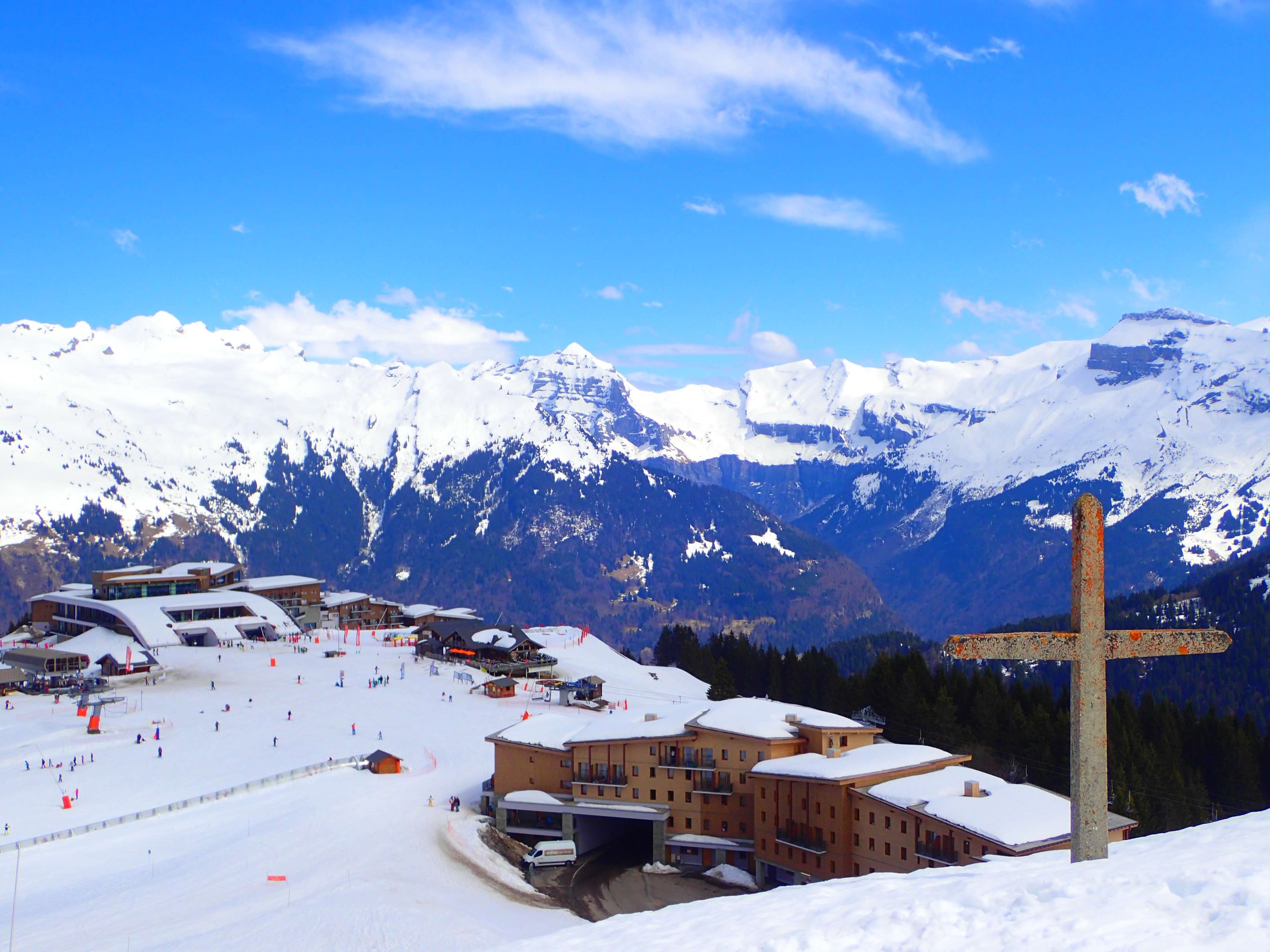
Staying in the village of Samoëns is a great base with plenty of restaurants, bars and shops within easy walking distance of your accommodation. It is worth noting that the village is a short walk or shuttle bus ride from the Grand Massif Express Gondola so you will need to factor this into your morning routine.
If you prefer on-slope accommodation there are several places to stay at Samoëns 1600 although you will miss out on the village vibe. Samoëns 1600 is also the base for a large Club Med hotel with all-inclusive facilities including a ski school. This would make a good base for families heading to the Grand Massif.
SAMOËNS LIFT PASS
Lift passes in Samoëns represent exceptional value. If you think you will ski more than one week in a season then consider getting the Grand Massif season pass, if purchased online before 30th November you save 50% meaning a whole season of skiing for €552. You can even add summer access so you have access to all the summer hiking and mountain biking.
If you are only visiting for one week then you can see all the options for lift passes here. I would always recommend getting the Grand Massif pass rather than the local area pass as it represents better value.
SAMOËNS PROS
Samoëns has direct access to the rest of the Grand Massif from the Chariande Express.
There is a brilliant beginner’s area in Samoëns that makes it the perfect base for never-evers.
Samoëns has a good mix of terrain in the local area making it a great base for mixed ability groups.
Aigle Noir black run is genuinely intense and for able skiers and snowboarders can represent a fantastic challenge.
SAMOËNS CONS
Crowding in Samoëns has become a problem during peak weeks since the closure of the Chariande 2 chairlift.
If you are staying in the village you will need to take a shuttle bus to the Grand Massif Express. Because of the bus timetable, it is hard to get to the GME before there is a queue during peak weeks.
Restaurants in the Samoëns ski area seem to charge more than in other Grand Massif resorts.
SAMOËNS GALLERY


NEARBY SKI RESORTS

FINAL THOUGHTS
Samoëns has been one of my favourite ski areas in France for years, I love it for the traditional village and the access it has to the rest of the Grand Massif. However, since the Chariande 2 lift has been out of action, Samoëns has had a problem, crowding during peak weeks. If you are visiting Samoëns outside of the main holiday weeks, I guarantee you will have a fantastic time! During peak periods, you may suffer from morning queues at the Grand Massif Express and Chariande Express chairlifts.
DISCOVER SAMOËNS
www.samoens.com
AROUND THE GRAND MASSIF

Australasia Snowboard Guide
Australia and New Zealand offer some great opportunities for summer snowboard trips. Australia is becoming more accessible and affordable, especially to Epic Pass holders with world-class facilities included on your unlimited lift pass. Perisher and Thredbo are the big names in Australia but there is plenty to explore at; Mt Hotham, Falls Creek, Mt Buller and Charlottes Pass.
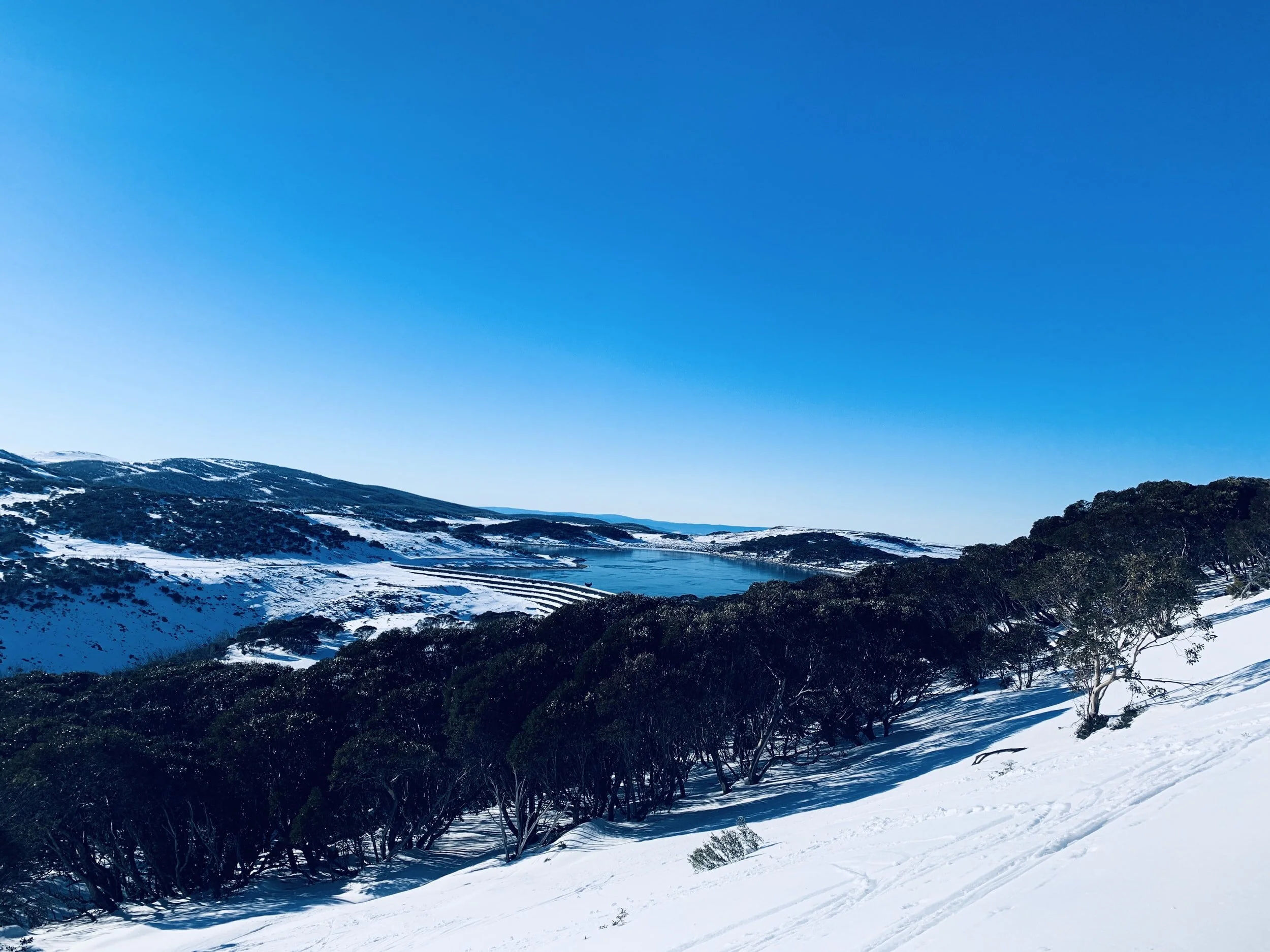
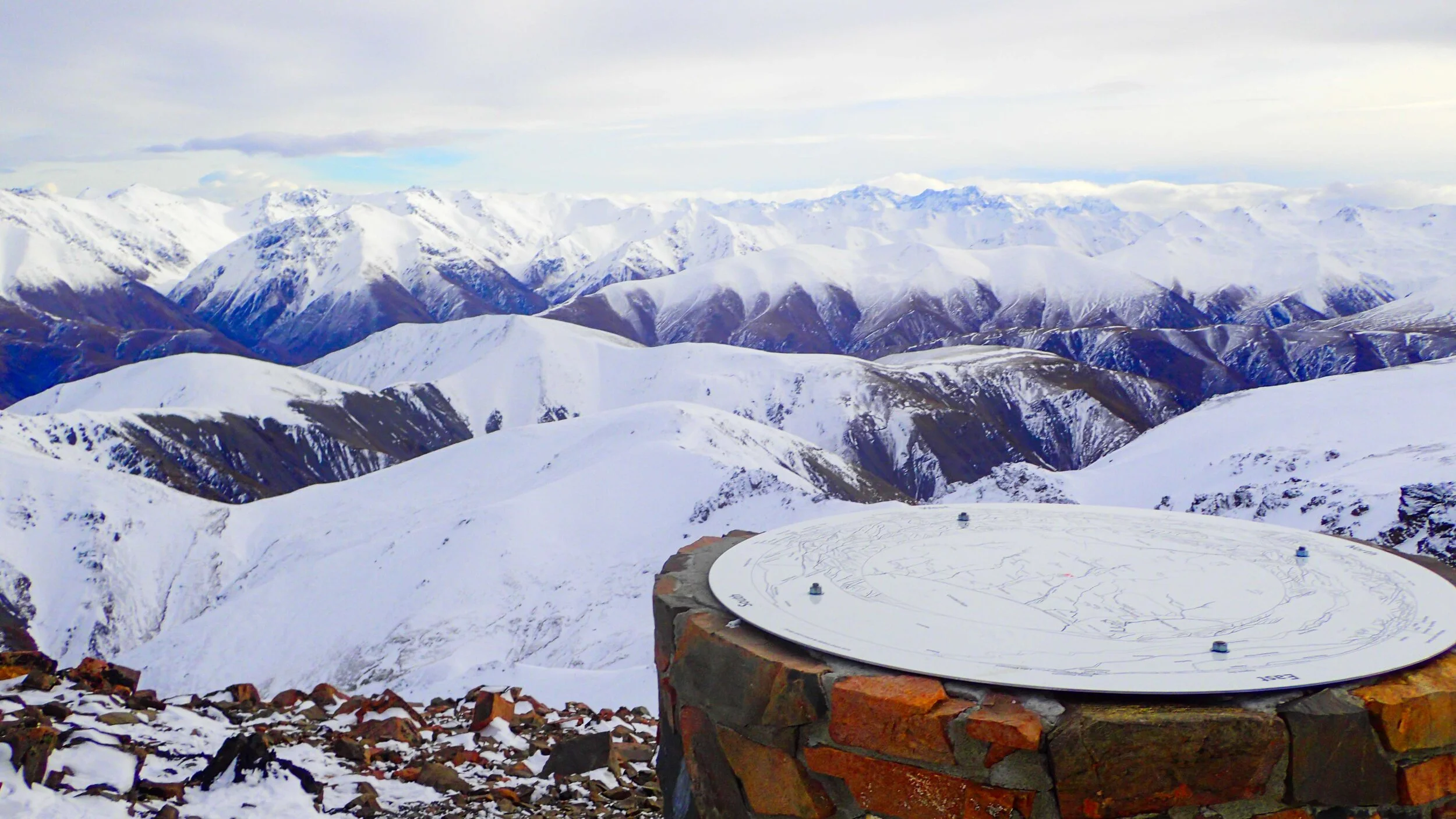
New Zealand offers a fantastic variety from the locals club fields at Mt Cheeseman or Mount Olympus to the world-renowned Cardrona and The Remarkables. Snowboard trips to New Zealand are perfect for road-tripping and following snow conditions. New Zealand is more affordable than its neighbour with early bird season passes for the NZSki Resorts of; Coronet Peak, Mt Hutt and The Remarkables costing less than 700NZD
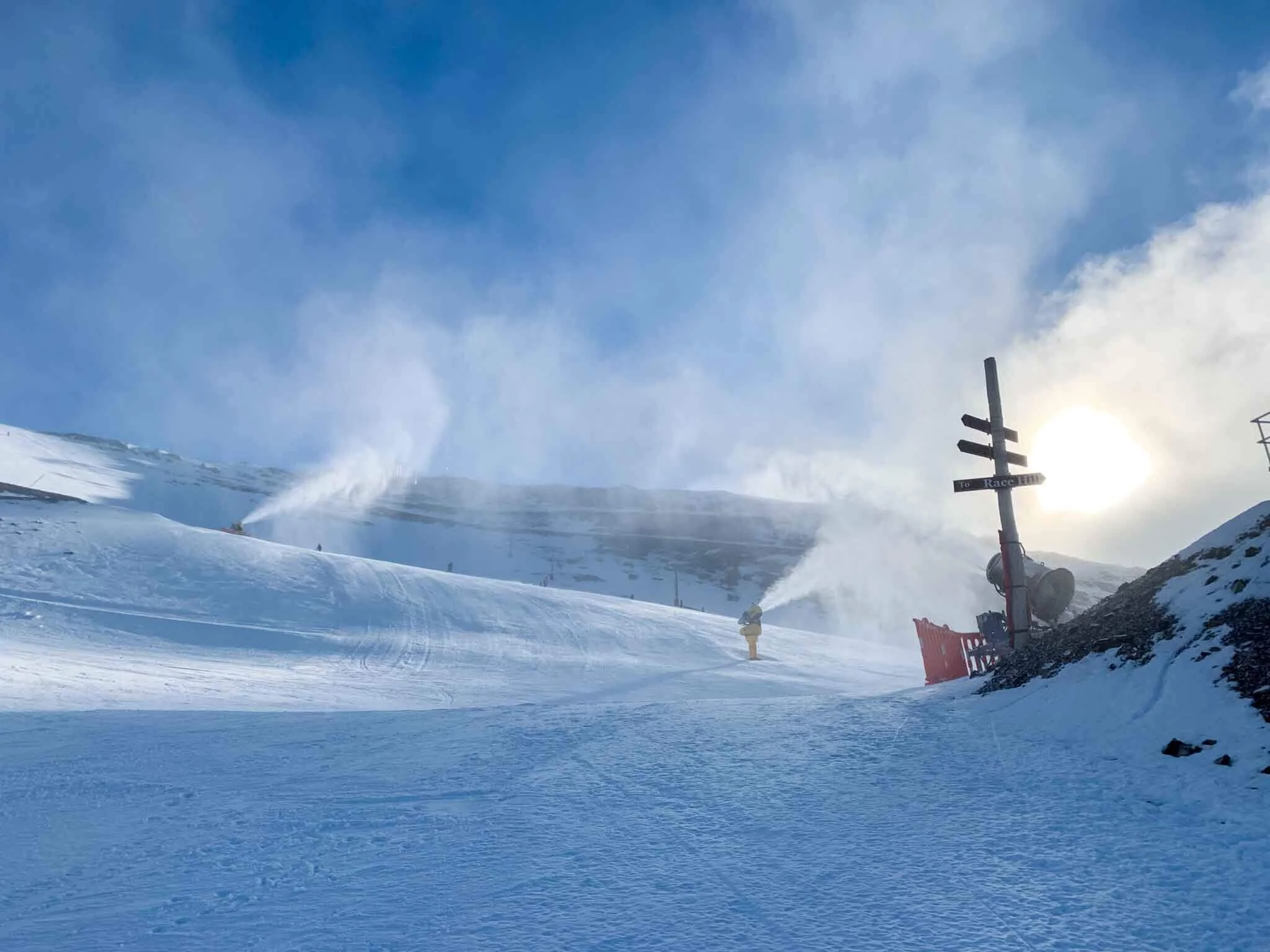
Australia is best known for its incredible terrain parks with resorts making the most of the man-made snow to shape some of the world’s best features. From the huge kickers at Thredbo to the half-pipe at Perishers Front Valley, Australia brings its park game. With lower vertical drops than most Northern Hemisphere ski areas, Australian resorts are fantastic at using what they have. Overall, facilities in Australia are great with modern lifts and huge investments made in snow-making. You will find resort accommodation with quick access to the snow, although be prepared to pay a premium.
New Zealand has a more traditional laid-back feel than Australia with a large number of smaller local run ski areas known as the Club Fields. In the clubbies, you will sacrifice modern facilities but not your soul with a number of ‘nut-crackers’ or rope tows to access the slopes. The most famous club fields are; Mt Dobson, Mt Cheeseman, Ohau and Broken River but many more exist. Away from the clubbies New Zealand also offers snowboarding at its world-class ski resorts; Cardrona, Coronet Peak, The Remarkables, Mt Hutt, Mount Ruapehu, and Treble Cone. Queenstown is a great base for a New Zealand snowboard trip with both The Remarkables and Coronet Peak accessible from the town. From Queenstown, you can also access Cardrona and Treble Cone by bus but access is easier from Wanaka. Further north the town of Methven in Canterbury will give the best access to Mt Hutt (regularly named New Zealand’s best ski resort). On the North Island, Mount Ruapehu and the resorts of Whakapapa and Turoa will be the main attractions.
EXPLORE BY COUNTRY

MULTI RESORT LIFT PASSES
AUSTRALIA
Perisher has been included on the Epic Pass for several years now, but recently Falls Creek and Mt Hotham have been included. This means it is possible to snowboard all summer on your Epic pass and make the most out of your winter. Thredbo is included on the Ikon but doesn’t have an unlimited option.
NEW ZEALAND
The best value pass in New Zealand is the NZSki Pass which covers unlimited snowboarding at Coronet Peak, The Remarkables and Mt Hutt. Buy early to get your pass for under $700NZD and snowboard at all three resorts. The price for the 3 Peak Season Pass does go up towards the season start dates, but you can find the most up-to-date information here.
FREQUENTLY ASKED QUESTIONS
Where do you snowboard in Australia?
In Australia you can snowboard in the states of New South Wales and Victoria. NSW is home to the biggest name resorts of Thredbo and Perisher whereas Victoria hosts; Mt Buller, Falls Creek and Mount Hotham.
Does Australia have snowboarding?
Well this article would be pretty pointless if it didn’t. Australias resorts have world class facilities and can be a great way to get summer turns. Australia is particularly popular with freestyle snowboarders and there are a number of professional Australian snowboarders.
What is the best snow field in Australia?
This really comes down to personal preference and what you value the most for your snowboard trip. Thredbo offers the greatest vertical drop in Australia therefore having the longest runs whereas Perisher has terrain across four mountains. Places like Selwyn Snow Fields or Mount Baw Baw are great for beginners.
Is snowboarding in Australia any good?
Again, this will largely depend on what you value but for us at the Snowboard Union we have had a great time in Australia. Although snow conditions can be a bit lacking at times Australian ski resorts are great at making the most out of what they have.
What months does it snow in Australia?
The ski season in Australia is short with snowfall for around 3 months between late June - early September.
What is the best time to snowboard in New Zealand?
The New Zealand ski season is a bit more reliable than Australia with resorts opening mid-late June. The best conditions will be found in August with spring conditions heading into September. Snowboarding in New Zealand can be subject to regular chair closures due to high winds. Use this as an opportunity to explore the local areas.
What is the biggest ski resort in New Zealand?
Mt Ruapehu’s Whakapapa side is the largest New Zealand ski resort. Whakapapa is home to over 40km of pistes. Add to this the Turoa side and the North Island Resort is the largest.
Is snowboarding in New Zealand any good?
Hell Yes! New Zealand is one of our favourite snowboard destinations. From the easy hikes at Remarks to the night skiing at Coronet Peak New Zealand makes a great snowboard trip. There is enough terrain to challenge most at New Zealand resorts and plenty of resorts to make an awesome road trip!
RELATED POSTS




Borovets Ski Resort Guide
Borovets in the Rila mountain range is a family-focused ski resort that makes skiing affordable. With modern facilities including some resort-style luxury hotels within walking distance of the pistes, Borovets could be what you are looking for. There are plenty of reasons to visit Borovets with more terrain than rival Bansko, alongside night skiing and cross-country trails, Borovets packs a punch without needing to spend too many £££.

BOROVETS FIRST IMPRESSIONS
Arriving at Borovets my first impression was one of surprise. Honestly, before heading to Bulgaria I was probably a bit of a ski snob leading to French alps or nowhere kind of attitude. The facilities in Borovets were much better than anticipated and this is the trip that really opened my eyes to the rest of the worlds ski hills. When walking around the resort and looking at the Borovets hotels, you could see that everything was a good standard.
BOROVETS SKI AREA
Borovets has invested to improve its lift system and improve uphill times, although its gondola is still antiquated. This is a small compromise to make for access to the largest number of pistes in Bulgaria. Strangely Borovets is split between two distinct ski areas, the slopes near the Rila Hotel and the slopes by Yastrebetz Gondola. The highest point of the resort is reached via the gondola with pistes at 2550m that allow you to ski down to the base area at 1300m. Strangely the cross-country courses can be found at the top of the resort with trails to 2900m.
The beginner’s area is situated near Hotel Rila, and as such is also the base for the ski school. The slopes here are mellow and are surrounded by restaurants, bars and hotel facilities. As you progress you will head to the Sitnyakovo chairlift that offers a little more challenge. This area is quite small but is enough to get you started. The Sitnyakovo chairlift also remains open for night skiing throughout the season.
If you are looking to explore further then head to the Yastrebetz gondola. From here you will be able to explore two main sections, at the top Markudjik and lower down Yastrebetz. The Markudjik ski area has another small beginners area with mellow slope serviced by a magic carpet and poma. You can also access some blues and a short black that will take you to the gondola’s mid-station. The Yastrebetz area offers the most challenge with some decent red runs that offer some decent vertical drop. If you want to stay in this area it is easy to lap via the Yastrebetz Express, a high-speed quad that ensures you can continue to get plenty of laps.
There is little challenge in Borovets for advanced skiers or snowboards with less than 10% of the piste map dedicated to black runs. There is some off-piste but unless the conditions are prime it can be best avoided. Skiing in the trees can be a bit of a disappointment with some forestry needed to make them truly skiable.
The Borovets ski map below gives a good overview of the accessible terrain throughout the ski resort. The layout of Borovets ski resort can be tricky if your group has varying abilities as you may find yourself split between distinct areas.

Borovets Ski Resort Piste Map
SEASON DATES
The ski season in Borovets runs from December through to April although snow quality and coverage can suffer in early and late season. It is getting better with improvements to snow-making facilities. The lower slopes especially can suffer and late season operations are moved to the top of the gondola. You can check the Borovets weather by accessing the Borovets ski webcam which is a good way to check the slopes before leaving your hotel.
BOROVETS LIFT TICKETS
Further discounts are available on Borovets lift tickets with family passes available at 20% discount. To check the latest pass prices click here
Below are my ratings for Borovets ski resort. All categories are scored out of five with higher scores being better. The only exception is crowds, a higher score in this category means the resort is busier. These scores are based of my experiences in the resort and I’d love to hear your views and experiences in the comments.
TRAVEL TO BOROVETS
WHERE IS BOROVETS
Borovets ski area is the located in the Sofia Province in the Rila Mountain Range. Close to the Bulgarian capital, Sofia travel to Borovets is fairly straightforward.
GETTING TO BOROVETS
From the UK low-cost airlines fly fairly regularly into Sofia (don’t get done by baggage fees). Flights to Sofia are regular and affordable from UK airports. A Sofia to Borovets ski resort airport transfer is 1hr. Most people book their Bulgaria ski trip through a travel company that will be on hand to organise your transfer. You can also fly into Plovdiv but your transfer time will be longer.
Search for flights here
SELF DRIVE
If you do not have an organised transfer then self-drive is possible with hire cars available in the airport arrivals area.
Search Car Hire Here
TAXI TO BOROVETS
Taxi or private hire is also available from Sofia airport but be sure to pre-arrange this with an agreed price. On our trip we used Get Transfers to find the best priced airport transfer for our group. Search Below.
HOW LONG IS THE TRANSFER TO BOROVETS?
The transfer time between Sofia International Airport and Borovets is 1 hr by coach although during busier periods this can take longer.
BOROVETS ACCOMMODATION
Borovets ski resort offers a range of hotel and accommodation options. Most hotels in Borovets are well placed offering decent services with swimming pools and spas. The food at the hotels can be hit and miss but if you need to eat out there are plenty of options that won’t harm your budget. I stayed in Hotel Rila which is a large hotel directly opposite the main slopes.
You can find great deals on accommodation in Borovets with 5* hotels offering half board options for between £500-£600pp.
BOROVETS PROS
Borovets offers great value for money European skiing
Getting to the resort is easy with plenty of options from Sofia and a short transfer time.
The Rila mountains are stunning and Borovets offer some beautiful views
The ski school provides a good service at low prices (please tip your instructor)
Borovets has a lively nightlife
Borovets has more terrain than other Bulgarian ski resorts
Borovets hotels are well placed for the slopes
BOROVETS CONS
Limited off-piste available
Borovets ski area is small when compared to large French / Swiss resorts
The Borovets gondola to Yastrebets from the base is long and slow!
BOROVETS GALLERY


OTHER ACTIVITIES IN BOROVETS
Borovets can be more than the average ski holiday with plenty of activities to keep everyone occupied. Great for days you just fancy a rest or as an addition to your trip consider the following Borovets activities.
Spa Day
Nothing says relax more than a spa day. Perfect for skiers and snowboarders with tired legs there a plenty of options for spa days in Borovets. The appeal is obvious, being sat inside a warm sauna or jacuzzi whilst everyone else is out in the cold will make your friends jealous. In Borovets, most hotels have spa and pool facilities, with the larger hotels offering treatments. A massage in Borovets is likely to set you back around £30
Tobogganing
Always a hit with the kids tobogganing can make a great evening activity. Sledges are available from the local bars which can be a risky combination! This can be a perfect way to wear out the younger members of the group while you sit back and enjoy the views.
Hot Springs
Known for its thermal pools Bulgaria has plenty of hot springs. This is a great activity for soaking weary muscles and helping recovery for your next ski day. Visiting the hot springs is possible during the day or in the evening so you do not need to miss out on any slope time.
FREQUENTLY ASKED QUESTIONS
Is Borovets good for skiing?
Hopefully, I have already answered this question but just in case you need more convincing the answer is yes. Borovets offers good skiing and snowboarding at low prices. You will find 58km of pistes, which mostly suit intermediate skiers. You will not find lots of off-piste or steep runs in Borovets but the terrain will suit most people. If you are looking for more challenging terrain in Bulgaria than consider a trip to Bansko or if you are a beginner consider Pamporovo.
Which is better Bansko or Borovets?
This is ultimately down to opinion and will vary from person to person. For me, there isn’t too much difference in the actual skiing between Bansko and Borovets. Bansko does have a world cup run which offers more challenge than anything you will find at Borovets, but Borovets offers more terrain. Away from the slopes both Bansko and Borovets have a lively nightlife. I like that you can get away from this in Bansko with a trip to the old town, a Unesco heritage site. In the Old Town, you will find restaurants and bars that are quieter and set in a beautiful setting. The closer you get to the gondola in Bansko it gets more modern and more nightlife oriented. Borovets also has a good nightlife scene, but you will find the hotels in Borovets offer great entertainment for kids with games rooms etc.
Where to eat in Borovets?
Borovets has a number of restaurants conveniently placed near the base of the slopes. If you like Mexican food then check out Mamacita’s which has decent reviews. Most holidays in Borovets include half-board accommodation so if you want to stay in your hotel then food is already sorted.
FINAL THOUGHTS
Borovets is a resort that I am happy I visited. As a intermediate it was great for me and my friends who were learning to ski. The ski school did a great job and we all improved significantly. I visited as a student and the value could not be argued with. We had full board, including ski hire and lift passes for less than some French Alps 6 day lift passes. I would not recommend it for the more advanced skier or snowboarder as you may feel it lacks challenge.
DISCOVER BOROVETS

How To Make The Most Of Night Skiing
For a long time, Night Skiing had been near the top of my bucket list. Although I have been snowboarding for a while now, I had never made it to a resort that offered some after-hour laps! When looking to visit the Hakuba Valley in Japan it became evident that this was going to be my opportunity. With Night Skiing available at Happo One, Tsugaike Kogen and Hakuba Goryu I was spoilt for choice and was bound to make this finally happen. More recently I was able to back up that experience by night skiing at Coronet Peak in New Zealand. Both experiences were really cool and helped me to realise some key tips to make the most out of night skiing.
CHECK OUT THE VIDEOS BELOW FROM MY NIGHT SKIING EXPERIENCES
Considering Night Skiing? Take a look at my tips below
Wrap-Up Warm - It should go without saying but when the sun goes down it gets colder outside. Adding an extra warm layer will help you stay comfortable during your nighttime session, especially when sitting on those nighttime chair lift rides.

Lens Choice - Wearing goggles with a high VLT (visible light transmission) will really help clarity when night skiing. Try to avoid dark lenses or those designed for sunny conditions. A clear lens would be perfect but any storm lens should provide enough visibility.
Take It Easy - When the sun goes down the ground hardens up. It can be better to ride at lower speeds until you are familiar and confident with the conditions.
Focus On A skill - Depending on where you are night skiing you may have more options. At Happo we were limited to one slope which can make it quite a repetitive process. I chose to focus on a skill, this helped me to get the most out of being restricted to a small area and made the experience useful and enjoyable.
Get There Early - Most night skiing will open when the sun is still shining. This a great opportunity to get some laps in whilst the snow is still a little softer.
Pay Attention To Daytime Temps - If it has been warm during the day it is likely the top layer of snow will have melted and will refreeze as the sun goes down. This will make the surface for night skiing more prone to icy spots and you should ensure your board or ski’s have had a recent edge tune.

Check The Forecast - If there is a storm incoming, Night Skiing could just be your chance to get some fresh turns before everyone else in the morning. Night Skiing tends to be quieter so offers less competitions for those powder turns.
YOUR TURN
Are you a night skiing regular? Or is it something that is on your ski bucket list? Let me know below in the comments.

Snowboard Sidecut... What Is It? And How Does It Effect How The Snowboard Turns?
Probably one of the more confusing aspects when choosing a snowboard, sidecut will influence the shape and size of your turns. The sidecut is what you see when you look straight down the edge of your board. Essentially, your sidecut is a small cut out of a larger circle influencing the shape of your turn. A smaller sidecut will give you a tighter turn whereas a longer sidecut will offer long drawn-out carves.

WHAT IS A SNOWBOARD SIDECUT
The term sidecut refers to the shape of the edge of the snowboard, in other words, it’s the curvy bit on the side. The arc of the sidecut will vary between boards and will depend on the intended use. You will hear the terms sidecut and sidecut-radius used to describe the snowboard’s turn shape.
In straightforward terms the deeper or more obvious the sidecut the shorter the turn and the smaller the sidecut-radius. This means if you are looking for a snowboard that will turn quickly you should look for a board with a deeper sidecut, this would be useful in the terrain park as you initiate a spin of a kicker. Alternatively, if you are looking to perform longer arcing turns then a board with a more shallow sidecut would be better.
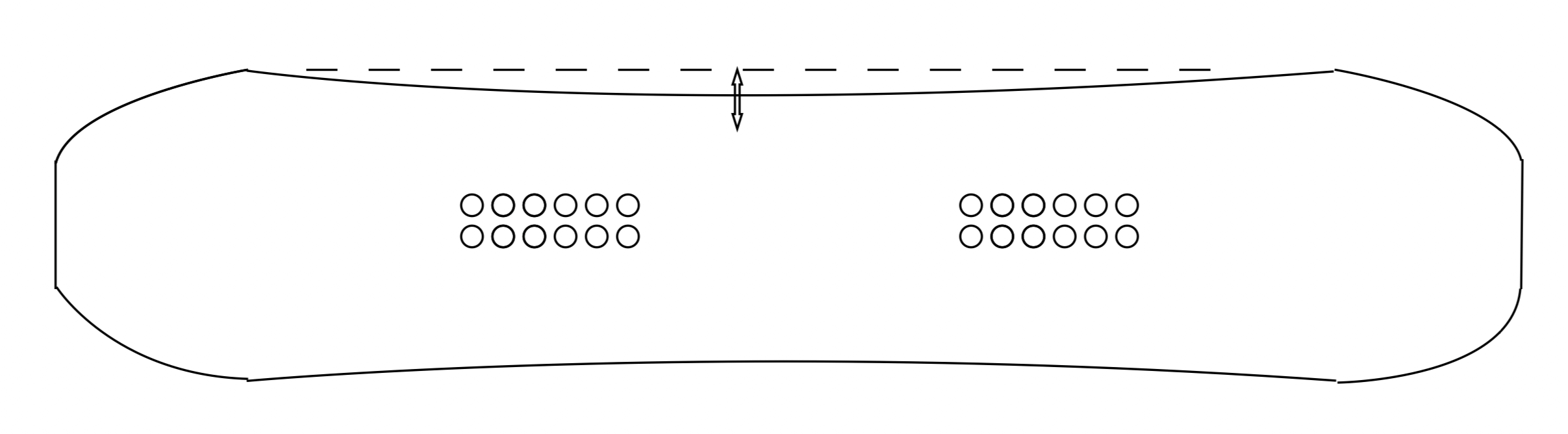

TYPES OF SNOWBOARD SIDECUT
To suit the variety of terrain that snowboarding has to offer there are also a number of sidecuts that will be suited for the purpose. Below is a generalized outline of the types of sidecut and their suited uses.
Radial Sidecut
Radial sidecut refers to boards that have a deeper sidecut for quicker and smaller turns. A radial sidecut will be very narrow at the waist of the snowboard ensuring a shorter turn radius. Radial sidecuts are often found on freeride boards that are designed for carving.
Progressive Sidecut
Progressive sidecuts use varying sidecuts along the length of the same board. The tip and tail may have a different sidecut to the middle of the board meaning that the board will act differently through the turn. This sort of sidecut can be used to help beginner riders when initiating a turn but ensuring the middle of the turn is longer.
Asymmetrical Snowboard Explained
Asymmetrical snowboards have a deeper heel sidecut than on the toeside. Heel turns are harder due to our bodies anatomy so an asymmetrical sidecut helps to even out this imbalance. Asymm boards allow for shorter heelside turns with minimal effort. Asymm sidecuts are found on a number of boards with all-mountain boards finding this sidecut increasingly popular.
Magna-Traction / UnderBite / Traction Tech
Brands use different terminology to explain this type of sidecut but essentially it is the same thing. A serrated edge that gives you more contact points on the snow. By introducing more contact points throughout the sidecut your board will have a better grip in icy snow conditions. Think of this sidecut as a bread knife with more contact points allowing you to slice through the snow more efficiently.
HOW DOES SIDECUT AFFECT YOUR RIDING STYLE?
Freestyle
Freestyle snowboards tend to have a shorter sidecut radius allowing the boards to turn quickly at slower speeds. Having a shorter sidecut on a freestyle snowboard will help initiate spins and allow quick changes of direction with greater manoeuvrability.
All Mountain
If you are looking for a snowboard that feels comfortable everywhere then consider a snowboard with a medium sidecut radius. A medium sidecut will be a middle ground between short sharp turns and long drawn out carves.
Freeride
Now, this is actually a tough one as it will depend on what type of freeride you like to do. If your only goal is carving on groomers than getting a snowboard with a sidecut of 8m + will suit you well. This larger sidecut radius will allow for mellow carves with a longer turning radius. That’s all well and good for a nice wide piste but if you want to have fun in some tight trees then you may want to size down that sidecut radius.
FINAL THOUGHTS ON SNOWBOARD SIDECUTS
Essentially, although sidecut might not be the first thing you look at whilst choosing your snowboard it will have a large impact on how your snowboard rides, specifically in carving and your ability to quickly go edge to edge. Choosing the right snowboard sidecut for you will ensure you have the best day on the mountain. Hopefully, that is the snowboard sidecut radius explained, however, if you have any questions make sure to drop them in the comments below. Make sure to check out the Snowboard Buyers Guide where you will find all the information regarding how to buy a snowboard.

Norikura Onsen Ski Resort Guide
Norikura or Norikura Onsen Ski Resort is one of the ten resorts included on the Hakuba Valley ski pass. Much less westernised than other ski resorts in the valley, Norikura feels a world away from Hakuba Village. You will not find any large chain rental shops or bustling restaurants at Norikura but you will discover an authentic Japanese skiing experience. Much quieter than the resorts of Happo or Goryu, it can feel like you have the resort to yourself which is always an incredible feeling.
HAKUBA NORIKURA ONSEN FIRST IMPRESSIONS
Arriving at Norikura feels a little different to arriving at the other Hakuba Valley resorts. To start with, if you are taking the free Hakuba Valley shuttle buses you will notice that most people stay on the bus and head to the neighbouring Hakuba Cortina ski resort. It is a strange feeling to arrive somewhere with a bus of 50 people and be the only person to get off! Once off the bus, you will not notice any major infrastructure other than the hotels at the base of the resort. You will walk straight off the bus and onto the chairlifts!
The second noticeable thing was the lack of crowds at Norikura. The majority of skiers and snowboarders appeared to be Japanese and I could count the western visitors I noticed on one hand. Once away from the base area, which has some mellow beginner slopes, don’t expect lift lines because there aren’t any!

HAKUBA NORIKURA ONSEN SKI AREA
Similar to most of the resorts in Hakuba you will not find a particularly large ski area at Norikura. With only 500m of vertical drop 1300m-800m and 14 trails, it’s a good job that Norikura is linked to its neighbour resort Cortina. The link to Cortina adds an additional 16 runs to the Norikura ski area which should be enough to keep most people occupied for a week of skiing or snowboarding, especially when you consider the amount of snow these resorts receive.
There is nothing particularly challenging about the terrain on the Norikura Onsen side with perhaps the most challenge to be found in the trees. The tree riding at Norikura is similar to Cortina in that it is open with skiers and snowboarders taking responsibility for their own riding in these areas. With 80% of the terrain marked as beginner or intermediate, those looking for a challenge should take the connecting lifts over to Hakuba Cortina where the runs are steeper. For those staying on the Norikura side, you will face less competition for your turns.
FREESTYLE TERRAIN NORIKURA ONSEN SKI RESORT
The ski area at Hakuba Norikura has a terrain park which features a good-sized half pipe. You will also find a border cross course and freestyle moguls set up. The freestyle terrain at Hakuba Norikura Onsen is minimal and if freestyle is your main interest you should consider visiting Hakuba 47 ski area.
BEGINNERS TERRAIN NORIKURA ONSEN SKI RESORT
If you are a beginner you will find that Norikura is a great place to learn and to have easy progression. There are some nice mellow runs just opposite the Hakuba Alps Hotel, near the bus stop, accessible from lift 1. Similarly, the green trail beneath the No. 6 chair will be enjoyable for beginners. A real perk of skiing or snowboarding at Norikura as a beginner is the lack of crowds. The runs at Norikura allow plenty of space to practice your turns without worrying about crashing into other skiers.
INTERMEDIATE TERRAIN NORIKURA ONSEN SKI RESORT
Norikura Onsen ski resort is great for intermediates looking to take their first steps into tree skiing. The tree runs here are widely spaced and lack the steepness found at neighbouring resorts. This combination makes tree skiing here less worrying and more enjoyable. Partner this with the copious amounts of snow received at Hakuba Norikura and this could be the perfect intermediate powder playground.
ADVANCED TERRAIN NORIKURA ONSEN SKI RESORT
The aptly named Expert course at Norikura is one of the few black trails on offer within the bounds of the resort. Just like other black ski trails at Norikura Onsen, the Expert Course is short and over in a flash. A real treat for expert skiers is the backcountry run between Hakuba Cortina and Norikura. This route can be lapped starting in Cortina and finishing at Norikura Onsen.
The nice thing about off-piste skiing at Norikura and the neighbouring Cortina ski resort is the lack of restrictions. A number of ski resorts in the Hakuba Valley require you to attend safety briefings (Tsugaike Kogen) or to register with ski patrol (Hakuba 47). This can be a bit… over the top when you compare the terrain you can access at European resorts without restrictions. The freedom to ski in the tree areas at Norikura and Cortina is perfect, especially on a powder day! Just be careful as the amount of snow you will encounter is probably much more than you are used to!
LIFTS AT NORIKURA ONSEN SKI RESORT
In what seems commonplace for Japanese ski resorts, Norikura has nearly as many lifts as trails. The nine total chairlifts are fairly basic and run at a mild speed without being overly slow. I guess the low vertical means you don’t spend too long riding the chairs.
No.3 and No.5 Pair lifts will offer the most challenge at Norikura Ski Resort. These chairs access the steeper terrain in the resort. Beginners will enjoy the terrain under the No.6 chair which offers mellow green ski trails back to the base area.

SNOW RECORD AT NORIKURA ONSEN SKI RESORT
The ski resort of Hakuba Norikura is situated to the North of the Hakuba Village close to Hakuba Cortina and Tsugaike Kogen. This end of the Hakuba Valley is best known for receiving the most snowfall and makes it the place to go for powder turns. If you are an experienced skier or snowboarder you should make the most of the linked ski pass that Norikura shares with Hakuba Cortina as this will allow you to make the most of the great tree skiing in the area.
NORIKURA PISTE MAP
SEASON DATES
The ski seasons at Hakuba Norikura typically runs between December and April with the best skiing found between the end of January and the end of February. It is during this period that Norikura receives massive amounts of snow fall. There is a reason they call it “Japanuary”.
TRAVEL TO NORIKURA
Where is Norikura Onsen
Norikura Onsen ski resort is in-between two of the most popular resorts in the Hakuba Valley. On one side is Tsugaike Kogen ski resort known for its DBD tree skiing area. On the other is Hakuba Cortina, which is close enough to be linked via chairlift to Norikura Onsen. This part of the Hakuba Valley receives the most amount of snow and it is here you will want to head for the best Japanese powder skiing.
How to get to Hakuba Norikura
Free shuttle buses run to Norikura via Tsugaike and Iwatake ski resorts. The buses do not run very frequently so you will have to check the most up-to-date timetable. On your way back to Hakuba village the bus will leave Cortina before reaching Norikura which can mean that seats are few and far between. The drivers try to save seats on a busy day.
NORIKURA ONSEN ACCOMMODATION
If you wanted a more relaxed feel for your Hakuba holiday you could base yourself in Norikura. The Hakuba Alps Hotel is at the base of the slopes and would represent a good ski-in ski-out option. Alternatively, there is lots of accommodation options in Hakuba village and really depends on your preferences and budget. I stayed in a guesthouse which was fairly basic but provided a space to cook, wash and sleep.
NORIKURA PROS
Norikura Onsen main selling point for me would be the lack of crowds. There is less waiting in line, less competition for first tracks and more room on the pistes.
Being a linked ski area Norikura and Cortina combine to make one of the larger ski areas in the Hakuba Valley. This means there is more terrain to keep you occupied without having to repeat the same runs.
The backcountry run between Hakuba Cortina and Norikura Onsen ranked number 1 in my Five Best Runs Hakuba Valley
The resorts of Tsugaike, Norikura and Cortina receive larger amounts of snow than the other Hakuba Valley ski resorts.
Free shuttles are available to Norikura Onsen Ski Resort from the Happo Bus Terminal
NORIKURA CONS
Although free shuttle buses connect Norikura to Happo Bus Terminal and the other Hakuba resorts, they do not run as frequently. This can make inter-resort travel a little tiresome.
No major challenge for advanced skiers or snowboarders meaning you could find yourself repeating certain runs.
NORIKURA VIDEOS
NEARBY SKI RESORTS
NORIKURA ONSEN FINAL THOUGHTS
Hakuba Norikura Onsen Ski Resort was great to visit for its more relaxed vibe and I found myself visiting the combined Cortina-Norikura ski area multiple times throughout my trip. Although by staying on the Norikura side you may sacrifice some challenge, I do feel it’s worth it for less competition for fresh snow.

Revelstoke Mountain Resort Guide
Revelstoke has the largest vertical descent in North America and if that wasn’t enough to catch your intrigue it also has some of the best terrain. The powder-rich ski resort is fairly young compared to many of the well-known Canadian ski areas yet Revelstoke is already making a name for itself. Opened in December 2007 and set amongst the Selkirk Mountains visitors to Revelstoke Mountain Resort can expect copious amounts of fluffy Selkirk powder and some epic terrain.

Photo @Takahiro
REVELSTOKE SKI AREA
With 75 trails at Revelstoke Mountain Resort, you could be forgiven for thinking Revy is a medium-sized ski area… but Revy is huge. With the largest vertical drop in North America and over 3000 acres of skiable terrain Revelstoke has plenty to offer visitors.
To access the ski area at Revelstoke you will need to take the Revelation gondola which has two stops. The mid-station is fairly low and serves the lower mountain which consists of some mellow green and blue terrain. Continuing past the mid-station the Revelation gondola continues to the Mackenzie Outpost at 1690m where skiers can head to the short Stellar chair, Ripper, or the famous Stoke chair.
Ripper chair mainly accesses green and blue trails however black Denver Dollars is in this area and runs directly beneath the chair. From the Ripper chair, there is also plenty of Revelstoke’s famous glades skiing to be found with; Powder Monkey Glades, Back 40 Glades and Glades of Glory all in this area. If you say one thing about Revelstoke they’ve got their trail names perfect!
The real interest at Revelstoke is found off the Stoke chair. The Stoke chair provides the closest access to the North Bowl and South Bowl and has some spicy black trails nearby, think Jalapeno and Hot Sauce.
REVELSTOKE LIFTS
Revelstokes main lift is the Revelation gondola. The Revelation gondola runs from the resort base area to the Mackenzie Outpost. The Revelation gondola is a two-part lift that skiers will need to depart and re-enter at the mid-station. Above the upper station of the Revelation gondola, there are three further lifts; Ripper, Stellar and Stoke. These chairs access the upper mountain with Stoke accessing the famous North and South Bowls.
REVELSTOKE LOCAL
Friend of the channel Matt, better known for his Youtube channel BRAMSKI, has been a Revelstoke local for the last couple of seasons. Because of Matt’s extensive local knowledge, I’ve enlisted his help to ensure you get the best information on Revy. If you find the information Matt provides in this section useful then why not hit this link and subscribe?
REVELSTOKE FIRST IMPRESSIONS
MATT WHAT WERE YOUR FIRST IMPRESSIONS OF REVELSTOKE?
I first noticed the gentle rumble of the trains passing through. But surprisingly it didn’t keep me up at night, it rocked me to sleep! Being from the UK, the street signs took some getting used to. It's all just numbers by North, South, East and West. All the shops, bars and restaurants are on two streets and roughly a 5 minute walk to get to. Very few of the tourist workers had arrived yet so it was very quiet, but the locals were super friendly.
There were still two months before the resort opened for skiing but taking the 10-minute drive from town was worth it. I was curious to see only one gondola at the base, a big hotel, two restaurants and some very nice private lodges (or chalets). You cannot see the top of the mountain, so your imagination runs wild on what it is actually like up there. Immediately I was trying to picture the snow falling and carving my first turns. Opposite the resort, the scenery of the Columbia River and Monashee Mountain Range is breathtaking.
REVY IS WELL-KNOWN AS AN EXPERT RESORT, BUT WHAT DOES REVELSTOKE OFFER FOR BEGINNERS?
It is true that 45% of the resort terrain is suited towards advanced skiers. But there is an entire area of the mountain designated for beginner riders. The Stellar Chairlift serves its own zone making it perfect for those learning to ski. Any traffic uphill has to go around the area.
WHAT DOES REVELSTOKE OFFER FOR INTERMEDIATES?
If you like long, rolling blues then Revelstoke has tonnes of them. I love the deep powder the resort offers but I can’t help myself when I see fresh corduroy on a blue groomer, (aka piste for the European readers). A personal favourite is “Hot Sauce” and if you ever get the opportunity to experience it on the first tracks program, it's an unforgettable experience. It's worth mentioning some of the intermediate runs start off as blacks due to the steepness at the top of the mountain before changing to blues as they stretch out. Snow Rodeo is another recommendation, and it's exactly like it sounds.
WHAT IS THE BEST ADVANCED TERRAIN AT REVELSTOKE?
I’ve already mentioned the steepness. The resort is also renowned for its high-quality snow and there’s lots of it. 10.5 metres of snow falls on average in winter here. To put that in perspective, a high-altitude resort in Europe might get 3.5m in a good year. The ‘Champagne Pow’ pulls many expert skiers in from across the world. Riders have four different powder bowls to choose from, divided by chutes and endless glades. But that's just for starters.
REVY IS FAMOUS FOR ITS GLADES SO WHERE IS THE BEST PLACE TO SKI DURING A SNOWSTORM IN REVELSTOKE?
It depends on which way the wind is blowing during the storm and if ski patrol has opened the terrain. Safety is a big priority at the resort and avalanches do happen. If it's the ‘perfect storm’ then head to North or South Bowl for the magic.
WHERE IS THE FIRST PLACE YOU HEAD ON A REVELSTOKE POWDER DAY?
That’s a secret Simon! But it really does vary depending on the conditions. Tally-Ho Glades is a personal favourite for a morning warm-up in the trees.
When the legs are pumping, I love a hike to the Sub-Peak before dropping down into South Bowl.
DOES REVELSTOKE HAVE ANY FREESTYLE TERRAIN?
The main terrain park features medium to large jumps with rails and boxes. If you are looking for something more gentle the ‘Gnome Zone’ next door has small-medium jumps with rails and boxes too. I don’t venture in the parks often, but the Gnome Zone can be fun skiing in fresh powder.
REVELSTOKE SNOW HISTORY
As mentioned earlier Revelstoke gets an average of 10.5m of snow during a winter. This makes Revy an exceptional destination to head for powder turns!
Photo @BRAMSKI Youtube
REVELSTOKE SEASON DATES
As with most Northern Hemisphere ski resorts, Revelstoke is open for skiing between December and April with exact dates for each season depending on conditions. For the latest hours of operation at Revelstoke Ski Resort check this link.
REVELSTOKE PISTE MAP
Revelstoke Piste Map
REVELSTOKE PROS
A young and active community in an isolated town.
The locals are very passionate, getting ‘Revelstuck’ is an actual thing.
The resort is a relatively new resort, only opening in 2007, and has huge growth potential.
It’s an all year round tourist destination.
REVELSTOKE CONS
Housing, of all kinds, is the biggest challenge facing the town and many others like it. I don’t have the answers but would always recommend people book or move well in advance for the best options.

REVELSTOKE GALLERY
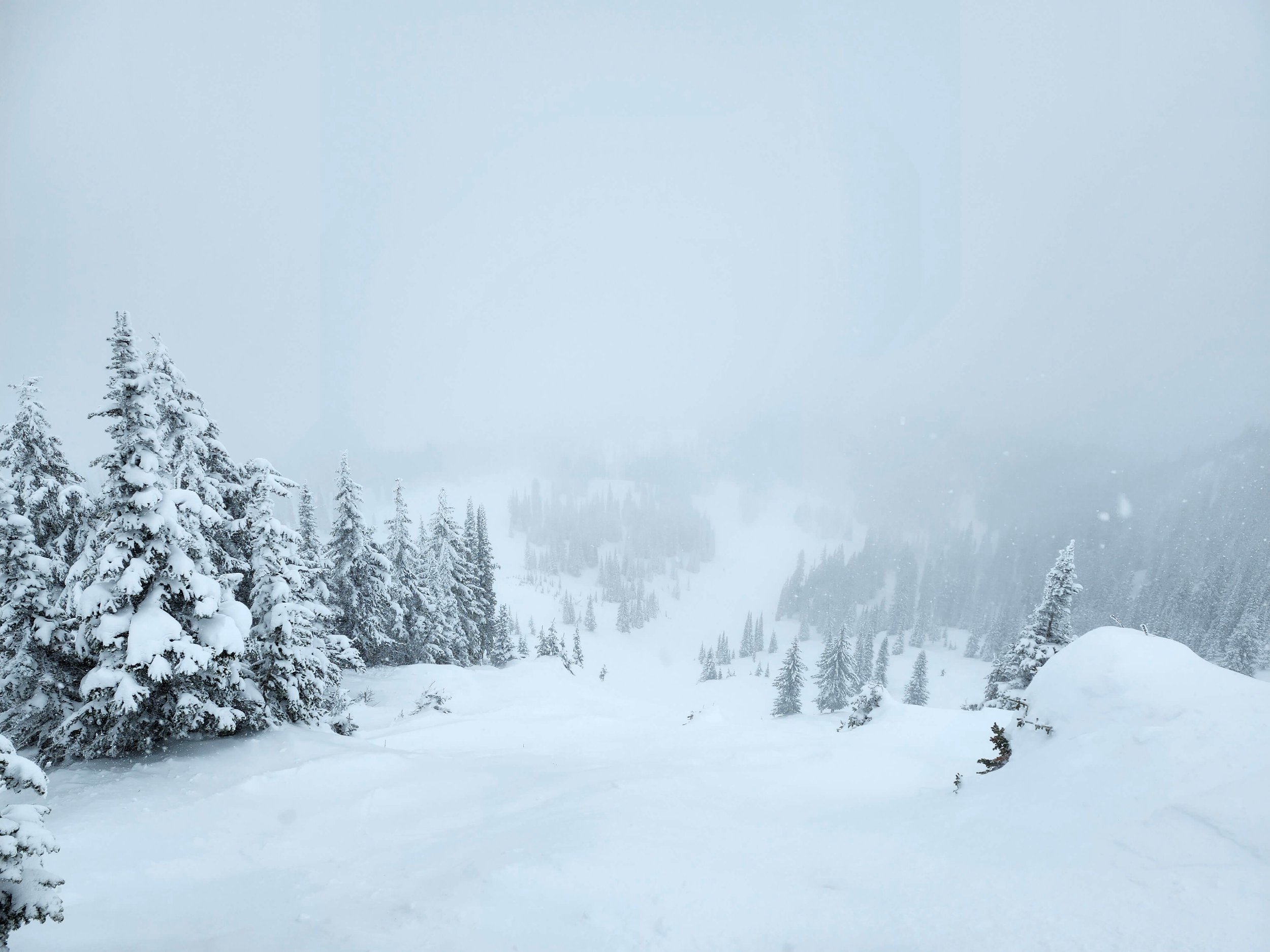

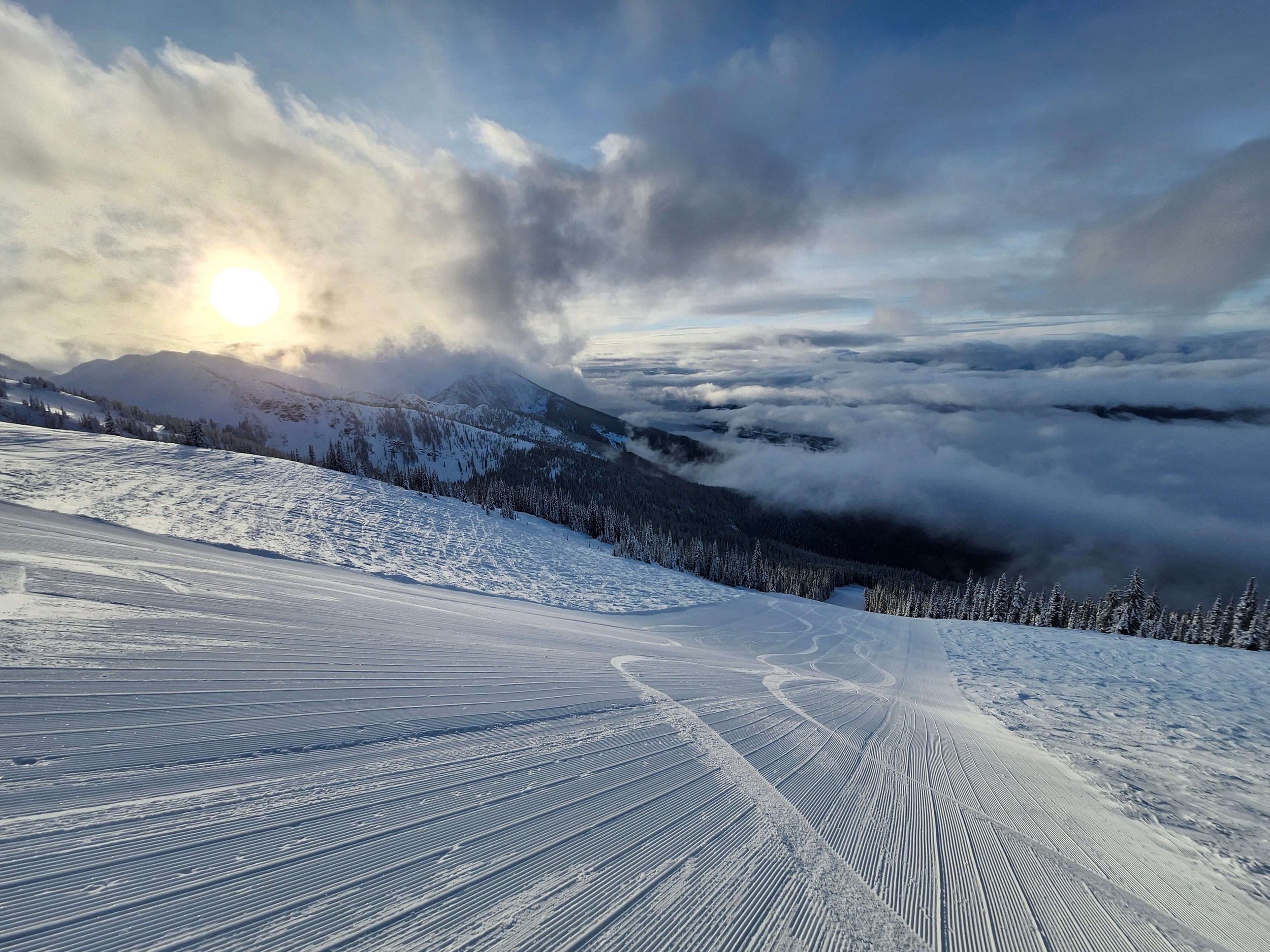
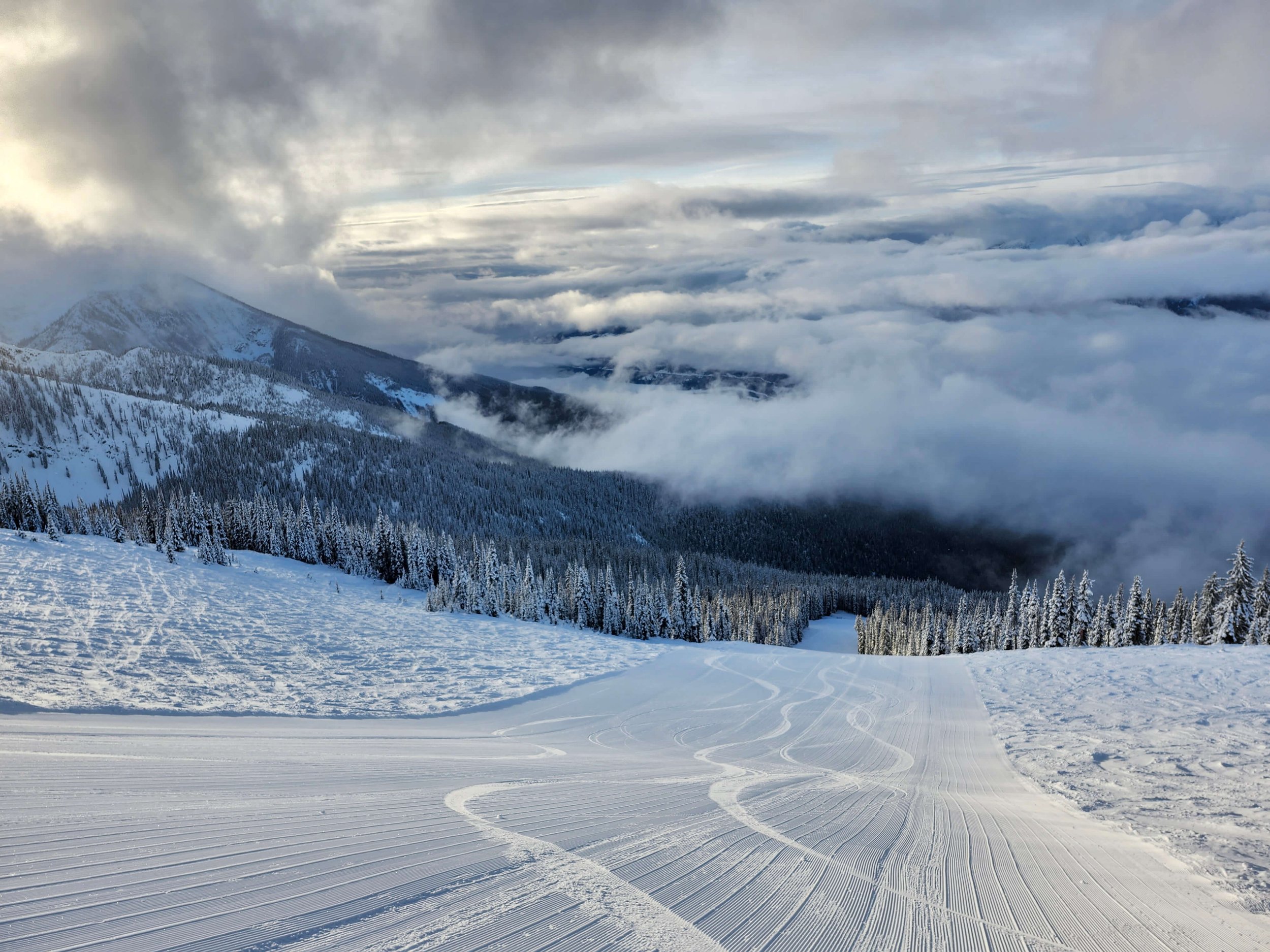

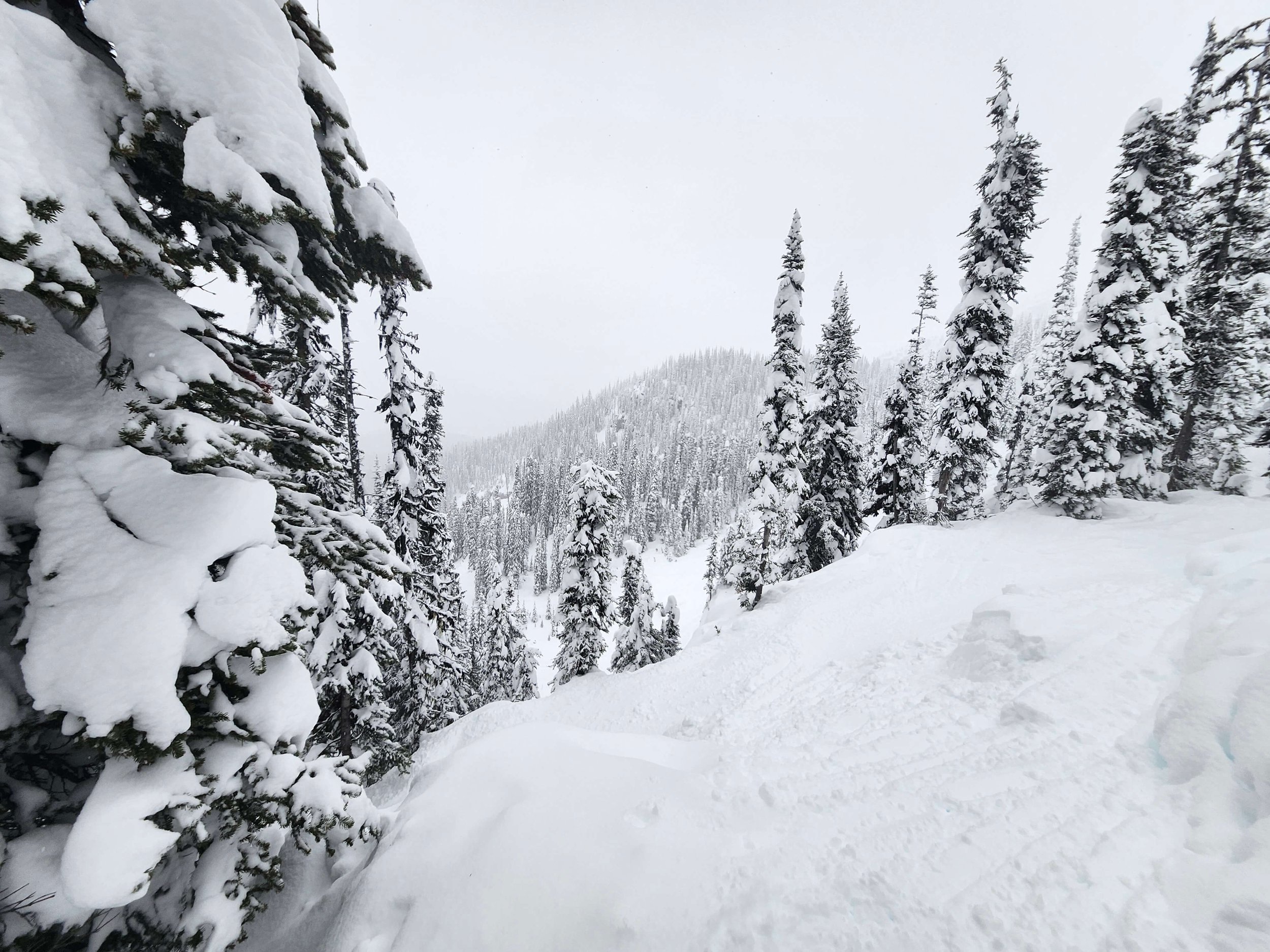
REVELSTOKE LIFT PASS
For the latest Revelstoke lift pass prices check here however at the time of posting a 6-day adult pass will set you back 884CAD with a 1-day pass at 179CAD. Revelstoke Ski Resort is also included as part of the IKON Pass with 7 days of access available for full IKON Pass holders.
GETTING TO REVELSTOKE
The closest airport to Revelstoke is (YLW) Kelowna International Airport which is a large hub for flights into BC with daily flights from the major cities across Canada. Kelowna is still 2.5 hours drive from Revelstoke so you will need to rent a car or utilise the Revelstoke Transfers service.
If you are staying in downtown Revelstoke and do not have access to a car, you can utilise the local Resort Shuttle which cost 2CAD for each ride. The Resort Shuttle runs daily between downtown and Revelstoke Mountain Resort.
MATT’S FINAL THOUGHTS
Despite Revelstoke being the hottest commodity on the ski circuit, it is the only ski town where I have felt there was an opportunity to begin laying down routes. Perhaps that was due to the two-year work holiday visa, I don’t know. The word ‘community’ gets used a lot in town, that’s because it's what makes Revelstoke so special. Everyone who lives in Revelstoke came from somewhere else and is trying to make a go of it long-term. Work, housing and food costs are all huge challenges to the ‘Canadian Dream’, and yet Revelstokians still find the time to contribute through projects, performances and activities.

Bansko Ski Resort Guide
Bansko holds an international reputation that stakes a claim to be Bulgaria’s premier ski resort. Offering something different to rival Borovets, Bansko is split distinctly into two areas; the modern village and the UNESCO heritage site of Old Town. In recent times Bansko has seen investment and improvement in facilities on and off the ski hill that makes it a worthwhile ski destination on a budget. Skiing and snowboarding in Bulgaria are underrated and great value compared to large-scale European resorts. This ski resort guide will cover everything you need from the Bansko piste map to the best time of year to visit Bansko, let’s drop in.

BANSKO FIRST IMPRESSIONS
Being my second trip to Bulgaria to snowboard I had some prior expectations for my trip to Bansko. Bulgaria is known for being a cheap ski holiday destination but that often goes in hand with the attitude that the experience cant be good. That's just not the case, with Bansko offering enough terrain to keep beginners and intermediates occupied without breaking the bank. Going to Bansko as an experienced snowboarder I was worried that there might not be enough challenge to keep me interested. The FIS course was certainly fun and there was some really nice red graded trails.
BANSKO SKI AREA
Bansko ski area has a total of 48km of pistes making it a decent size for a weeks ski holiday. Around 10km from the base of the gondola and the town you will have to endure a 30-minute gondola ride to reach the slopes at Bundarishka. Installed in 2003, the gondola still feels dated and ambles it’s way up to 1635m. At the top of the gondola, you will find some restaurants a beginners area and lifts to whisk you around the rest of the resort. Fortunately, the chairs run faster than the gondola so you should be able to get your laps in.
The more confident will want to head towards Todorka and Banderitza chairs. These lifts will lead you to some brilliant red graded pistes. Head here first thing in the morning to make the most of the grooming. The Tomba is the only notable black piste in Bansko. If you are looking to venture off-piste you may be disappointed. There isn’t much within the confines of the resort and you may wish to book a ski-touring excursion. However, it is not all bad news. Bansko beginner reputation tends to scare away interested freeriders so when the conditions are good you can have it all to yourself.
Intermediates skiers and snowboarders will appreciate the Bansko terrain the most. There are plenty of interesting blue runs that will fill you with confidence to try the reds. Wide pistes are a theme at Bansko and make cruising about really fun. The highlight has to be the long 16km piste from Todorka Peak to the base area.
Beginner terrain makes up about 40% of the skiable runs in Bansko. This makes Bansko the perfect place for beginner skiers and snowboarders. The local ski schools in Bansko are excellent and offer more affordable packages then French or Swiss ski resorts. Learning to ski or snowboard in Bulgaria is a good way to gain confidence without breaking the bank.
The Resort
Bansko town offers a large town with a choice of accommodations. Choose from large spa hotels or self-servicing apartments. Bansko hotels are good value with half-board options if you want an easy holiday. The resort is known for its apres-ski with Bansko nightlife attracting the stag/hen crowds. It is worth keeping this in mind as the parties can last into the early hours. Luckily if that isn’t your thing Bansko has plenty of other activities to keep you occupied. The resort is also home to a number of decent restaurants where eating out will not cost a premium.
The Old Town
Offering a different pace the cobbled streets of Bansko Old Town seem a world away from the fluorescent streets and bars surrounding the ski centre. A UNESCO World Heritage site, Bansko’s Old Town has a special feel. Its Bulgarian Renaissance houses that line the backstreets offer a charm not found elsewhere in Bulgaria. The Holy Trinity Church is exquisite in design and noticeable by its tall bell tower is a symbol of Bansko’s history.
The Bansko ski map below gives a good overview of the resort. The highlight has to be the 16km blue run from Todorka Peak back to the base of the gondola. This is one of the longest runs I have snowboarded and it is such a good way to end the day. Bansko slopes cover 48km.
Bansko Ski Resort Piste Map
SEASON DATES
Snow cover in Bansko is good with snow from December until April. The upper slopes generally stay in a decent condition throughout the season, however, if help from snow-making is required, Bansko has those facilities. The best time to ski in Bansko is January through March where the conditions are the most stable.
HOW MUCH IS A LIFT PASS IN BANSKO?
Further discounts are available on Bansko lift tickets with family passes available at discount. To check the latest pass prices click here
Below are my ratings for Bansko ski resort. All categories are scored out of five with higher scores being better. The only exception is crowds, a higher score in this category means the resort is busier. These scores are based on my experiences in the resort and I’d love to hear your views and experiences in the comments.
TRAVEL TO BANSKO
Where is Bansko
Bansko ski area is located in the Pirin mountain range around 160km from Bulgaria’s capital city Sofia. The transfer to Bansko is around 2 hours.
Getting To Bansko
From the UK low-cost airlines fly fairly regularly into Sofia (don’t get done by baggage fees). Flights to Sofia are regular and affordable from UK airports. A Sofia to Bansko ski resort airport transfer is 2hrs. Most people book their Bulgaria ski trip through a travel company that will be on hand to organise your transfer.
Self-Drive
If you do not have an organised transfer then self-drive is possible with hire cars available in the airport arrivals area. Car rental is easy but the journey can be more stressful. Fair to say in Bulgaria the overtaking can be hairy at times so if you are wanting ease… take a transfer.
Taxi
Taxi or private hire is also available from Sofia airport but be sure to pre-arrange this with an agreed price. The is a Bansko App that allows you to book taxi transfers in advance. The earlier you book the better the price you will get. Private transfers will cost around €120 for the round trip.
Public Bus
The most affordable way to access Bansko is on the public bus service from Sofia. A ticket will cost you 15BGN and you have two departure points. For up-to-date departure times check here
How long is the transfer from Sofia to Bansko?
The transfer time between Sofia International Airport and Bansko is two hours by coach although during busier periods this can take longer.
BANSKO ACCOMMODATION
When considering Bansko accommodation you have plenty of choices but make a smart decision. If you don’t want to be involved in the apres scene search for accommodation that is further away from the gondola base area. It is here that the noise can be loud and may disrupt your sleep. Although staying in a Bansko hotel near the ski lifts gives you prime access to the gondola in the morning.
The Bansko hotels have decent facilities with pools or spas commonplace. Hotel food in Bulgaria is a bit basic but there are plenty of places to eat out if you fancy a change. That being said, a Bansko hotel all-inclusive option makes for a hassle-free holiday. All-inclusive in Bansko can include; food, ski hire and lessons so look for these deals.
If you would prefer the self-catering experience then consider staying in an apartment with many conveniently located for the gondola and restaurants.
BANSKO PROS
Incredible value as a European skiing holiday
The ski school offers a good service at low prices (please tip your instructor)
Bansko has a good apres ski scene
Bansko has 48km of pistes which should suit most people for a weeks holiday
BANSKO CONS
Longer transfer time then Borovets
Bansko ski area has little for advanced skiers or snowboarders
The 30-minute gondola from the base area gets tedius.
Other Activities In Bansko
When booking a ski holiday It is always worth considering what other activities are available locally. Bansko doesn’t disappoint with plenty to do and see should you fancy a day off the snow.
OLD TOWN
Already mentioned but worth repeating, Bansko’s Old Town is a UNESCO World Heritage site. More relaxed than the area around the gondola, head into the Old Town for a stroll around the cobbled streets. Unique houses and interesting matsurev’s (restaurants) will keep you occupied.
SPA DAY
Bulgaria is home to over 800 natural mineral springs so it’s fair to say Bulgarians know a thing or two about relaxing. Taking a trip to the spa in the evening is the perfect way to recover those weary muscles for another day of snowboarding. Most Bansko hotels will be able to arrange for you to receive a spa treatment with the luxury hotels hosting good facilities.
ICE SKATING
Ice skating in Bansko is the perfect winter evening activity. Bansko’s Ice rink is located on Pirin St in the centre of town. Tickets cost 12BGN for a two-hour ticket. Including skate hire.
ESCAPE ROOM
If you are hoping not to leave Bansko just go and hide out in one of the escape rooms. Found at Aparthotel Lucky Bansko and open to hotel guests and visitors there are two escape rooms to try. Prices vary depending on how many people are in your team. There are two themes, the Egypt room and the Hacker room. Let me know if you got out.
FREQUENTLY ASKED QUESTIONS
Is Bansko good for skiing?
This is probably the most common question and comes up because of the low cost holidays to Bansko. Cheap holidays doesn’t mean bad holidays, just a different experience. Honestly, I really enjoyed visiting Bansko. Would I go back.. probably not. That is only because I feel like I have seen it now. I know families who go to Bansko each year and it is more than ideal for their needs. The 48km of pistes is ample terrain for a ski holiday and Bansko town has everything you need.
Which is better Bansko or Borovets?
This is ultimately down to opinion and will vary from person to person. For me, there isn’t too much difference in the actual skiing between Bansko and Borovets. Bansko does have a world cup run which offers more challenge than anything you will find at Borovets, but Borovets offers more terrain. Away from the slopes both Bansko and Borovets have a lively nightlife. I like that you can get away from this in Bansko with a trip to the old town, a Unesco heritage site. In the Old Town, you will find restaurants and bars that are quieter and set in a beautiful setting. The closer you get to the gondola in Bansko it gets more modern and more nightlife oriented. Borovets also has a good nightlife scene, but you will find the hotels in Borovets offer great entertainment for kids with games rooms etc.
Are Bansko Lift Tickets Cheap?
Normally one of the biggest expenses on a ski holiday, lift tickets in Bansko are very reasonable. A 6-day Bansko ski pass will cost £180 for adults. That is £100 cheaper than a 3 Vallees 6-day lift ticket.
Is Bansko Snow Sure?
Bansko’s upper slopes are high enough to maintain good snow coverage throughout the season. The season runs into April with the best conditions found in January and February. Bulgaria and therefore Bansko tends to receive less snow than the Alps but combat this with extensive snowmaking.
How Much is Beer In Bansko?
The standard measure of how expensive a destination is can always be related to the cost of a pint. In Bansko, a beer costs 3BGN or £1.35 for a pint which represents decent value. This price can get even better with many bars offering happy-hours deals as the lifts stop turning. The Happy End is a good place to start and finish your night with live music.
FINAL THOUGHTS
Bansko is a destination that ticks a lot of boxes. The terrain is big enough to keep most people occupied although advanced riders may want more. As a beginner, there is plenty of reason to go to Bansko with a good ski school, cheap ski hire and nice blue terrain to progress onto. Intermediates will probably love Bansko the most with the majority of terrain being blue or red graded runs. Bansko is a ski destination that offers it all but at a fraction of the cost. why not?
DISCOVER BANSKO

Tsugaike Kogen Ski Resort Guide
Tsugaike Kogen ski resort may still be the best-kept secret in the Hakuba Valley. Nicknamed ‘Powder Heaven’ but often overlooked by the more popular Happo One or Hakuba Cortina, Tsugaike Kogen is the place to go for uncontested powder turns.
One of 10 ski resorts on the Hakuba Valley Pass, Tsugaike Kogen ski resort is a Japanese ski resort that retains a local feel. Tsugaike receives an average of 12 metres of snow each winter season which makes it popular with snowboarders in search of fresh turns. Tsugaike Kogen lies along the same shuttle bus route as Hakuba Cortina and with most skiers opting to remain on the bus to its final destination, Tsugaike is the place to go to avoid lift lines on a powder day.
TSUGAIKE KOGEN FIRST IMPRESSIONS
Tsugaike has its own village with a number of hotels, pensions, restaurants and rental shops. As you approach you can tell that you are somewhere with a different feel to Happo. Tsugaike is pretty subdued in terms of its nightlife or apres scene and it’s clear that people are here for one reason and one reason alone… the powder.
Queuing for the bottom gondola at Tsugaike you see powder chasers with wide-waisted skis and fat snowboards adorning swallowtails. This sets the tone for what to expect. Taking the gondola from station one to the mid-station leaves little to get excited about for more advanced skiers and snowboarders. But from the mid-station to the top station, the gondola hovers over the famed DBD tree riding zone. It is from here that you can see why people flock in search of Tsugaike's famous well-spaced trees.
TSUGAIKE SKI AREA
Having spent more days snowboarding at Tsugaike ski resort than any other Hakuba resort on my trip, it’s hard to argue against it being my favourite as I kept going back. The Tsugaike Kogen tree access is the main draw with the DBD offering everything from quite mellow terrain at the top of gate 1 to steeper runs through gates 3, 4 and 5.
The terrain at Tsugaike Kogen is divided into two main zones, upper and lower Tsugaike. The total vertical drop of Tsugaike ski resort is over 900m which is great when considering the size of other local resorts. Tsugaike Kogens highest point is about 1700m.
TSUGAIKE LOWER MOUNTAIN
The lower mountain at Tugaike Kogen includes anything found beneath the mid-station of the gondola. The majority of this terrain is mellow beginner’s terrain with 5 short chairlifts and the gondola accessing beginner’s trails to the base. The lower mountain at Tsugaike Kogen would make an ideal place to learn with the mellow terrain feeling the opposite of intimidating.
TSUGAIKE UPPER MOUNTAIN
There are still entry-level green pistes on the upper mountain and this is one of the reasons why Tsugaike is so popular with beginners. If learners are feeling confident enough to take the gondola to the upper mountain then the winding green course through the forest makes an exciting edition for beginners.
The upper mountain however is mostly home to the intermediate and advanced terrain at Tsugaike Kogen ski resort. The pinnacle of this is the Tsugapow DBD courses. In this area, there are five separate gates that you can take to enter the designated tree-skiing zones. If the snow conditions are good then this area is unrivalled and is one of the best zones I have ever snowboarded in.
In addition to the DBD Tsugaike Kogens upper mountain has a number of red-graded terrain and one black (Horseback Course). The upper mountain is also home to TG Parks, Tsugaikes freestyle terrain. The terrain park at Tsugaike is well worth a visit and has the benefit of running underneath the No.3 Quad Lift.
BEGINNERS TERRAIN AT TSUGAIKE KOGEN
The lower mountain at Tsugaike Kogen is perfect for beginners. All of these runs are wide, mellow slopes that have suitable lift access.
On the upper mountain, there is an interesting green trail that winds its way along a Cat Track trough the Tsugaike trees.
INTERMEDIATE TERRAIN AT TSUGAIKE KOGEN
The upper mountain consists of mainly intermediate terrain. There are a couple of long red-graded pistes with the steeper Champion slope also of note.
ADVANCED TERRAIN AT TSUGAIKE KOGEN
Advanced skiers and snowboarders will love the tree skiing found in the Tsugaike Double Black Diamond gates. To access this area you need to take a course (more info follows in this post).
Also of note is the run Uma no see which follows a narrow ridgeline.
FREESTYLE TERRAIN AT TSUGAIKE KOGEN
Tsugaike Kogen has 2 terrain parks which is fantastic for a Japanese ski resort. The main Tsugaike Park is decent and is one of the longest in the Hakuba Valley. The parks consist of jumps, rails and lots of great side hits and banks.
TSUGAIKE DOUBLE BLACK DIAMOND GATES
To access the Double Black Diamond or DBD you will first need to attend a safety lecture, sign a disclaimer and then collect your armband. The courses run out of Jacky’s kitchen, a diner near the top lift station. It’s best to head to Jacky’s Kitchen early so that you can beat any rush on a powder day.

The DBD course provides you with information about local hazards within the designated tree-riding zone and although many skiers I spoke with found it pointless, I appreciated the extra safety precautions. The courses are run by local skiers who ride at Tsugaike Kogen regularly, their first-hand knowledge was useful.
In the Tsugaike DBD there are five gates. Gate 1 is closest to the chairlift and offers the easiest terrain. In fresh snow plenty of fun can be had in gate 1 without heading into the more challenging areas. The remaining 4 gates access terrain with more hazards such as cliffs. The DBD area is an incredible place on a powder day!
TSUGAIKE KOGEN PISTE MAP

TSUGAIKE KOGEN SKI PASSES
The Hakuba Valley lift pass is valid at Tsugaike Kogen and may represent your best option if you want to explore more than one Hakuba ski resort.
As a beginner, you can purchase a lower mountain lift pass at a discounted rate. This beginner’s lift pass will allow you access to the base area lifts and some very mellow green terrain.
Tsugaike and the Hakuba Valley is also valid on the somewhat controversial Epic Pass from Vail Resorts. Personally, I love the Epic Pass and have made many videos about it in the past.
If you just want to pay as your play then a 1 day lift pass at Tsugaike will cost around 5000 Yen.
LIFTS AT TSUGAIKE KOGEN
The main lift you will use at Tsugaike Kogen is the gondola which links the base area with the top of the resort. The gondola journey takes a while but it is travelling a fair distance in the process. Actually, after the leg-burning tree runs a long rest in the gondola was quite welcoming.
Tsugaike has a further 9 high-speed chairs and some that are much slower… 19 lifts in total service the resort although only the lower mountain is open for night skiing.
SEASON DATES TSUGAIKE KOGEN
Tsugaike Kogen has a long season opening the resort in mid December and remaining open until the beginning of May.
TSUGAIKE KOGEN SNOW RECORD
Tsugaike Kogen is located in Northern Hakuba at the snowiest end of the valley. The resorts in this region get absolutely pounded with snow and Tsugaike Kogen averages 12m of snowfall every winter. This means the top of the resort and tree skiing gets ample amount of snowfall for any powder skier.
VILLAGE AT TSUGAIKE KOGEN
Despite Tsugaike having a quieter village than Happo, it is fair to say that it has been commercialised. You will find a high ropes course on the slopes and fast food restaurants surrounding the mid-gondola station. This isn’t necessarily a bad thing but won’t be to everybody’s taste. A popular stop at the end of a day on snow is the bar near the base gondola station. You will recognise it from its uniquely Japanese foot spa, the perfect way to rejuvenate your feet at the end of a day on snow.

TSUGAIKE KOGEN PROS
Tsugaike Kogen receives an abundance of snow! 12m on average per season.
Tsugaike tree skiing is fantastic and although you have to take a course to enter this isn’t too much hassle.
Despite the combination of a great snow record and incredible tree skiing, Tsugaike is much less crowded than the nearby Hakuba Cortina resort.
Getting to Tsugaike ski resort is really simple using the Hakuba Valley shuttle buses that are provided free with your lift pass.
Tsugaike is great for beginners and provides English instruction through their snow sports school.
Due to transport links, it is easy to ski at Tsugaike and the resorts of Iwatake, Norikura or Cortina on the same day.
TSUGAIKE KOGEN CONS
On-piste skiing at Tsugaike is fairly mellow so may not suit a more able skier or snowboarder
Night skiing at Tsugaike Kogen is available but only accesses the beginner terrain which is quite dull.
Taking the course to enter the DBD area will take up some valuable on snow time and you will need to wear an armband each time you wish to enter the trees.
TRAVEL TO TSUGAIKE KOGEN SKI RESORT
Tsugaike is easily reachable from all main transport hubs in Hakuba with regular shuttle buses running throughout the day. Tsugaike ski resort is further out of Hakuba than some of the other resorts with the journey taking between 20-30 minutes depending on conditions.
The resort of Tsugaike Kogen is located between Iwatake and Norikura ski resorts. This makes it perfectly placed to be able to ski at more than one Hakuba resort on the same day. The resorts are linked by shuttles and this makes navigating the area fairly straightforward.
ACCOMMODATION AT TSUGAIKE
Tsugaike Village is an option for accommodation close to the slopes in Hakuba. Staying in the village would represent a more laid-back option where you can get away from the more western restaurants and bar scene. Be aware that around Tsugaike it is likely that you will encounter less spoken English and not every shop or restaurant will accept credit cards.
Alternatively, you can stay closer to the main hubs and commute to Tsugaike on the days that you would like to ski or snowboard there. I stayed at Nori’s sharehouse, which is a no-frills share home in the Hakuba Village. The location was good and I had no complaints about my stay. The house even had a workstation to tune your gear. There are plenty of other accommodation options in and around Hakuba
TSUGAIGE KOGEN VIDEOS
ACTIVITIES AT TSUGAIKE KOGEN
In addition to skiing and snowboarding at Tsugaike Kogen there are many other ways to stay entertained. The high ropes course at mid-mountain will be popular with families and children, as will the tubing area.
A Japanese ski holiday wouldn’t be complete without a trip to a local Onsen. At Tsugaike there are a coupe of Onsens in the village that you can visit after your day on snow.
NEARBY SKI RESORTS


FINAL THOUGHTS ON TSUGAIKE KOGEN SKI RESORT
Tsugaike featured regularly in my discussions when choosing which resort I wanted to ride at during my trip. I really enjoyed the DBD trees area but sadly on a couple of occasions, this area was closed. For me when the DBD was closed there wasn’t enough to keep me entertained so I would normally take a bus to another resort. When the DBD was open Tsugaike represents one of the best tree skiing zones in the Hakuba Valley.

A Guide To Snowboarding In Japan
Japan quite simply is a snowboarding trip like no other. If the idea of perfect trees, untouched powder and unwinding in an onsen sounds like your dream, well you can live it in Japan! Japan is a mix of the best skiing you are likely to experience and a cultural holiday in a country that is full of surprises. Everything from endless snowfall to the stunning Japanese Alps and a journey on a bullet train make Japan a place every skier and snowboarder should visit.

Skiing and snowboarding in Japan is amongst the best powder skiing in the world. Known worldwide for the copious amounts of snowfall falling between December and March, Japan is the perfect powder ski trip. What makes snowboarding in Japan even better? The trees! In Japan, you will discover glade skiing unlike elsewhere in the world.
Regulars to Japan will speak of the incredible snow conditions with resorts receiving upwards of 10m of snowfall. Some Japanese ski resorts even report DOUBLE that. Regular big dumps of snow are expected during late January and February so these are great months to plan your visit. What’s more, Japanese snow is incredibly light and dry making it perfect for throwing up into those face shots.
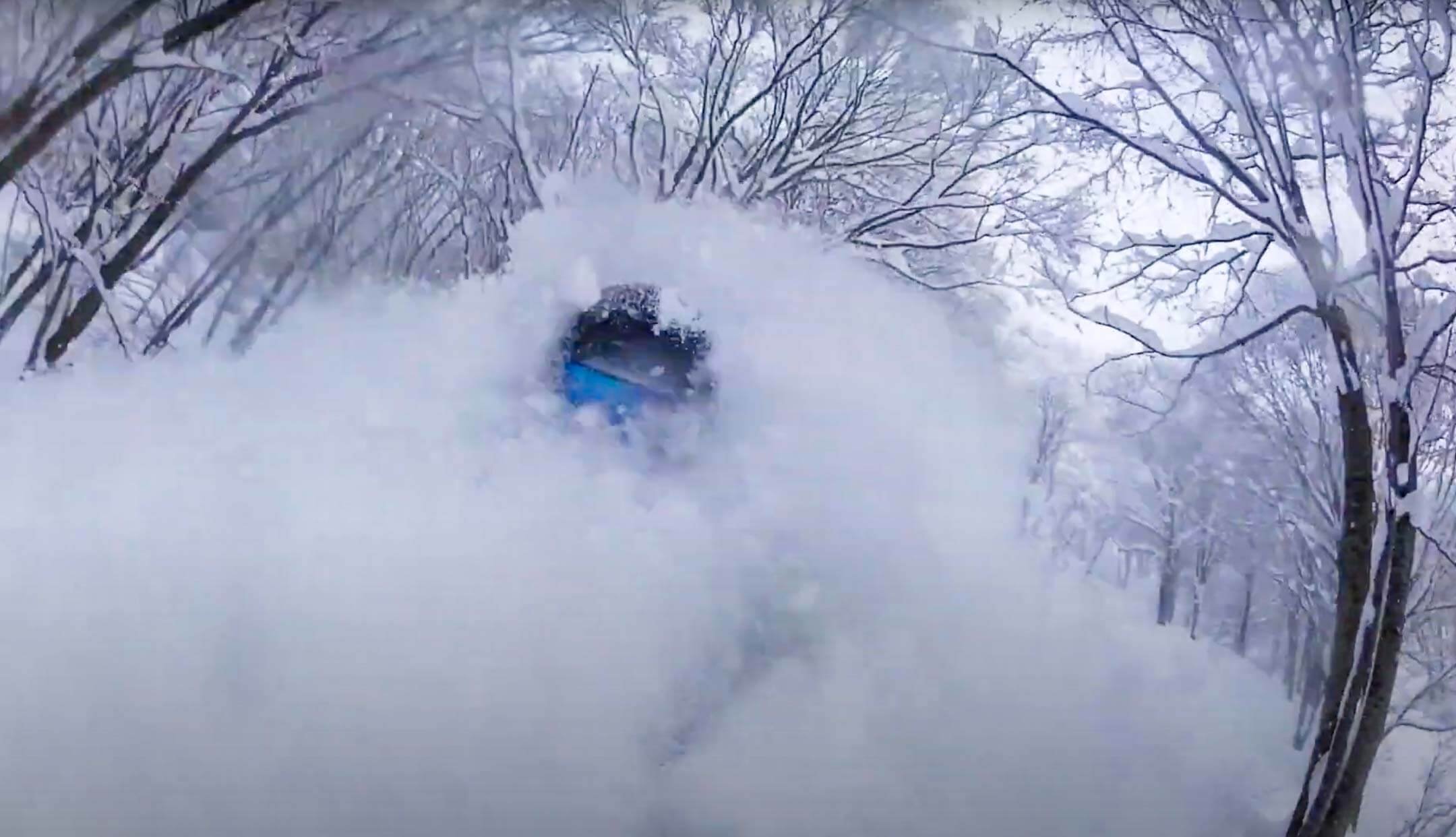
Face Shots Hakuba Cortina Trees
Skiing and snowboarding in Japan is split between the North and South islands. Hokkaido on the North Island is where people head in search of major powder stashes. The ski resorts of Niseko and Rusutsu are probably the most popular resorts in the north of Japan with copious amounts of snow falling between January and March. Niseko is very popular with tourists and if you prefer a quiet resort vibe Japan always has some smaller local resorts to explore.
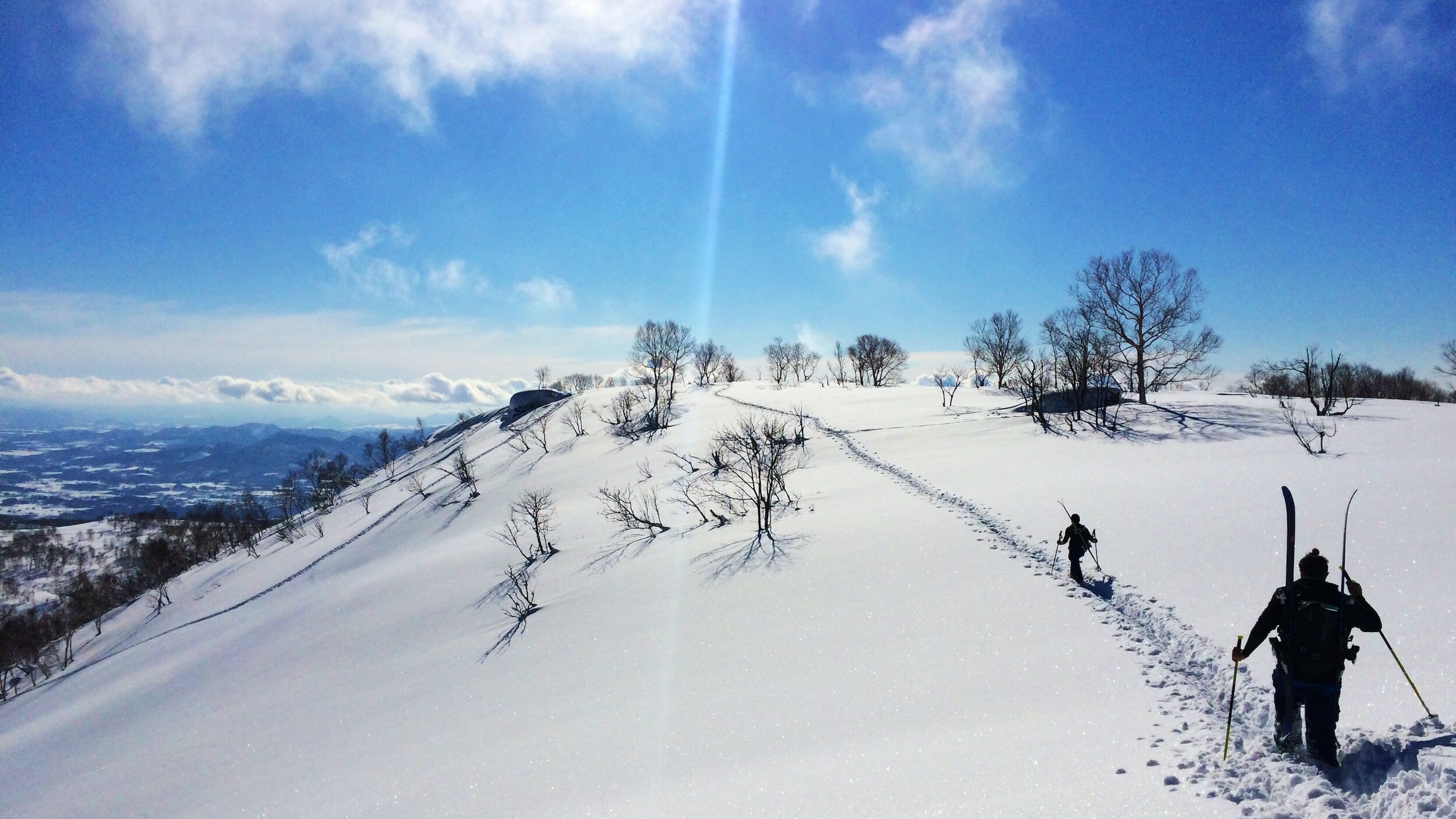
The South Island offers skiing within a few hour’s train ride from Tokyo airport with Hakuba being amongst the most popular. The Hakuba Valley is a combination of ten ski resorts that are all available on the same lift pass. Each resort offers something different, from Happo One (former Olympic hosts), Sanosaka (a small local resort with no crowds) and Tsugaike (some of the best tree skiing). Away from Hakuba, the resorts of Myoko, Shiga Kogen and Nozawa Onsen are gaining popularity.
Japanese ski resorts are not just about powder laps through the trees….there is also a big freestyle scene. Terrain parks in Japan are well thought out with a good range of features. One example is Hakuba 47 which makes the most out of a small space with a full park set-up including; a small, medium and large jump line, a half-pipe and some small rail features. Japanese skiers also love bumps leading to resorts developing purpose-built mogul lines. Norikura has a freestyle moguls course and Goryu has a mogul line down its steep frontside.
After a full day of riding leg-burning powder, you may want to find a way to relax. Luckily the Japanese have just the answer, the onsen. Onsens are an incredibly important part of Japanese culture. An Onsen is a Japanese thermal bath or hot spring that can be found in every region. There are strong rules involved in onsen use that need to be adhered to. Most onsens operate a no swim-suit policy and you will need to wash thoroughly before entering. This can put some people off but you can find private onsens to protect your modesty.
Equally Japanese food is a huge part of the experience. There are plenty of international options for the less adventurous but be sure to try some local dishes as well.
Japan ski holidays can be taken during the months of December through to April. The Japanese ski season is longer in the southerly resorts with Hokkaido receiving its huge snowfall during January to March. The famous Japan powder skiing is made possible by resorts receiving between 10 - 18 metres of snowfall throughout the winter. To put that in perspective, famous European resorts such as Verbier, known for its freeride, receive an average of 6 metres of snow in winter.
Away from the snow, Japan offers plenty of cultural experiences. The numerous temples and historical sites can provide an insight into Japanese culture, whereas trips to visit the snow monkeys are well worth it!

TRAVELLING TO JAPANESE SKI RESORTS
FLYING TO JAPAN
To arrive in Japan you will most likely transit through Tokyo’s Narita International Airport. Depending on whether you will be snowboarding on the North or South Island will determine your next steps.
HONSHU
For international visitors, Honshu may be a more favourable destination. Flying into Tokyo is easy from pretty much all around the world and the transport links are fabulous. Depending on your budget coaches run from Tokyo Narita to most major ski areas or if speed is important the bullet train will get you there faster. There are even options direct from the airport that allow you to send your baggage ahead so you can get the train hassle-free.
HOKKAIDO
Getting to Hokkaido generally means taking a connecting flight from Tokyo. The most popular airport for Hokkaido arrivals is Sapporo New Chitose Airport. New Chitose Airport is the closest to Niseko United which is the most popular of the Hokkaido ski areas. There is the opportunity to transfer to New Chitose Airport from other international airports such as Singapore.
If you would prefer to take a journey to Hokkaido on the famous Japanese rail network then this is also possible. The North and South Islands of Japan are linked via an underground rail tunnel. Taking the train to Hokkaido from Tokyo will be a much longer journey (7-8 hours) but it will be the best way to see Japan.
RESORT REVIEWS
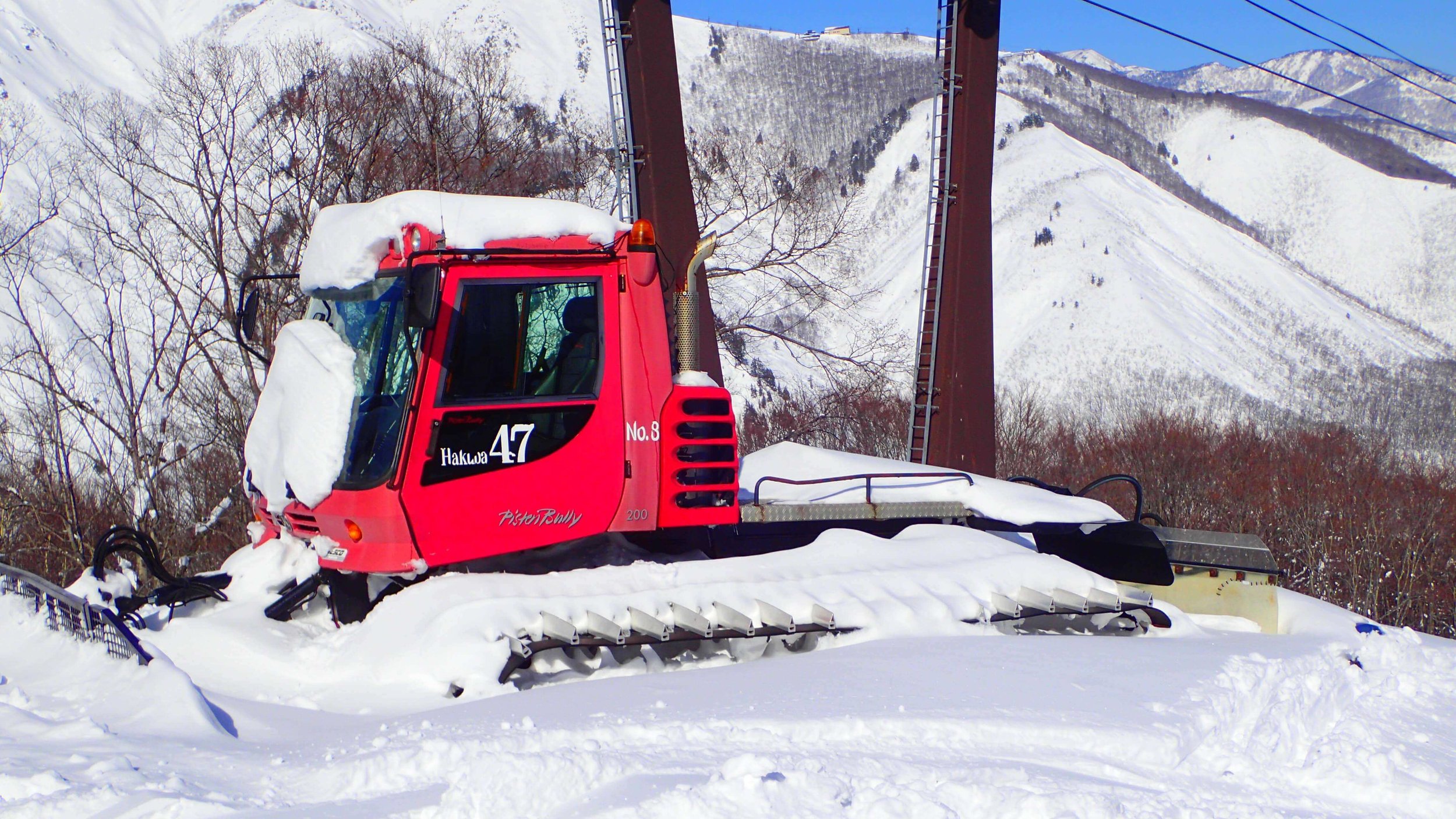

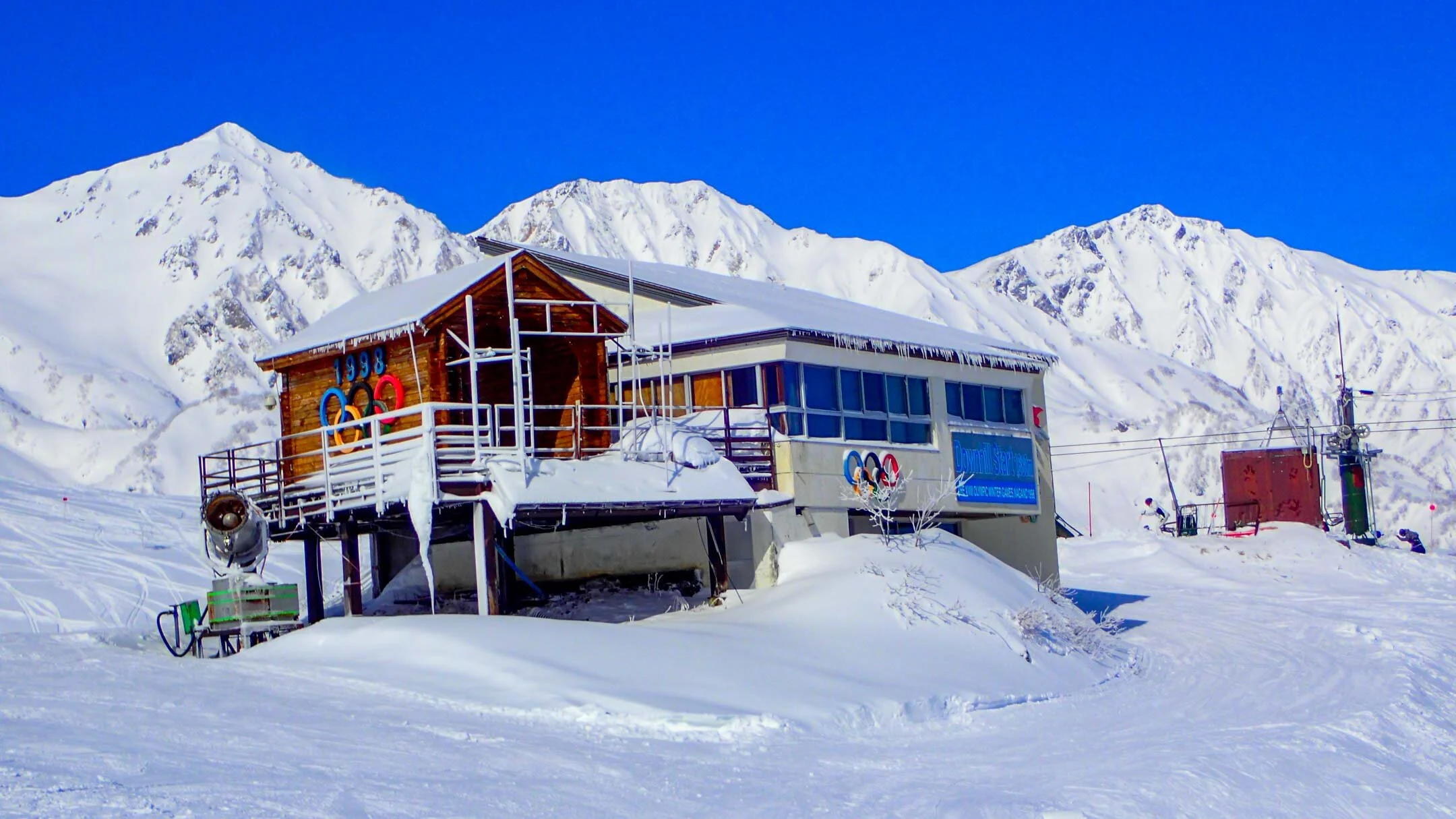
FREQUENTLY ASKED QUESTIONS
Is skiing in Japan expensive?
In general ski holidays are pretty expensive but there are always ways to cut costs. Japan in itself can be considered an expensive country to visit but in terms of skiing, there are certainly ways to cut costs. Currently, skiing in Japan is available on the Epic Pass in Hakuba and Rusustu which will be music to the ears of American readers. Getting five days in both areas will already see Epic Pass holders saving money when using their pass. Lift tickets in Japan are considerably cheaper than some European or American ski resorts. Bearing this in mind it is possible to save on the cost of your Japanese ski trip. My advice, spend less on your accommodation as in Japan you will want to spend as little time there as possible!
What is the best month to ski in Japan?
The best month to snowboard in Japan is probably February if you want to have your best chance of epic powder conditions. Late January is also great with an incredible snow record as well. If you are looking for a bargain consider heading to Japan for spring skiing in April although some resorts will be closed by this time.
Does Japan have good ski resorts?
Simple answer, Yes. Forgetting the epic conditions for a minute, Japan has plenty of great ski resorts with fantastic facilities. You will find base lodges and restaurants, ski rentals and stores that will serve all your needs. There are modern lifts in resorts, although a number of old single or double chairs still remain. Sometimes a slower lift is needed in Japan to help you recover from the last powder lap!
Is skiing in Japan good for beginners?
Japan has plenty of beginner-friendly ski resorts that would be perfect for learning to ski or snowboard. Sanosaka has nice gradients for learners and Happo has a number of popular ski schools. Learning to ski or snowboard in Japan would be pretty interesting with the opportunity to learn on a pow day! Even less reason to be worried about falling over!
What is better Niseko or Hakuba?
Probably the two most popular Japanese ski areas; Niseko and Hakuba offer something different. Hakuba combines skiing and snowboarding across 10 resorts on the same pass making it incredibly diverse. Hakuba has a longer season with a good quality of snowfall although Niseko tends to receive more snow. What is obvious to me is that both ski areas are worth visiting.
Where do you fly to ski in Japan?
Arriving in Japan from international destinations means it is likely you will transit through Narita International Airport in Tokyo. If heading to the North Island there are plenty of international transits that have connecting flights to Sapporo. If staying on the South Island, from Narita you can take the train or bus to reach your final destination.
How cold is skiing in Japan?
Really guys? How is this a most asked question? Skiing in general is going to happen in cold conditions. Dress for it and you will be fine. That being said Hakuba averages temperatures of zero to minus five degrees throughout the winter! That’s perfect for Japan’s quality of snow! The cold is a blessing!
What is the largest ski resort in Japan?
Ski resorts in Japan tend to be smaller than European ski resorts. That’s a huge benefit of ski areas like Hakuba which have a number of resorts combined on the same lift pass. The largest stand-alone resort is Shigakogen Mountain Resort which has over 80km of slopes.
WHY SKI OR SNOWBOARD IN THE JAPAN
Planning a ski or snowboard trip to Japan is a no-brainer. The quality of the snow conditions in Japan tends to be better than anywhere else in the world. If powder is your thing, just book now. Japan also offers a decent variety of skiing experiences from the well-developed modern ski areas of Niseko and Hakuba to the more locally orientated yet-to-be-discovered ski areas.
Away from the snow, Japan could just open your mind to a whole different way of life. The culture in Japan varies dramatically from the one back home and learning more about Japan was certainly worth it. Taking time away from the snow to discover Tokyo, ride a bullet train or participate in Onsen will be well worth the effort.
JAPAN SKI RESORT SNOW RECORD
More snow than anywhere else on the planet on a more regular basis. That is a pretty fair assessment of the snow record at Japanese ski resorts. Japan tends to receive between 10m-18m of snowfall throughout the winter. The North Island resorts will reach the upper end of that number whereas Hakuba Cortina and Tsugaike tend to receive around 12m on average.
MULTI RESORT PASSES
Both the main American multi-resort passes include ski days in Japan. Epic Pass allows 5 days of skiing in Hakuba and 5 days at Rusustu. The IKON pass includes 7 days of skiing at Niseko. Even Indy Pass is getting in on the act by including skiing in Japan!
Within Japan, there are a number of multi-resort passes that you should consider if you are planning a Japanese ski trip.
The Hakuba Valley is home to 10 ski resorts which are all included on the same pass. Olympic host Happo One is probably the biggest name on this pass, but don’t miss out on Tsugaike and Cortina for the tree skiing.
Niseko has its own 4 mountain pass called Niseko United. The interconnected resorts of; Niseko Annupuri, Niseko Village, Grand Hirafu and Hanazono are all included on this pass making it perfect for those heading to these world-renowned ski areas.
The Kamori ‘K Winter’ Pass includes some of the best of the best ski resorts in Japan. Rusustu is a popular destination on the Kamori pass with Sahoro and Sapporo also worth noting.
THE JAPANESE SKI SEASON
The ski season in Japan runs between December and April with the South Island having a longer ski season than the North Island.
JAPAN GALLERY
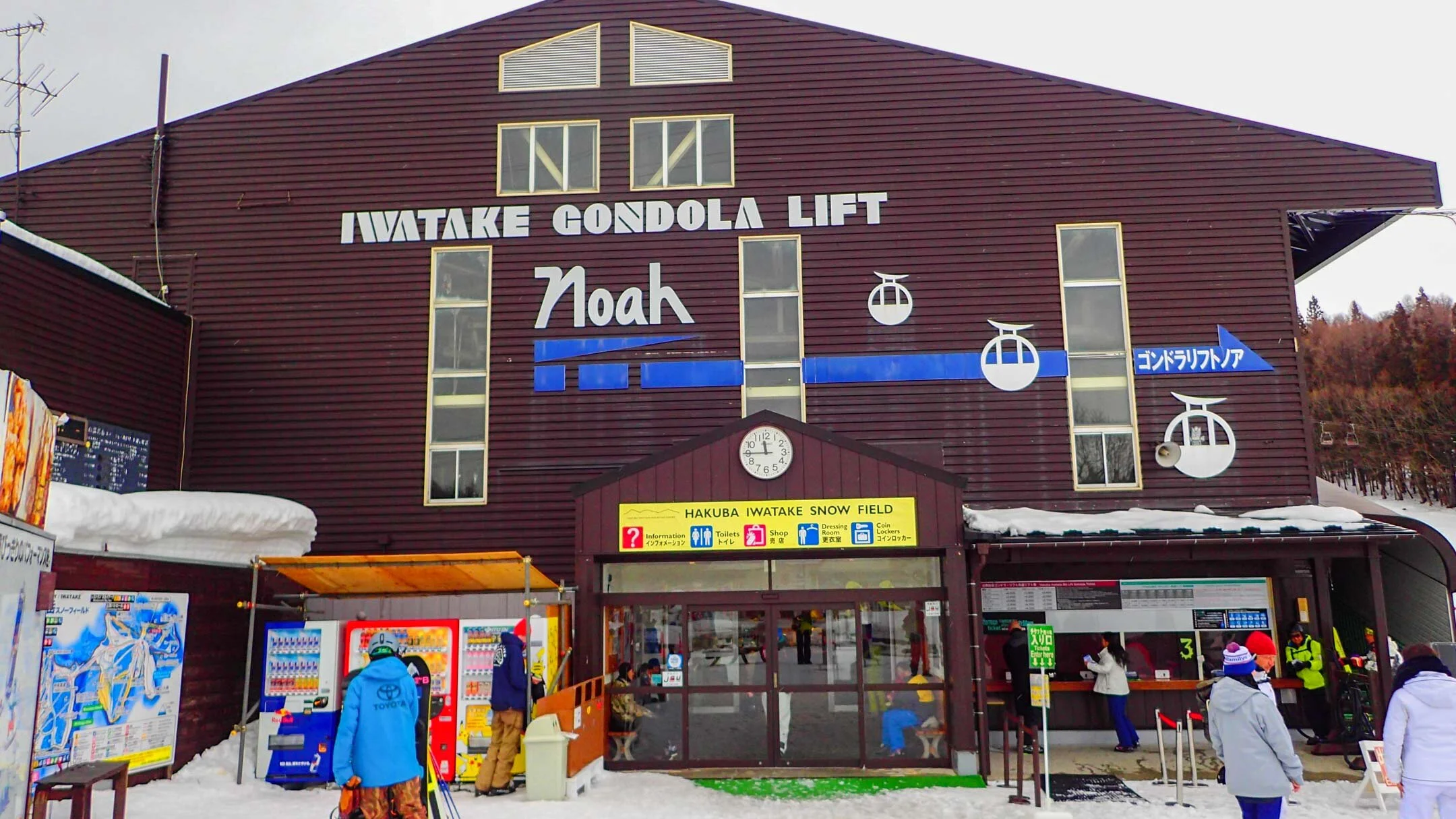
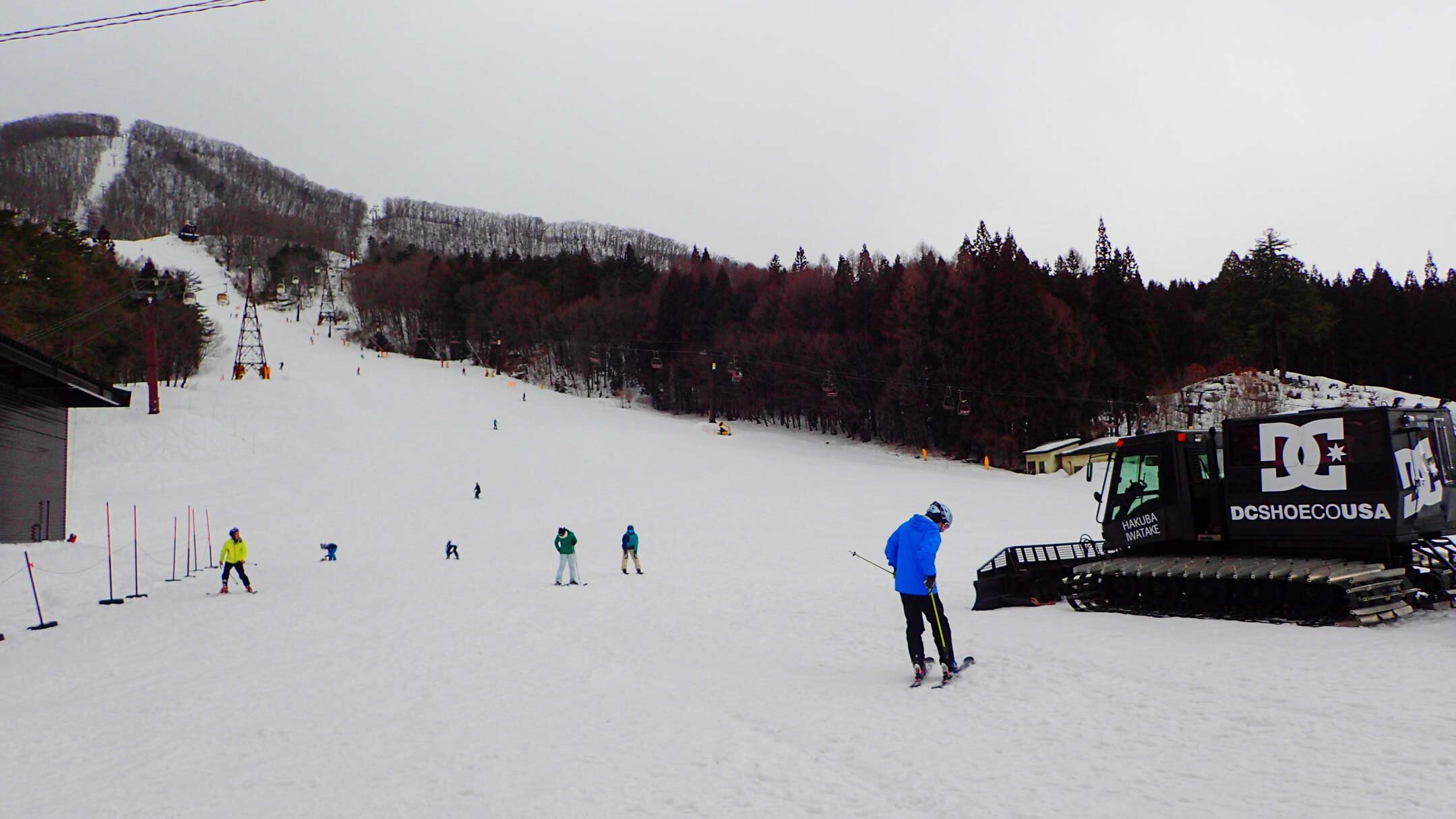
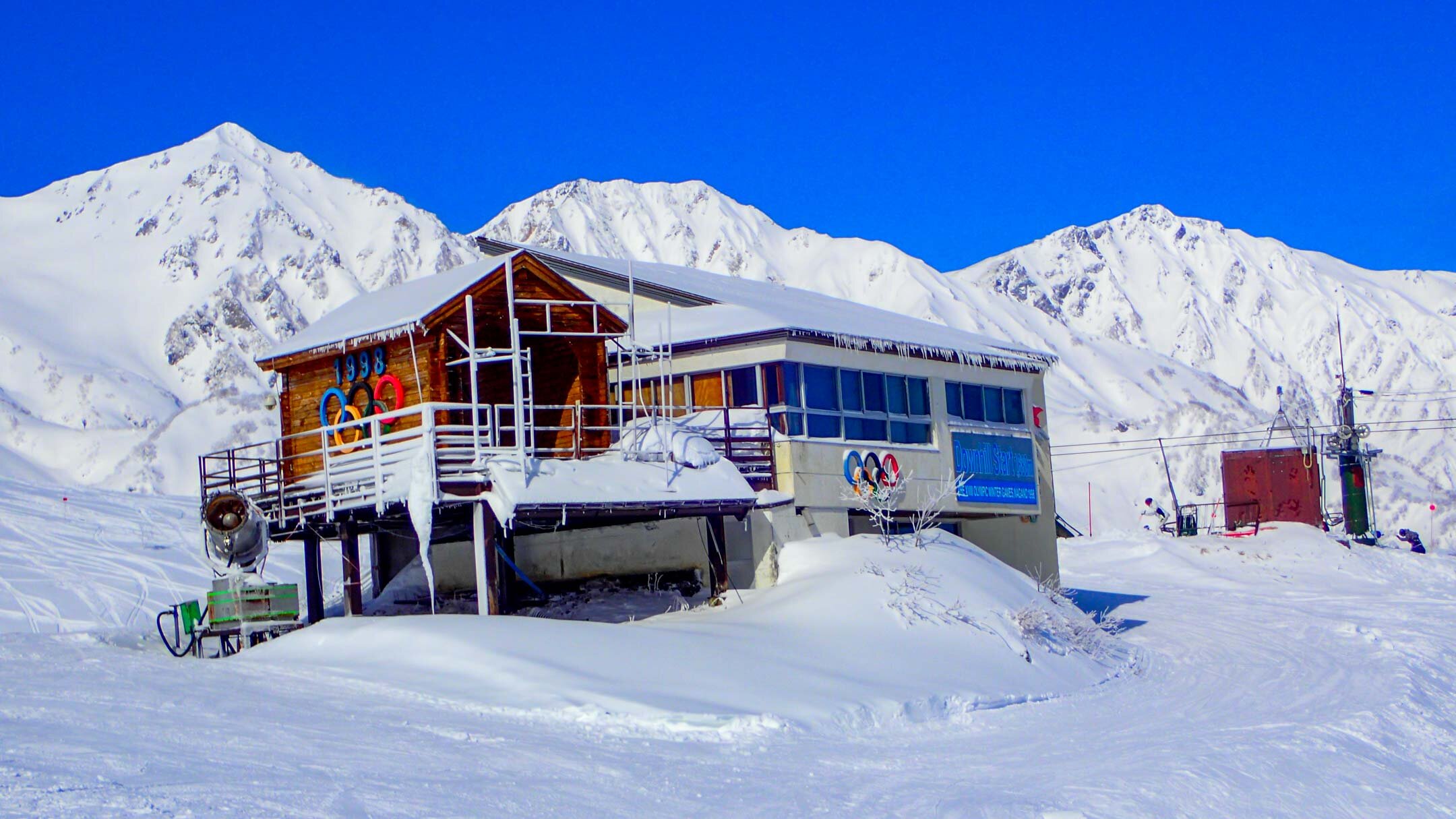
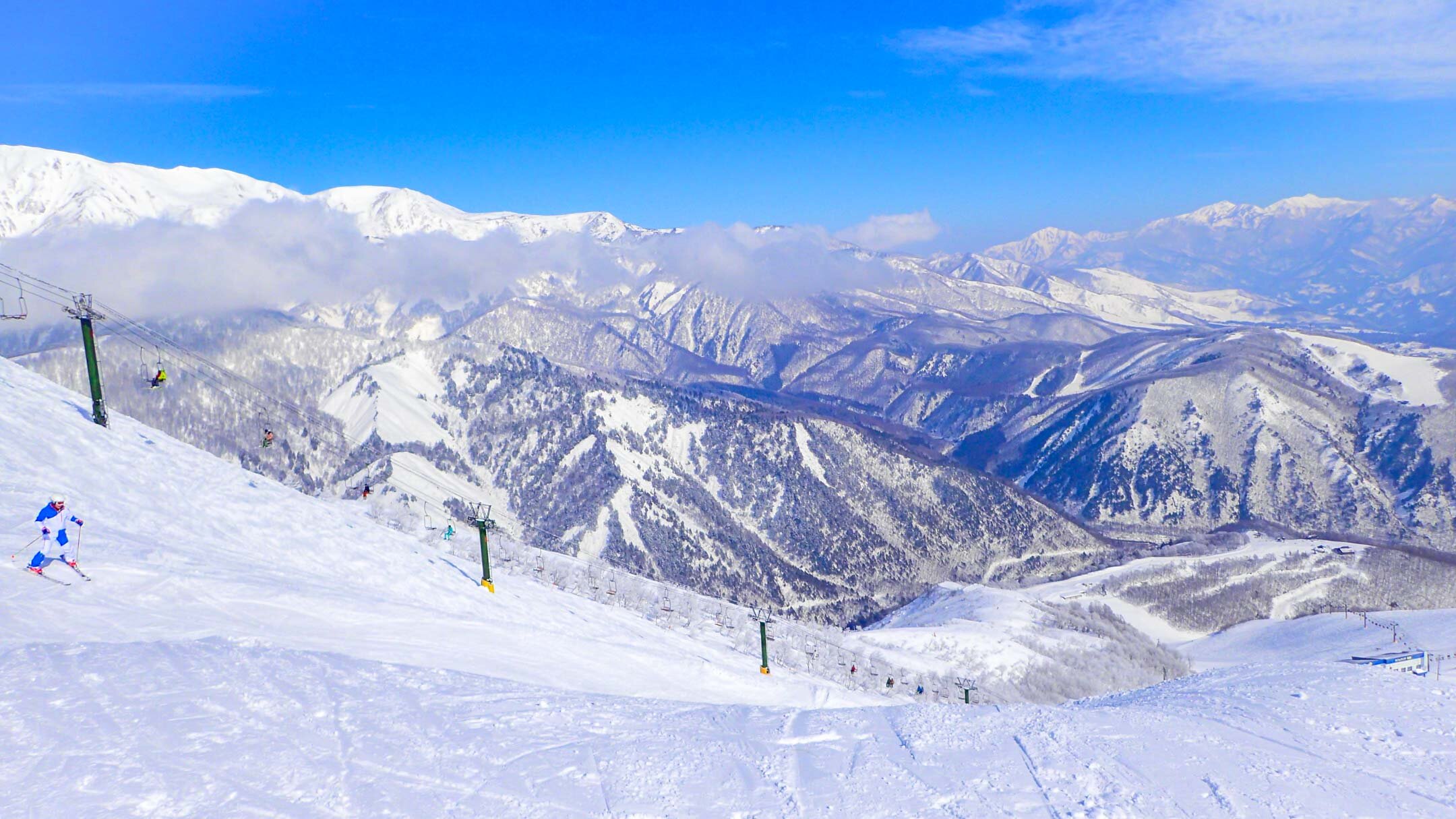
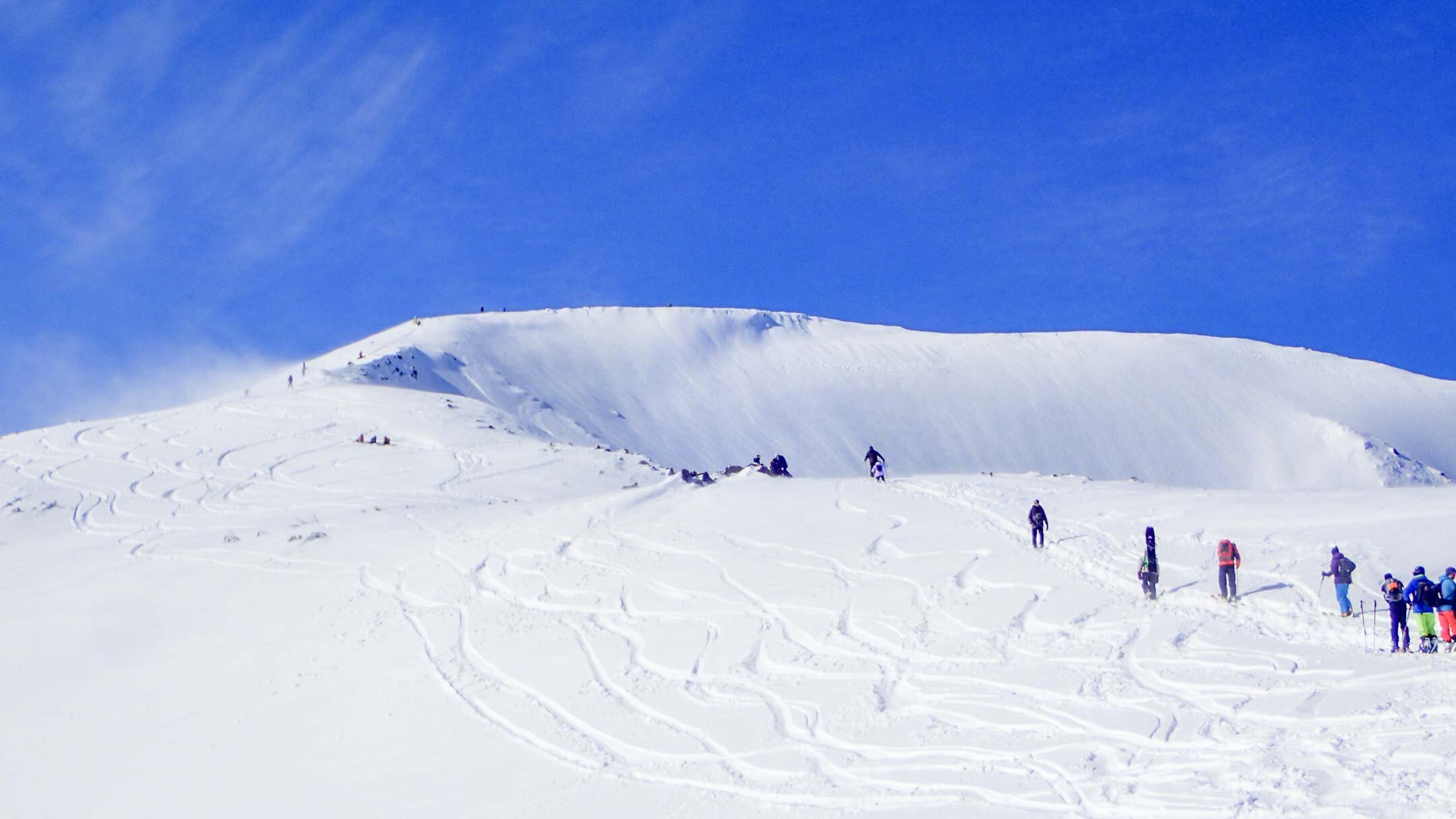
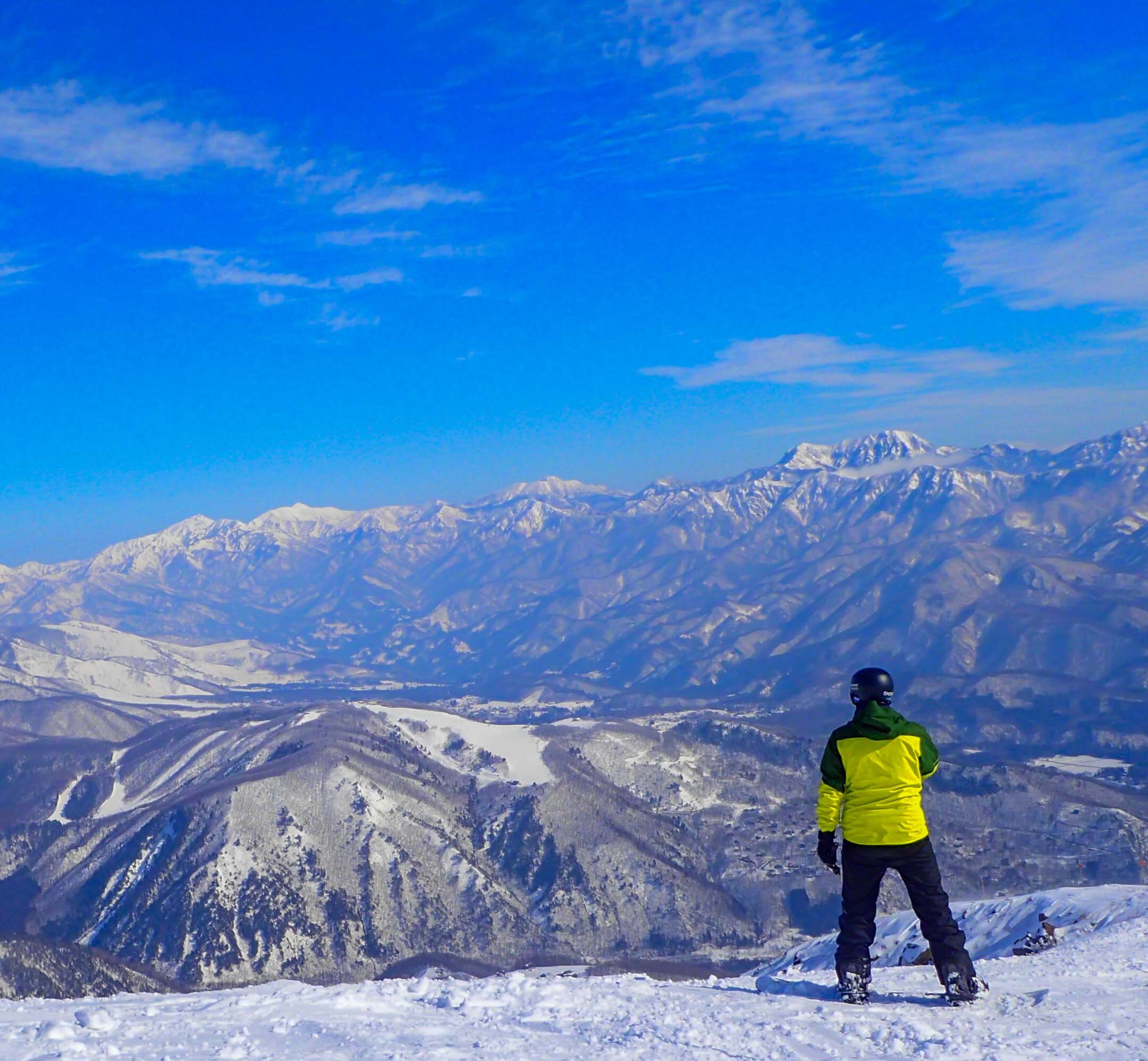
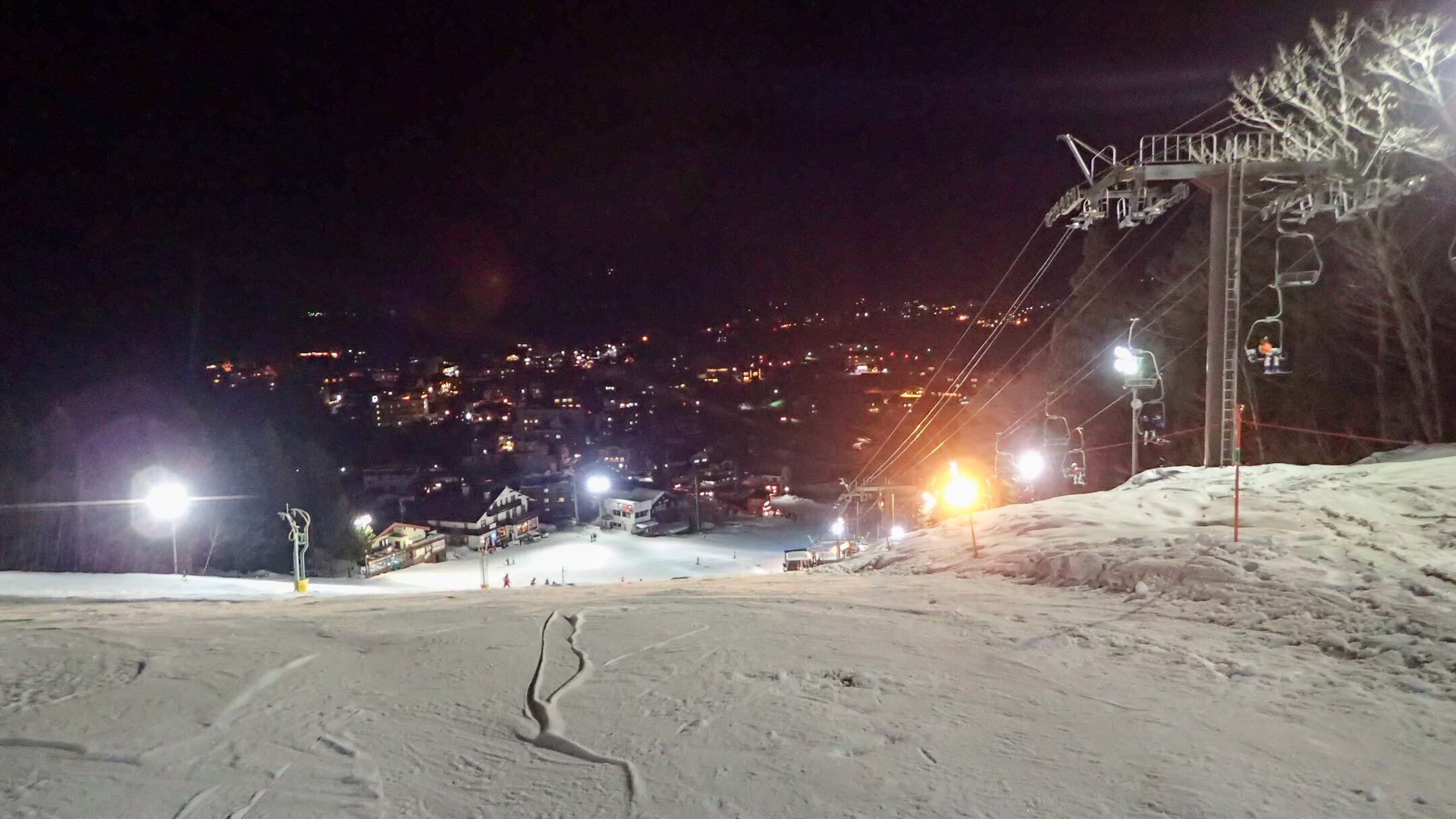

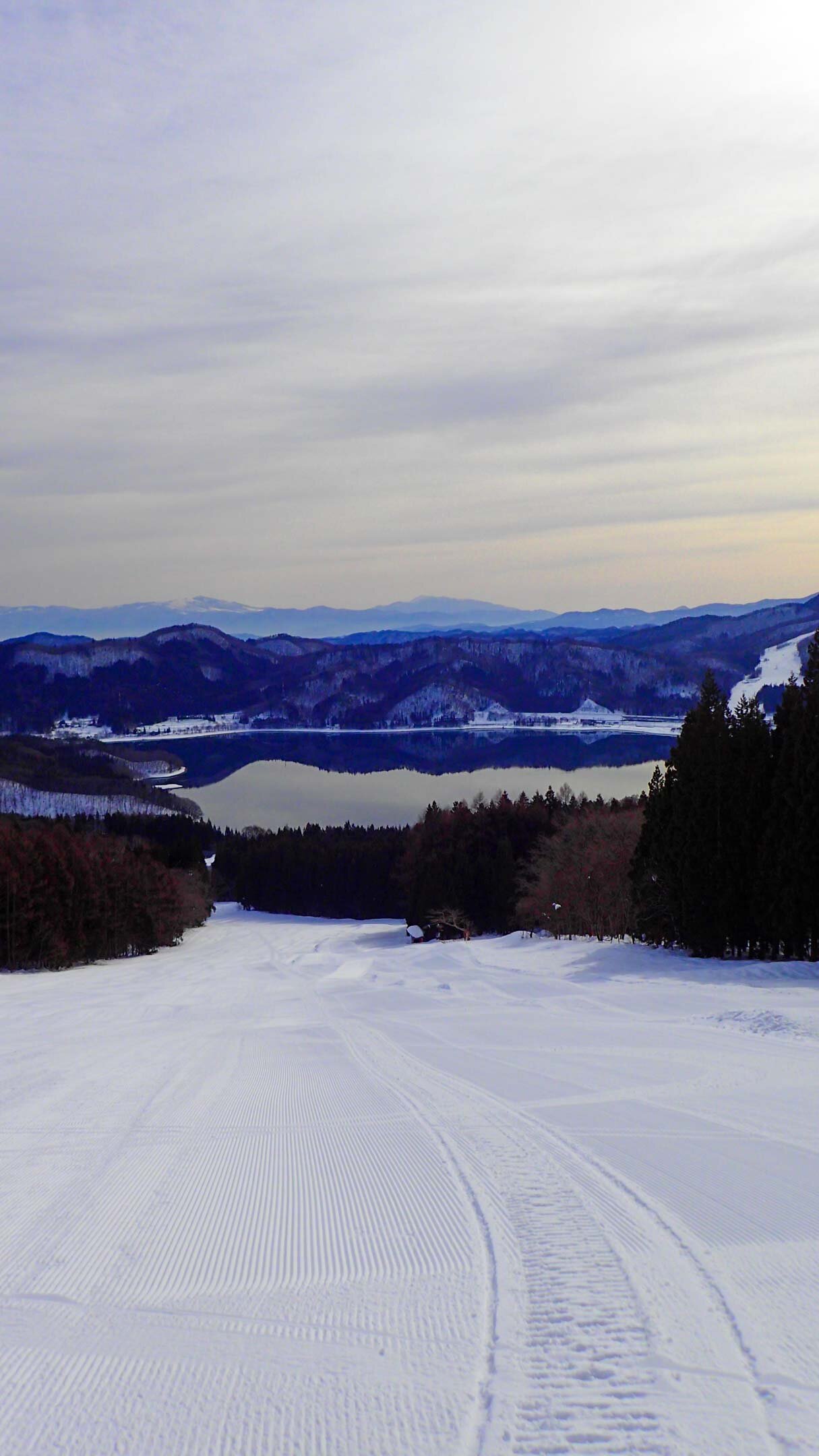
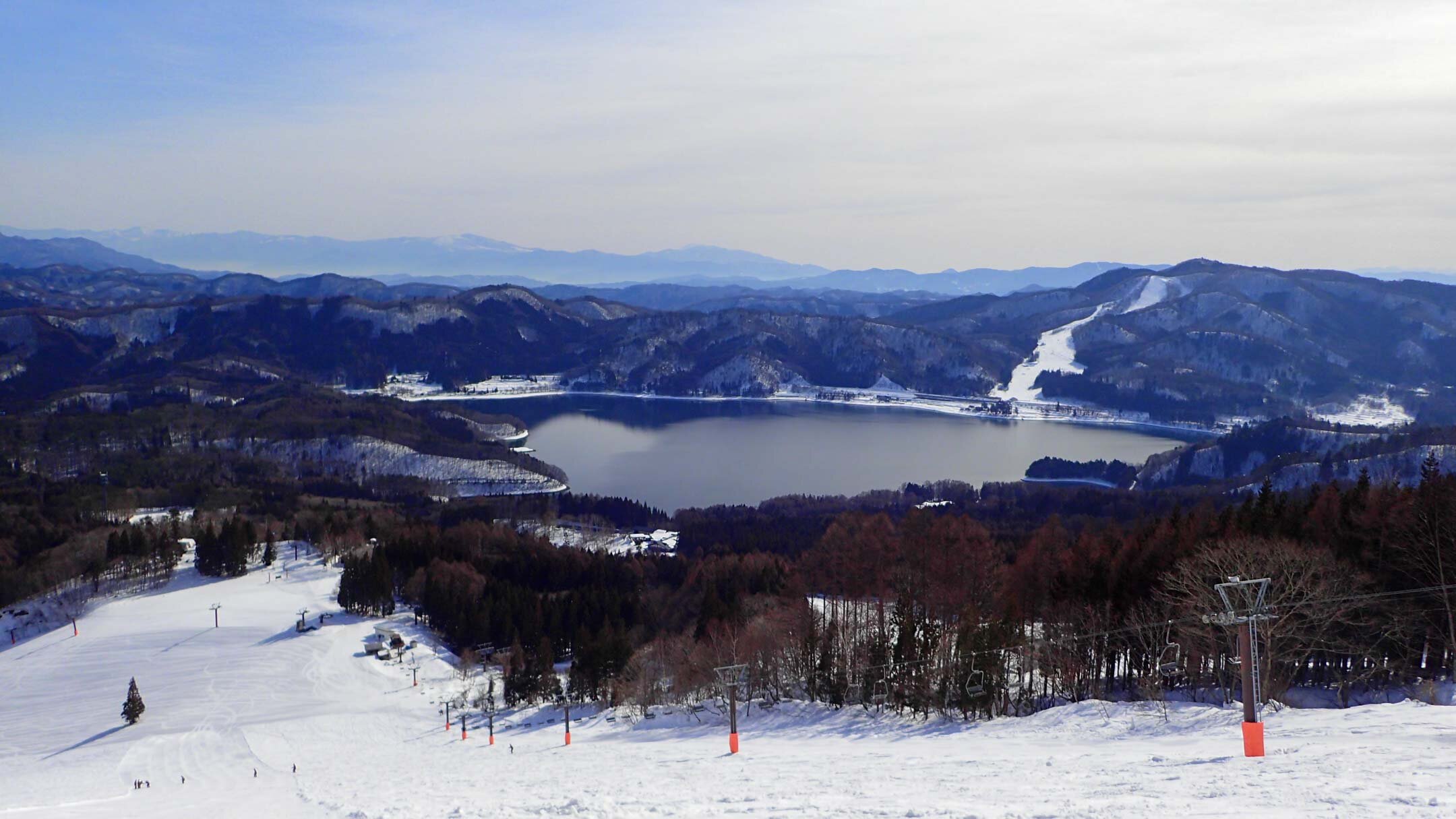


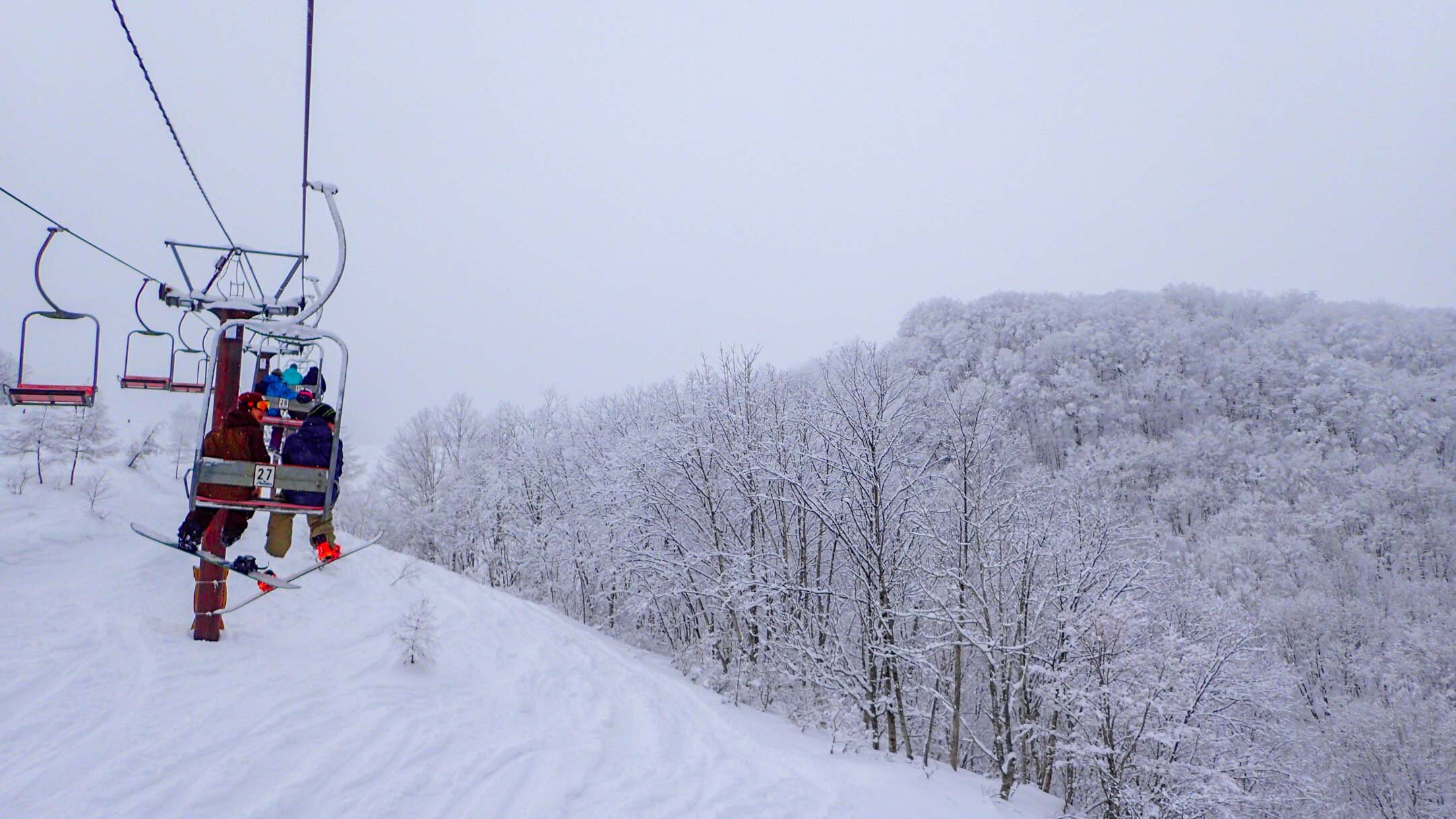
JAPAN VIDEOS
COST OF A JAPANESE SNOWBOARD TRIP
The cost of skiing in Japan can be as cheap or as expensive as you intend to make it. Japan is home to some premium resorts with lavish hotels but it doesn’t have to work out that way. It is also possible to ski in Japan on a budget. Let’s take a dive into the costs of skiing and snowboarding in Japan.
LIFT TICKETS
Generally, lift tickets in Japan are available as daily tickets. There is also the availability for half or even hourly lift tickets! Day passes at Japanese ski resorts normally cost around 4000 yen (£30). Weirdly, around Hakuba, it was possible to find discounted lift tickets at convenience stores. So keep an eye out for coupons.
A multi-resort pass like the Hakuba Valley pass could also cut down costs, as this also includes the cost of all inter-resort shuttles.
ACCOMMODATION
Japan has plenty of premium hotels and lodges surrounding their ski areas and who could resist staying at the Hakuba Green Plaza Hotel with its Tudor styling and slope-side location? Well for £1200 for 4 nights maybe a few might resist.
Don’t fret as there are plenty of budget-friendly options like the Guest House I stayed in during my time in Hakuba.
FLIGHTS
A major stumbling block for many when it comes to planning a Japanese ski trip will be the cost of flights. Direct flights from London into Tokyo Narita will set you back around £800. When you consider that flights from London to Geneva can be found for less than £100 that is sure to put some people off.
JAPAN EXCURSIONS

FEATURED POSTS
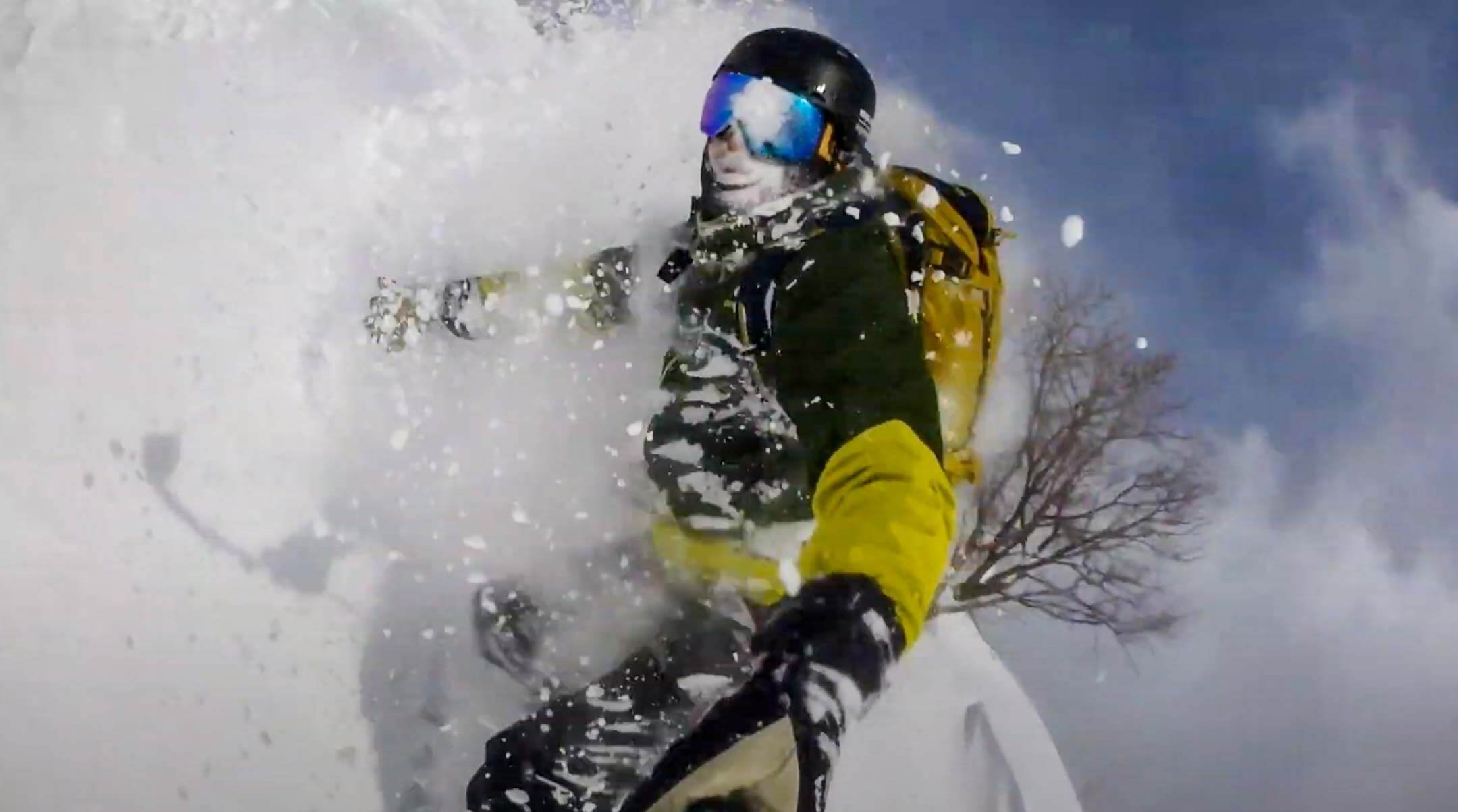


The Best Argentine Ski Resorts For Your Bucket List
It’s the middle of summer and your feet are itching to get back on your snowboard. You try to distract yourself by watching a couple of snowboard movies but you know the reality… the only thing that can satisfy that urge is to get back on that board and Argentina is calling you, but where do you go? With ski resorts spread throughout the Andes, there are plenty of choices. So please sit back, relax, and let’s break down the best ski resorts in Argentina.
La Laguna @ Cerro Catedral
CAVIAHUE SKI RESORT
Have you ever dreamed about snowboarding on an active volcano? Well, a visit to Caviahue ski resort in Argentina could just be your opportunity to do just that. Copahue Volcano is still active and it is possible to be snowboarding down the slopes at Caviahue and see large ash deposits flying through the air. Everything about the setting of Caviahue is pretty awesome, with the town set on the banks of Lake Caviahue at the base of the volcano.
In terms of terrain, Caviahue has a rather modest vertical drop at 420m with around 20 pistes across the resort. For advanced riders, the most interesting line is hiking to the top of the Volcano, conditions permitting… obviously. Caviahue is best suited to beginner and intermediates with 70% of the terrain dedicated to these abilities. Caviahue has a decent snow record and receives over 6m of snow per season.
Caviahue Ski Resort Piste Map
CERRO BAYO
If epic views are your thing then Cerro Bayo ski resort has you covered. From Cerro Bayo, there are panoramic views across Lago Nahuel Huapi and into Chile that will have your friends frantically taping the like button. The views from Bayo across the lake make for a rather surreal experience, at times you feel like you are snowboarding on a postcard.
Cerro Bayo is a small ski area, especially in comparison to its nearby bigger brother Cerro Catedral. With only 14km of pistes, equal to The Remarkables in New Zealand, you could be forgiven for deciding to give Cerro Bayo a miss but hat would be foolish. Similarly to The Remarks, the fun at Cerro Bayo is on the off-piste. It is in the off-piste where you will have the best time hunting down those powder stashes.
Cerro Bayo Ski Resort Piste Map
CERRO CASTOR
Here is one for the bucket list, snowboarding at the most southerly ski resort in the world, Cerro Castor. If that tickles your fancy then be sure to read on as Cerro Castor ski resort offers a pretty unique experience. Outside the town of Ushuaia, Cerro Castor is a mid-sized ski resort that has the lowest ski resort base in Argentina at 195m. If you were in Europe, a lower base might have you worried but not here where the harsh conditions and cold climate ensure that Cerro Castor receives over 5m of snow per season. In the event of a bad season, Cerro Castor has invested in snow-making to ensure it can keep operations flowing.
Cerro Castor Ski Resort Piste Map
Cerro Castor has a vertical drop of over 850m which opens up some decent terrain. The figures will tell you around 30 marked trails with the majority of the terrain suited to beginners. It is outside of the resort’s boundary where the terrain comes alive for the more advanced skiers and snowboarders. There are plenty of touring opportunities at Cerro Castor so bring your split-board.
CERRO CATEDRAL
The closest ski resort to Bariloche, the gateway to Patagonia, Cerro Catedral has some of the most immense views we have ever seen at a ski resort. Looking down on Lago Nahuel Huapi and across into Chile almost distracts you from actually snowboarding. The resort itself is no less impressive with the top of the resort covered in large granite rock formations that form an imposing landscape.
Cerro Catedral is a large commercial ski resort that has seen lots of development on lifts and infrastructure. There are still modernizations needed with a number of slower, older lift installations in place, however, it is moving in the right direction. If you want to stay closer to the action than Bariloche, Cerro Catedral has a purpose-built village at the base. The village is lively with a number of places to eat and an exceptional chocolate shop.
Cerro Catedral is second to none in terms of South American terrain. The largest ski resort not just in Argentina but in South America, Cerro Catedral Alta Patagonia has it all. The 120km of pistes are mostly suited to intermediates, with around 30km of that making up advanced terrain. The best part of snowboarding at Cerro Catedral has to be the side country. La Laguna is a short hike or tour from the main lifts and offers numerous off-piste options. The area at the top of the Nubes chairlift is also great when conditions are right, although this will close on high wind days. Cerro Catedral also has a pretty decent terrain park, fairly modest in size but is serviced by its own chairlift and has a line for jibs and jumps.
La Laguna @ Cerro Catedral
CERRO CHAPELCO
The town of San Martín de Los Andes is along one of the most scenic drives in Argentina, The 7 Lake Route or Los 7 Lagos Ruta. This road is worth driving without the possibility to snowboard but with Cerro Chapelco en-route it would be silly to miss the opportunity.
Cerro Chapelco Piste Map
Cerro Chapelco has some great facilities and is fairly modern compared to lots of South American ski resorts. There is a gondola to take you from the base to the mid-mountain where you can take further chairlift’s to the highest lift points at 1980m and 1970m respectively. The terrain at Chapelco ski resort looks quite small on paper with around 20 trails. There is a considerable vertical drop of 730m which at least guarantees you a long run to the base area. If you are looking for a challenge you will need to head to the upper areas of the resort where it is possible to find bowls and chutes just outside the resort’s boundary. Inbounds, there is off-piste riding that can be really fun in the right conditions.
Beginners will be happy at Chapelco with some rather mellow beginners terrain accessible. There is a long winding green run from outside Refugio Graeff at mid-mountain that ambles its way down to the base area.
LA HOYA
La Hoya is found outside of Esquel, an old mining town nearly 200 miles south of Bariloche. The vibe in Esquel is completely different from that of bustling Bariloche. Similarly, La Hoya is nothing like the much larger Cerro Catedral but that’s ok. At La Hoya, you will find a small ski area with a small terrain park. The resort only has around 20km of pisted terrain but this is much more when you consider the off-piste.
Freeriding at La Hoya is opened up by taking the ‘Traversía Del Filo’ which opens up a much larger area of terrain. Following the traverse, you can have your pick of steeps, chutes, and powder lines in the wide bowl. La Hoya will treat you to enough days to make the most of the traverse with an exceptional 8m of snow falling per year in the resort.
La Hoya Ski Resort Piste Map
LAS LEÑAS
Possibly the best-known ski resort in Argentina, Las Leñas is a freeride mecca. The definition of big mountain snowboarding, Las Leñas has plenty of terrain dedicated to expert skiers and snowboarders. Its butt-clenching lines are what attracts many pro riders from around the globe.
At Las Leñas you will find a number of large gated off-piste zones that can make the resort seem huge. Unfortunately, a lot of this terrain is accessed at the top of the Marte chairlift that can spend a long time closed, with the resort staff said to be quite slow at opening the Marte chairlift after a storm. When everything is open at Las Leñas ski resort there is a pretty impressive 1,200m of vertical drop which shows there is plenty to get those thighs burning. On the pistes, you will find some excellent groomed runs which are great in the mornings. Intermediates/advanced snowboarders will enjoy making the most of these whilst the Marte is closed.
Similar to most Argentinian ski resorts Las Leñas can receive around 6m of snow per season, although it does go through bad seasons. When the conditions are right there are not many better places to be. To avoid disappointment consider a longer trip to Las Leñas to make the most out of the resort.
Las Lenas Piste Map
LOS PENITENTES
Close to the border and the famous Chilean ski resort of Portillo, you could be forgiven for driving straight past Los Penitentes. Los Penitentes ski resort doesn’t receive a large amount of international tourism but that shouldn’t put you off. If you make the journey to Penitentes you will be rewarded with some interesting terrain and decent snow.
With the highest lift point at 3,190m, Los Penitentes ski resort is high in the Andes but is still dwarfed by the surrounding peaks. The ski area is rather small with 25 pistes but half of the trails are dedicated to red and black runs which means there is plenty of challenge to be discovered. In addition to the pisted terrain, there are splitboarding opportunities available and off-piste to be explored.
GET IN TOUCH
As always thanks for reading and know it is your turn to have your say! Let me know in the comment section which of these resorts you have visited? Are any on your bucket list? Or have I missed out on the best of the lot.
PIN IT FOR LATER
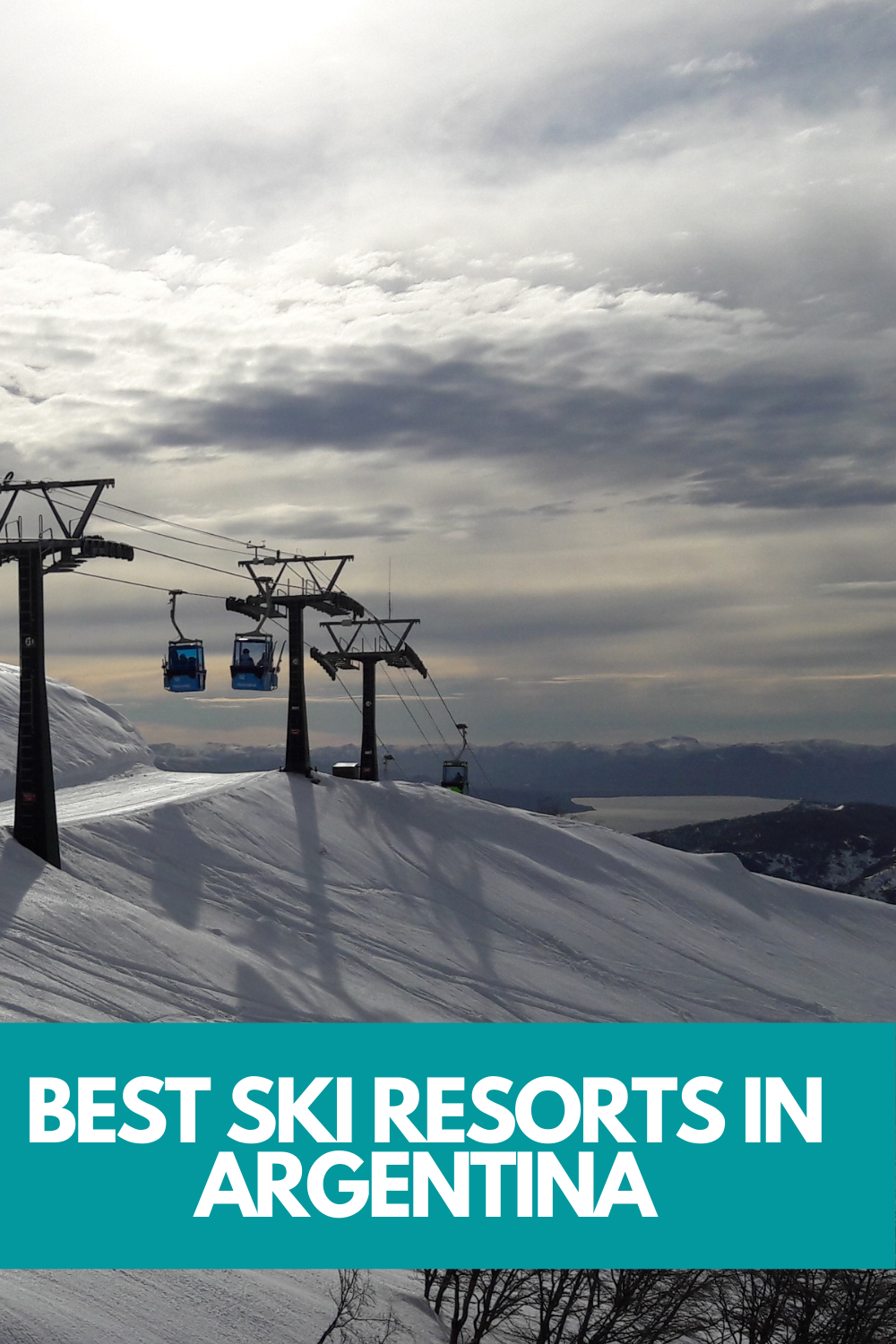

CARE TO SHARE?
IF YOU FOUND THIS POST USEFUL AND YOU THINK IT MAY ALSO HELP OTHERS, PLEASE LIKE, SHARE AND COMMENT TO PROMOTE IT TO OTHERS

Les Carroz Ski Resort Guide | Grand Massif
Les Carroz may be my favourite of the Grand Massif ski resorts. The resort is well-located within France’s fourth-largest ski area ensuring from Les Carroz you can explore everything the Grand Massif has to offer. The local Les Carroz ski area offers everything from pristine pistes, to fantastic off-piste and the best terrain park in the Grand Massif. Les Carroz is a great base for any Grand Massif ski holiday.
Looking over Les Carroz from the Tete de Saix
Located in the heart of the Grand Massif ski area in the French Alps, Les Carroz village is a charming alpine destination that offers a perfect blend of traditional Savoyard architecture and modern amenities. Surrounded by stunning mountain scenery, Les Carroz is the perfect base for skiers and snowboarders wanting to make the most of their trip to the Grand Massif. From world-class skiing and snowboarding in the winter to hiking, mountain biking, and paragliding in the summer, Les Carroz delivers for everyone.
LES CARROZ FIRST IMPRESSIONS
Arriving at Les Carroz village had a different feel to many French ski resort villages. The traditional town square with restaurants and bars was welcoming and the access to the ski area was easy. Depending on your base in the village, a free navette shuttle will take you to the base of the Kedeuze gondola. When on the slopes my overriding first impression was how good the groomed pistes were with plenty of blue and red runs to keep the majority happy.
LES CARROZ SKI AREA
Les Carroz ski area is part of the Grand Massif ski area in the French Alps, offering a variety of terrain for skiers of all levels. Les Carroz offers access to 265km of pistes inclusive of the wider Grand Massif resorts of Samoëns, Flaine and Morillon.. Locally, Les Carroz offers 37 km of slopes, including some of the best red and blue-graded trails across the entire Grand Massif.
It’s fair to say that Les Carroz is well-suited to intermediates with 15 blues and 7 reds on the piste map. This matches nicely with the rest of the Grand Massif which caters well for skiers and snowboarders who are looking for nicely groomed pistes, however, Les Carroz is much more than this. There are 4 black trails which offer substantial challenge and the off-piste and tree runs here are incredible. Don’t believe me? Well check the videos here and here which were both filmed in Les Carroz. Beginners will find a Magic Carpet at the base of the Kedeuze gondola with a mellow learners slope. Additionally, the Coin Coin area at the top of the Kedeuze gondola has another Magic Carpet and drag lift with an ideal learners slope.
BEGINNERS TERRAIN LES CARROZ
Beginners heading to Les Carroz will not be disappointed. Never evers have two dedicated learner areas within Les Carroz at the bottom and top of the Kedeauze gondola. As beginners find their legs, the Plein Soleil piste is perfect for testing your skills on its rolling terrain. As confidence grows, beginners should consider heading to nearby Morillon to take the fantastic Marvel ski run.
INTERMEDIATES TERRAIN LES CARROZ
Les Carroz delivers for intermediates with the majority of its terrain red or blue-graded. Intermediates visiting Les Carroz will have fun exploring under the Gron and Les Molliets chairs where there is a good mix of trails including the the short Rhodos red (my favourite) and the long Marmottes blue (long but busy).
Intermediates who want to test themselves should try the Chamois red, near the Tete de Saix, which has a prolonged steep section and leads to the Oasis Snowpark. Timalets is another favourite red in Les Carroz but can suffer later in the season as it is closer to the base area.
Intermediate skiers and snowboarders should certainly make the most of the effective links between Les Carroz and Samoëns and Morillon where there are further exceptional red and blue runs.
ADVANCED TERRAIN FLAINE
With only four black trails on the piste map it is fair to assume that some advanced skiers may not get too excited about a visit to Les Carroz. This would be unfair as there is certainly challenge to be found within Les Carroz and the wider Grand Massif ski areas.
Corbalanche black is popular with many as soon as there is fresh snowfall, possibly because you can view skiers and snowboarders enjoying their pow turns from the Tete de Saix lift. This run is great after fresh snow but equally, it offers another challenge when the powder has turned to large moguls. The area close to Cobalanche is also home to some fantastic tree-skiing and those who know head here when the snow falls.
Felire Run Les Carroz
Elsewhere the Felire black trail is tucked away and is easily missed, which can make it a great place to test yourself away from the crowds. Advanced skiers should venture to Samoëns and Flaine to test themselves on Aigle Noir and Diamont Noir respectively.
WHERE TO SKI IN LES CARROZ DURING A STORM
Snowboarding in a whiteout sucks, so it is important to find your context. The best place to head in a storm is always the trees; luckily, Les Carroz has a few options. Able skiers and snowboarders can enjoy the trees of Corbalanche but for a mellower experience, Plein Soleil is lined with trees. For the best experience, consider heading to Morillon which has fantastic tree-lined pistes that are a great refuge in whiteout conditions.
ACCESSING THE GRAND MASSIF
From Les Carroz it is simple to head to the neighbouring Grand Massif resorts. Taking the Tete de Saix chair from Les Carroz you will find yourself at the crossroads of the Grand Massif. From the Tete de Saix it is possible to ski directly into Samoëns and Morillon without taking additional chairs. To access Flaine, head from the Tete de Saix to the Vernant chair which will take you over to Flaine.
FREESTYLE TERRAIN LES CARROZ
Freestyle in Les Carroz is pretty decent. Les Carroz is home to the Oasis Snowpark which offers a full spread of freestyle features with everything from airbag jumps, boarder cross tracks and jump and rail lines. The Oasis Terrain Park is accessible from the Tete de Saix or via its own drag lift that runs along the side of the park.
The Oasis Terrain Park has everything from tiny ride-on features up to larger jumps. To learn more about Freestyle in Les Carroz, watch the video above where you can skip to 3:50 to see the Oasis Snowpark.
LES CARROZ SNOW HISTORY
Les Carroz has a good snow record but you need to consider that the lower slopes will vary in conditions greatly to the upper slopes in early or late season. The Kedeuze gondola runs even when Les Carroz’s lower slopes are lacking which means you can still access some great skiing in the resort. I have experienced some incredible conditions snowboarding in Les Carroz, but sadly I have also experienced the worst. Luckily when you are in Les Carroz, you have the option of riding in neighbouring Flaine when the conditions suck where you will generally find more consistent snow conditions.
LES CARROZ LIFTS
The main entry point to the Les Carroz ski area for most will be the Kedeuze gondola. Kedeuze leave the village and drops skiers and snowboarders at 1800m. Elsewhere in Les Carroz, you will find Les Molliets, Tete de Saix Express, Gron, and Plein Soleil serving skiers. These four lifts vary greatly with the Tete de Saix being a modern six-seater that whisks skiers up to the mountain, whereas Gron is a slower 4 seater than gently ambles its way.

SEASON DATES
The Grand Massif is open between December and April with Flaine having the longest season. Les Carroz closes a week or so earlier than Flaine (conditions dependent).
LES CARROZ PISTE MAP
To see the interactive piste map click here
GETTING TO LES CARROZ
Getting to the villages of the Grand Massif is simple with lots of Transfer companies available from Geneva Airport. The short transfer time means that self-drive is also fairly straightforward forward however my personal thoughts are that you do not need a car when in the resort so transfer makes the most sense.
TRANSFER COMPANIES
Most of my transfers to Flaine have been with GO MASSIF. Go Massif have been fantastic for shared transfers between Geneva and the Grand Massif and having used their service multiple times I would recommend them.
Alpin Bus are a company that I have used for private transfers between Geneva Airport and the Grand Massif. The communication throughout has been fantastic and service came in cheaper than Go Massif for the private option.
SELF-DRIVE
If you would prefer to self-drive there are numerous counters available at Geneva Airport where car-rental is possible. From Geneva, you can expect to drive for 1 hour depending on the conditions.
ACCOMMODATION
Les Carroz Village offers many different styles of accommodation with a range of hotels and self-catering apartments. The village is a great base for families and even those without young children due to the many amenities on offer. I have always enjoyed a self-catering option when staying in Les Carroz as there are many nice restaurants to enjoy in the evening.
LES CARROZ LIFT PASS
Lift passes in Les Carroz represent exceptional value. If you think you will ski more than one week in a season then consider getting the Grand Massif season pass, if purchased online before 30th November you save 50% meaning a whole season of skiing for €552. You can even add summer access so you have access to all the summer hiking and mountain biking.
If you are only visiting for one week then you can see all the options for lift passes here. I would always recommend getting the Grand Massif pass rather than the local area pass as it represents better value.
LES CARROZ PROS
Les Carroz is central to the Grand Massif ski area meaning it is very easy to access the whole of the wider ski area from Les Carroz.
Les Carroz has several modern lifts including the Tete de Saix and Kedeuze.
Les Carroz ski resort offers a good variety of terrain to suit all-abilities
The beginner’s ski areas in Les Carroz are great with Magic Carpets and gentle drag lifts.
The tree-skiing in Les Carroz is fun with further challenges found near Corbalanche.
LES CARROZ CONS
The lower slopes in Les Carroz can have dodgy snow conditions in early and late season.
Les Carroz doesn’t offer ski in ski out accommodation like Flaine, Morillon Les Esserts and Samoëns 1600.
Locally Les Carroz is the smallest of the Grand Massif ski areas.
LES CARROZ VIDEOS
NEARBY SKI RESORTS
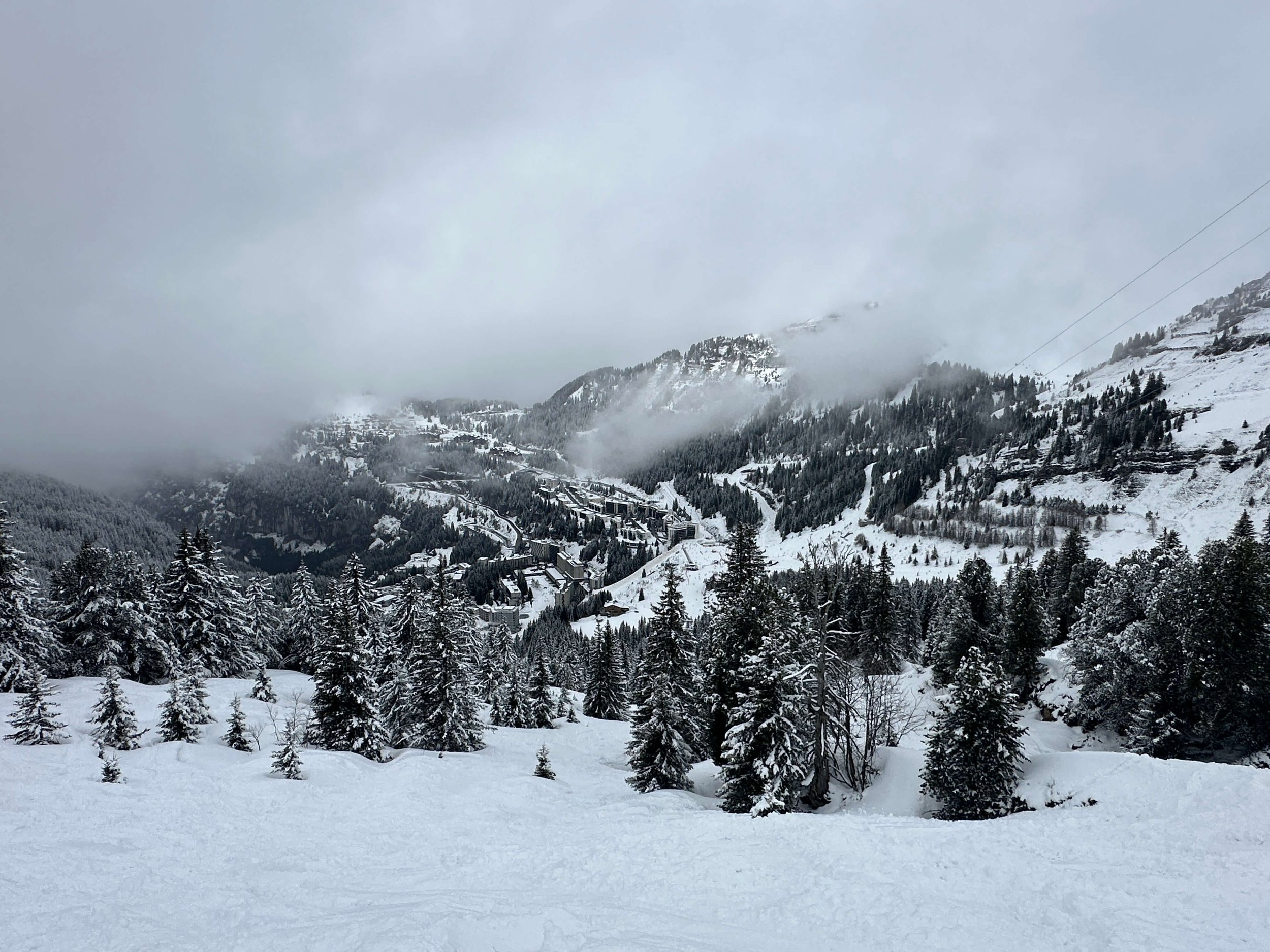
FINAL THOUGHTS
Les Carroz may be my favourite of the Grand Massif villages. I love its central location to the other ski areas and how easy it is to explore the wider Grand Massif from here. But Les Carroz itself is home to some of my favourites… Rhodos red is one of my favourites across all the resorts despite its short length, The Oasis Terrain Park has more going for it than freestyle in Flaine, and the off-piste near Corbalanche is among my favourite in the whole Grand Massif. Les Carroz and it’s village have lots to offer and I would head back without hesitation.

How To Choose The Correct Snowboard Length
Traditionally people would choose their snowboard length based on their height but ultimately that doesn’t really make sense. Imagine two people of equal heights, however one weighs 70kg, and the other weighs 90+ kg. Due to the difference in weight, it would make riding the same snowboard feel much different. Then throw into the mix the riders terrain preferences… if one wanted to ride park whilst the other wanted to ride powder then riding the same length of snowboard would not work. Below I break down the things that really matter when choosing the correct size of snowboard to ride.
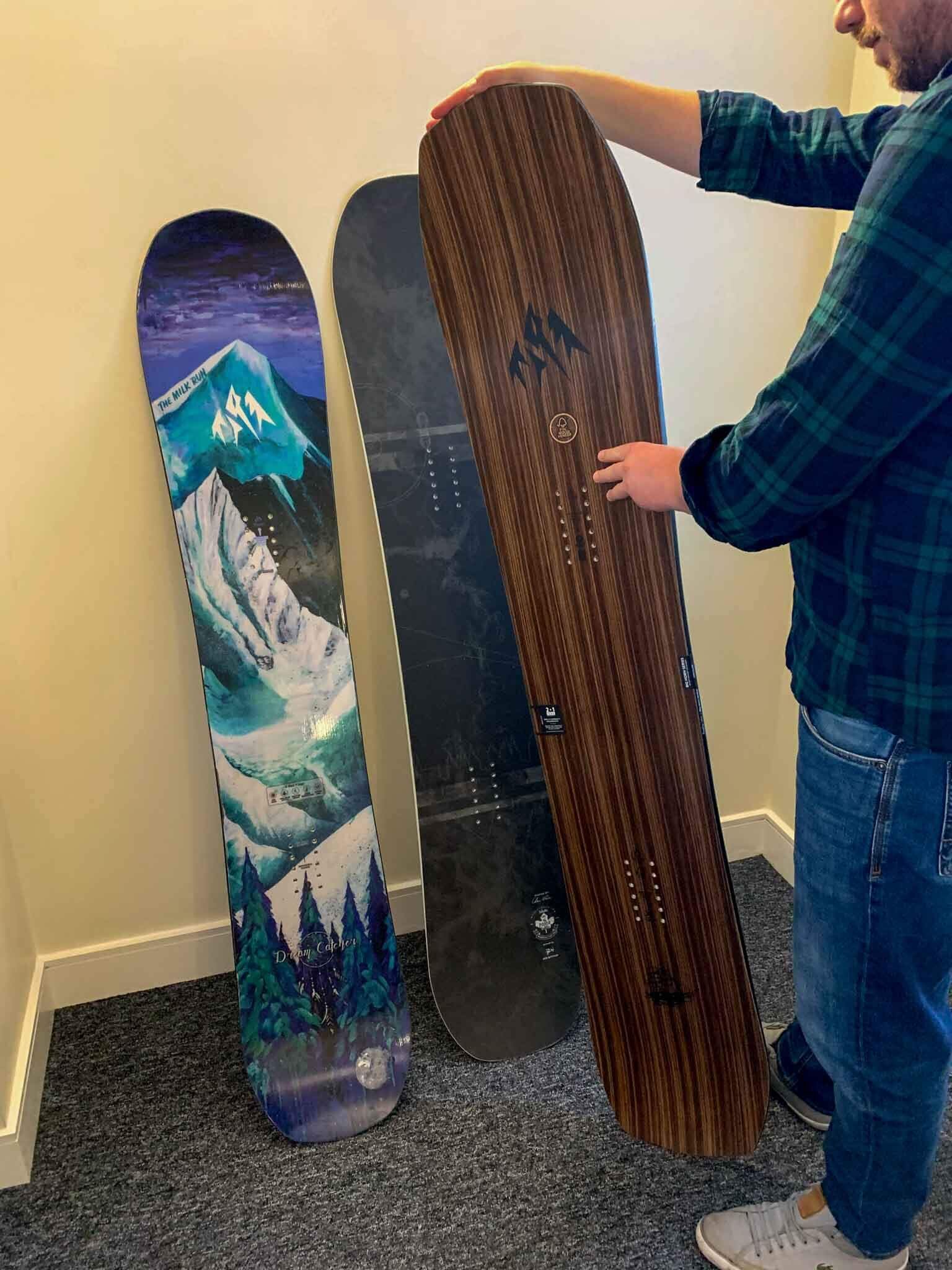
WEIGHT
The most important aspect to consider when choosing snowboard length is the weight of the rider. This is so important that snowboard manufacturers put a handy weight range on the back of every board. Below is the information for my snowboard from Prior Snowboards. Each brand will produce a snowboard size chart or snowboard size calculator for the boards in their range.
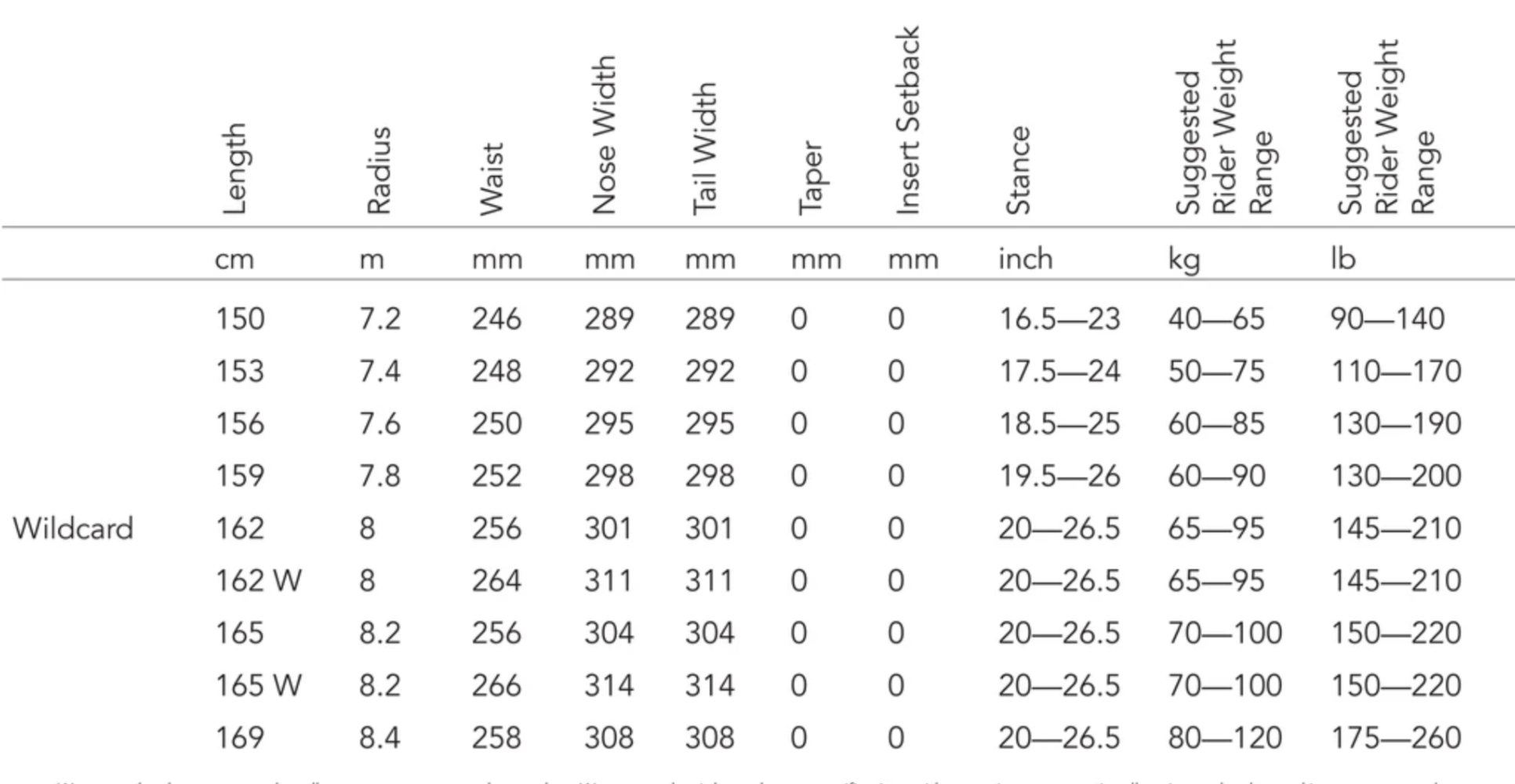
Looking at the snowboard sizing guide above you can see that each size has a recommended weight range. Taking weight into consideration we can work out how to choose the correct size snowboard. The reason we rely on weight and not height is that each snowboard has a set flex pattern (Learn More - Snowboard Flex).
If you are below or towards the bottom of the weight range you will find the snowboard harder to press and manoeuvre. Being too light for the board will prevent you from using your body weight to apply the correct pressure to the board. This will make learning ground tricks and butters quite difficult. On the other hand, if you are above or towards the top end of the weight range you could put too much pressure on the board whilst flexing. This could result in the snowboard snapping or breaking if landing backseat of a jump. Being over the recommended weight range for the board will cause the board to flex more and make it less stable at higher speeds.
In an ideal scenario, you want to be in the middle of the recommended weight range for the snowboard. This will give you the best on-snow experience and you will feel the board ride as it was intended to be ridden.
The recommended weight ranges on the snowboard sizing charts are not a definitive answer to the question. Here are some reasons you may wish to size up or down your snowboard.
TYPE OF SNOWBOARDER AND SNOWBOARD LENGTH
The type of snowboarding you do will influence the size of snowboard you should ride. This is why people who snowboard frequently often have a quiver of boards in different lengths or sizes so they can ride a board well-suited to the conditions or type of snowboarding they are doing that day.
FREESTYLE
Freestyle snowboarders may choose to ride a shorter snowboard. A shorter snowboard will be easier to spin and press, whilst it will also feel easier to initiate turns and sharp movements. By opting for a snowboard that is a few centimetres shorter you will find your park riding will be easier to progress. Be wary of going to short, as if you are well above the weight range you may snap your snowboard.

FREERIDE
The opposite applies to freeride snowboarders who will value stability and float over manoeuvrability. By opting for a snowboard that is a few centimetres longer a freeride board will feel fast and stable allowing you to rip around the mountain. A longer board will have a longer edge meaning that you will have more edge in contact with the snow helping you maintain grip. Do not go for a board that is far too long for you as you may find this difficult to initiate turns on.
ALL-MOUNTAIN
All-mountain snowboarders should aim to stick to the recommended weight ranges as these will allow the most versatility. If you are an all-mountain freestyle then opt 1-2cm shorter but no more. If you prefer freeride than 1-2cm longer.

HOW ABILITY INFLUENCES SNOWBOARD LENGTH
Ability can be a key factor in snowboard length choice and it can have a big impact on your enjoyment. When I first learnt I was given a 162cm snowboard which was far too long. I found for learning that it was better to use a shorter board as they were easier to turn. Building confidence is important in the initial stages of snowboarding and riding a board that is too long for you can really put a dampener on the enjoyment factor. It is ok for a beginner to ride a snowboard where they are slightly above the weight category as they are unlikely to be doing anything extreme to snap or break the board.
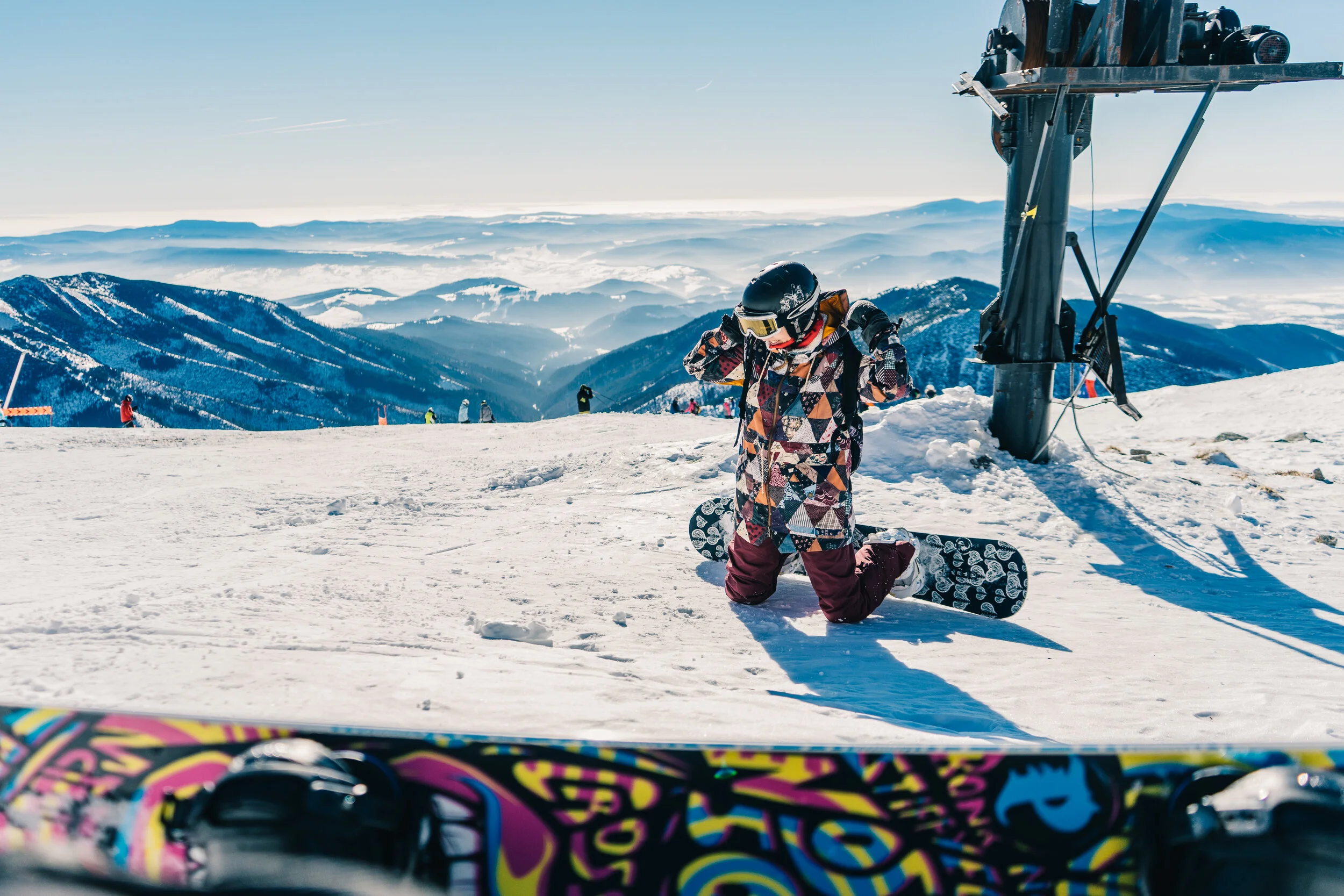
After the beginner stage, there is little reason to consider snowboard length dependent on ability as the other factors such as weight and riding style take priority.
HEIGHT AND SNOWBOARD LENGTH
As mentioned in the intro to this post height is traditionally the method used to determine snowboard length, however, it is outdated and shouldn’t be used as the determining factor. Height if anything should be used as a starting point and should then be refined using the rider’s weight and riding style.
Particularly short or tall people should pay attention to the length of their snowboard as they want to ensure they can fully adjust their stance into a comfortable position. A tall snowboarder on a shorter board may end up with too narrow a stance whereas the opposite may apply to a short rider on a longer board.
IS IT BETTER TO GET A LONGER OR A SHORTER SNOWBOARD?
Ultimately the answer to this question really depends on the type of snowboarding you want to do and your ability. Short snowboards will be easier to turn, making them great for beginners. A longer board will be more stable and have more contact with the snow ensuring they are perfect for carving. Advanced snowboarders who favour park may choose to downsize their board by around 2-4cms. Similarly, snowboarders only interested in freeride may opt for a board that is longers by 2-4cm.
STILL UNSURE?
As always thanks for reading and if you are still unsure feel free to get in touch via the socials or the comment section. Make sure to check out our Snowboard Buyers Guide where you will find all the information regarding how to buy a snowboard.
Care to share?
If you found this post useful and you think it may also help others, please like, share and comment to promote it to others.

Multi-Resort Lift Passes in Japan
Multi-resort lift passes have been all the rage ever since EPIC and IKON waged their war on the US ski scene. Whatever you feel about partner ski resorts versus independent ski hills it is undeniable that these passes can offer some of the best value skiing and snowboarding across the globe. It is fair to say that there are now a number of really great products across the world from Switzerland’s Magic Pass, Europes Snow Pass and Austria’s Tirol Snowboard… but what are the best value ski passes for snowboarding in Japan?

YOUR EXPERIENCES
Before I get into it I would love to hear from you on your experiences of using the below lift passes in Japan? Have you taken your IKON or EPIC pass to Japan? Are you planning to hit the INDY resorts this winter? Let me know in the comments.
EPIC AND IKON PASSES
Let’s start with the big players in the world of multi-resort ski passes EPIC and IKON. The EPIC and IKON passes could rightly consider themselves amongst the best multi-resort ski passes in the world. Both passes entitle holders to skiing across multiple continents. This was the reason I chose Epic back pre-pandemic as my plan was to ski in Europe, North America, Asia and Australasia all on the same lift pass.
In terms of Japan, Epic Pass offers holders 5-days of skiing and snowboarding at the 10 Partner resorts in the Hakuba Valley. Further to this EPIC has also partnered with Rusustu to offer a further 5-days of additional lift privileges. IKON has added Niseko United to its offering with 7days of access to the 4 mountains in this area.
=
=
INDY PASS
Not on the same scale as IKON and EPIC but certainly making a name for itself is North Americas INDY pass. The INDY pass offers 2 days riding at 76 resorts, four of which are in Japan. Get Kogen, Okunakayama Kogen, Shimokura and Tazawaka are all accessible on this pass that costs less than $300.
HAKUBA VALLEY PASS
The Hakuba Valley pass is great value if you intend to make the most of the 10 resorts in this area. Including world renowned Hakuba Cortina and Happo One this pass packs a punch. What I loved about this pass was the access to lesser known resorts like Sanosaka that I may not have visited had it not been for the Hakuba Valley pass. A 7 day Hakuba Valley pass will cost around £280 but remember Epic Pass holders get 5 days included for free.
NISEKO UNITED
Niseko is probably Japans most popular ski resort area famed for its endless snowfall between January and March. With 4 resorts included on the Niseko United Pass you can ski the interconnected area without having to worry about additional passes.
MOUNTAIN COLLECTIVE
Back to another American pass and the Mountain Collective is similar to INDY in that it offers 2 days skiing at its partner resorts. Niseko United is included on the Mountain Collective list of destinations but is the 2 days really worth it? This wouldn’t be my go to multi-resort lift pass of choice for Japan.

ALSO CONSIDER
It is also worth considering that lift tickets in Japan don’t always follow the same system as in Europe or America. It is possible at some ski resorts to pay by lift rather than by day. This normally works on a point system that charges points based on the list you choose. Slower lifts cost fewer points, whereas gondolas tend to charge more points as they travel further distances. Depending on whether you have a set plan for that day or are only using the lift to access a backcountry area, this could be a suitable way to access the slopes.